Product News | October 11, 2021

In-advance DOOH transactions for buyers: Your questions answered

Automation is a huge part of the conversation in the out-of-home (OOH) advertising space right now. While automation in OOH is typically associated with programmatic buying, that’s really just one piece of the puzzle. The bigger picture is how automation can streamline the entire process, from the initial planning all the way to campaign delivery.

With the release of Broadsign’s new automated, in-advance digital OOH (DOOH) transaction capability, we sat down with John Dolan, Vice-President, Global Head of Media Sales at Broadsign, to discuss what this means for media buyers and how it can unlock a more seamless and modern buying experience. 

Booking OOH should be as easy as booking a flight. How does Broadsign In-Advance help make that vision a reality?

When you look at how OOH campaigns are bought today, programmatic campaigns can arguably be booked as easily as a flight. You log into a DSP, set your targeting, pick the days, data, venue types, and geographics you wish to execute. But the reality is that programmatic represents only 5% of total OOH ad spend, meaning that 95% of all OOH transactions are still managed manually. 

The real friction remains in direct out-of-home buys, which require a heavier lift due to the back-and-forth with media owners. If you’re managing a diverse campaign that needs to run on the inventory of six different media owners, that’s six different sales conversations, six negotiations, six separate contracts, six creative deliveries, and six reports you have to aggregate to track performance.

“Broadsign In-Advance helps bring this vision closer to reality by taking the speed and automation that everyone loves about programmatic and combining it with the guaranteed aspect of direct-booked DOOH campaigns.”

John Dolan, Vice President, Global Head of Media Sales at Broadsign

How does this save time for media planners and buyers? Can you walk us through a before-and-after scenario?

When you receive a campaign brief, you’re looking for media targeting and setups that best match the client’s objectives. In a direct OOH campaign, that means:

  • Reaching out to a media owner, or multiple depending on the geographic and campaign objectives, to start the brief by looking at flight dates and venue types. 
  • Assuming the media owner has the inventory available for your desired dates, you begin negotiating on pricing, terms of the deal and the parameters for holding the inventory. 
  • Once you’ve reached a consensus, additional paperwork needs to be pushed back and forth before the contract is signed. 
  • Once the deal is secured, the agency then needs to provide the creatives directly to the media owner, and if you’re dealing with multiple media owners, that means meeting their respective aspect ratios. 
  • Finally, proof-of-play procedures are different for each media owner. So, how fast you get the reporting, in what format, and how fast you’re able to audit the reports and consolidate them on your own becomes a heavily nuanced, time-consuming process. 

With Broadsign In-Advance, you’re able to book direct OOH campaigns in a similar way you would a programmatic one:

  • Through Broadsign’s DSP OutMoove, or your DSP of choice, you identify the inventory that best fits your campaign objectives and request its availability. A response comes instantly from our ad server, providing a simple yes or no.
  • If it’s available, you’re presented with a price and a simple terms box to select that inventory. If approved, the inventory is officially booked – no holds, no negotiations needed on pricing or terms. 
  • When it’s time to launch the campaign, you upload your creative directly into the DSP, just as you have done hundreds of times before. 
  • While the campaign is in flight, you’ll have access to real-time proof-of-play reporting that’s standardized across all media owners in one centralized, auditable place. 

“With Broadsign In-Advance, it’s a journey that you can take on your own. Of course, there will be collaboration with media owners on matters that add value to all parties, like what creative works best for what screen, but it does cut away the vast majority of the back-and-forth between media owners and buyers, allowing for a more seamless activation.”

John Dolan, Vice President, Global Head of Media Sales at Broadsign

Why would a media buyer choose to use Broadsign In-Advance if they’re already using programmatic DOOH? 

Broadsign In-Advance wasn’t designed to replace programmatic DOOH, but rather to complement your existing buying strategy and address a critical gap between traditional direct deals and pure programmatic transactions. As more media buyers and owners adopt the solution, we’ll continue to find brilliant new use cases for it, but here are a few ways we see it being used: 

Secure premium inventory during key seasonal periods

During the holiday season or key travel periods, retail-focused venues and other premium screens become limited, driving up competition and programmatic prices. We often hear from buyers that they avoid OOH altogether because it sells out during key trading periods. Broadsign In-Advance solves that problem by allowing you to reserve key inventory months ahead of time.

“Think about major, fixed events like the 2026 World Cup. Those tentpole opportunities are going to sell out fast. Broadsign In-Advance allows a buyer to secure those specific screens and guarantees playout, providing a frictionless activation that traditional programmatic can’t promise.”

John Dolan, Vice President, Global Head of Media Sales at Broadsign

Mix and match your OOH buys to maximize reach

Broadsign In-Advance can also be used to strategically support your usual OOH buys. For instance, you might have a traditional static or programmatic digital OOH buy, but need a digital portion that needs to run at a specific time on specific screens. You can book a direct digital placement through In-Advance, guaranteeing your ad will be visible when you need it to, while complementing your other placements. 

Leveraging consistent planning data 

With the ability to plan your direct OOH campaigns and access the inventory of multiple media owners through one platform, Broadsign In-Advance would allow you to leverage a consistent data set when building your campaign. Rather than relying on audience data provided individually by each media owner, you can use a widespread data application for your planning, making your multi-network buys more coherent and easier to audit.

“Ultimately, it’s about giving buyers a guaranteed, automated pathway to securing high-value inventory. For media owners, it also means maximizing revenue from both direct and programmatic sales by allowing buyers to lock in demand early. It’s a win for certainty and speed on both sides.”

John Dolan, Vice President, Global Head of Media Sales at Broadsign

When should a media buyer choose this capability over a traditional or programmatic open exchange buy or a programmatic guaranteed buy?

It’s important to look at this against all the different types of buys because we are not asking buyers to simply swap one method for another. Broadsign In-Advance is the tool you choose when you need the speed of digital buying paired with the certainty of a direct OOH deal. 

Today, Programmatic Guaranteed (PG) is largely set up on a priority basis. That priority is based on a programmatic slot that a media owner has made available. Broadsign In-Advance takes this concept a step further by allowing buyers to reserve inventory that is being booked into a direct slot of the media owner’s inventory. It also gives buyers access to additional buy types for their DOOH campaigns, including Share of Voice (SOV), Budget or Play Goal, and Takeovers.

“With Broadsign In-Advance, your DOOH campaign isn’t privy to any sort of priority. It won’t be bumped. It gives buyers the confidence that the delivery of their goals for their customers won’t be interrupted, and I think that is what differentiates it from Programmatic Guaranteed buys.”

John Dolan, Vice President, Global Head of Media Sales at Broadsign

Can a buyer still leverage data and targeting with an in-advance transaction, similar to how they do with programmatic buys?

The short answer is absolutely. The advantage of Broadsign In-Advance is that it combines the data-rich planning experience of programmatic with the guaranteed delivery of a direct buy. As soon as media owners have selected the inventory they want to make available for in-advance transactions, that inventory is surfaced in the platform the same way that programmatic inventory is.

The data that exists there is still indexed against those screens. This means that all the various data partners available in your DSP can still be selected, utilized, and executed for planning. This gives you a consistent planning framework time and time again, ensuring you’re reaching the same audience with the same methodology across a myriad of place-based and outdoor media types. 

Does this integrate with the DSPs I already use?

Yes. It is currently available through Broadsign’s DSP OutMoove, and we are actively working with a host of demand partners today to make this technology available through their platforms. It’s not our goal to guard this capability from the market. We hope it’s a framework that’s adopted across the ecosystem, and we’re happy to explore and have those conversations with our global partners – many of which we’re already integrated with from a supply perspective today. 

What level of flexibility do in-advance transactions offer? Can a campaign be adjusted or optimized after it has been booked? 

In the vast majority of cases, when we think about flexibility, it typically involves cancellation periods or shifting budgets for optimization purposes. Any cancellation would have to fall under the existing contractual terms of the media owner with whom the transaction was agreed upon. 

In an in-advance transaction, there shouldn’t be a need to adjust the campaign in-flight. If you’ve selected the correct allocation and the creatives have been uploaded properly, you can be assured that it will be delivered. Buyers do, however, have the ability to manage creatives dynamically. As long as the media owner approves the content, different creatives can be used for each play. 

That being said, Broadsign In-Advance DOOH campaigns enjoy the same automated ad delivery optimizations as traditional direct DOOH campaigns. Since the inventory is booked as a direct slot in the media owner’s inventory, In-Advance campaigns benefit from our rebalancing tool, which automatically adjusts pacing to ensure that ad delivery stays on track throughout the campaign’s duration.

What’s next for Broadsign In-Advance? 

The future for In-Advance is about two things: broadening its reach and deepening its utility. We’ve laid the foundation, and now we’re aggressively driving demand and developing new features that our partners need. The earliest enhancement will be to make static OOH available for in-advance transactions in 2026. Looking a bit further ahead, we’ll be focused on: 

Driving global demand and adoption

We’re in constant discussions with agencies, media owners, and demand partners across the world to increase adoption. We see Broadsign In-Advance as a foundational buying framework for the entire ecosystem, and these discussions are critical to understanding how it fits into everyone’s workflows. 

Evolving buying metrics

We’re focused on making sure the way you book In-Advance campaigns aligns with the way OOH is traditionally measured and planned. This means actively having discussions around different buying frameworks:

  • Does it need to work on an impression framework?
  • Can we look at Share of Voice or Share of Time?
  • How do we ensure we’re providing the critical metrics that standard OOH buyers are looking for, whether that’s reliable reach and frequency or other established measurements?

Expanding availability to the full ecosystem

It would be naive to think we can drive this fundamental change all on our own. So, we are currently building technology that allows media owners – regardless of their backend software or whether they are a full-stack Broadsign client – to be able to connect, activate, and execute in this manner. It’s about broadening our scope from a technology perspective and making this standard practice industry-wide.

“We are committed to being humble, listening to feedback, and taking direction to ensure media owners feel comfortable about this change and for buyers to truly understand where Broadsign In-Advance fits best into their overall media mix.”

John Dolan, Vice President, Global Head of Media Sales at Broadsign

Product News | October 11, 2021

Why in-store retail media is essential to an omnichannel RMN strategy

Retail is no longer defined by individual channels, as consumers move seamlessly between digital and physical environments, they expect a connected, consistent experience at every touchpoint.

Omnichannel retail connects ecommerce, mobile, marketplaces, and physical stores into a single, seamless experience across the customer journey. Shoppers can browse on their phones, check local inventory, receive personalized offers, and complete purchases in-store with consistent pricing and messaging. For retailers, this means unifying customer experience, data, and operations to improve engagement, build loyalty, and drive efficiency.

With 80% of shopping still happening in-store, physical retail continues to play a central role across North America. Rather than just another channel, it acts as a high-impact environment that amplifies the entire retail media mix.

The evolving role of in-store in an omnichannel RMN

As retailers advance their omnichannel strategies, digital channels have taken the lead, driven by stronger targeting, measurement, and automation. At the same time, the physical store is evolving from a point of transaction into a critical moment where digital intent turns into real-world action.

This shift is reflected in retailer priorities, with 46% focused on enhancing omnichannel experiences and 36% investing in loyalty programs to deliver more personalized value, signalling a push to better align data, touchpoints, and customer interactions.

In-store environments sit closest to purchase, where messaging can directly influence decisions from discovery to conversion. Yet they often remain disconnected from broader retail media efforts, limiting true omnichannel alignment.

When fully integrated, in-store media strengthens the entire strategy. It reinforces digital messaging, creates a more consistent experience, and engages shoppers at the moments that matter most. By linking in-store environments with signals like online behaviour, purchase history, and audience data, retailers can move from isolated tactics to coordinated, full-funnel execution across onsite, offsite, and in-store.

Technology and data are transforming in-store media

Technology and data are transforming in-store media into a more measurable, responsive, and connected part of the retail media ecosystem. Real-time analytics enable retailers to adjust messaging, promotions, and placements based on live shopper behaviour, while dynamic content adapts to context like time of day, location, and audience signals.

Tools like dwell time analysis help identify high- and low-engagement zones, optimizing store layouts and improving both the customer experience and campaign performance. At the same time, more immersive formats, including touchscreens and augmented reality, are increasing engagement, turning stores into active media environments.

The real impact comes from how these capabilities are connected. By combining in-store signals with online behaviour, purchase history, and customer data, retailers can build a more complete view of the customer. This enables more precise targeting, stronger value for brand partners, and coordinated campaign execution across channels, while improving measurement and tying digital engagement to in-store outcomes.

In-store drives more RMN revenue

In-store media expands both what retailers can sell and how they sell it. It introduces new, high-intent inventory within owned environments, from digital screens in high-traffic areas to placements tied to specific aisles, categories, and products. Unlike traditional digital formats, this inventory sits at the point of decision, where budgets are often larger and tied more directly to sales outcomes.

It also enables more commercial, retailer-driven monetization models. Beyond standard ad placements, retailers can package sponsored product campaigns, category exclusivity, and seasonal takeovers that align with merchandising priorities. In-store media can also be used to drive private-label visibility, turning media into a lever for margin, not just ad revenue.

Where this becomes more powerful is in how it’s packaged. On its own, in-store is valuable. But when bundled with onsite and offsite media, it allows retailers to move from selling placements to selling outcomes. Campaigns can be positioned around influencing the full path to purchase, which supports larger, more strategic investments from brand partners.

It also changes the economics of measurement. With in-store in the mix, retailers can connect media exposure to actual transactions, strengthening closed-loop attribution and making performance easier to prove. This is increasingly critical as brands scrutinize retail media spend and shift budgets toward channels that demonstrate real impact.

Without in-store, RMNs risk becoming overly reliant on digital formats that are easier to compare and commoditize. With it, they can differentiate through exclusive access to shoppers, richer data, and the ability to influence and measure outcomes at the shelf.

Practical steps to activate in-store in an omnichannel strategy

Operationalizing in-store media within an omnichannel RMN requires the right foundation across data, infrastructure, and activation.

  • Invest in integrated data platforms: Consolidate in-store and digital data to create a unified customer view. Connecting in-store interactions, online behaviour, and purchase history supports better targeting, measurement, and planning, while aligning online, merchant, and retail media teams around shared performance.
  • Upgrade in-store media infrastructure: Ensure your store environment can support dynamic, scalable media. This includes deploying digital signage and screen networks that can deliver flexible, real-time content across locations and formats.
  • Implement advanced analytics tools: Use analytics to understand how shoppers move, engage, and convert in-store. Insights like dwell time, traffic patterns, and product interaction can inform both media strategy and store optimization.
  • Enable programmatic buying and activation: Integrate in-store inventory into programmatic workflows so buyers can plan, purchase, and activate campaigns alongside other channels. Retailers can activate specific parts of the store (like POS systems, vestibule screens, or gas pumps) to support programmatic demand without introducing competing or misaligned brands. This reduces friction while maintaining control over the in-store experience and aligning with how media is bought today.
  • Continuously monitor and optimize performance: Treat in-store media like any other performance channel. Track results in real time, measure against business outcomes, and refine campaigns based on what is driving engagement and sales.

In-store is the foundation of omnichannel

Omnichannel success depends on connecting every touchpoint into a single, cohesive system, including the store. The path forward is clear: treat in-store as media, not infrastructure. Integrate it into your retail media strategy, connect it to your data and buying workflows, and package it alongside digital channels. Retailers that do this will unlock new revenue, stronger performance, and a more differentiated offering.

Ready to make your in-store signage a seamless part of your RMN? Learn more about how Broadsign can help you unlock the full value of your in-store presence.

Product News | October 11, 2021

What is out-of-home? A marketer’s guide to OOH media and outdoor advertising

Out-of-home (OOH) advertising, also known as out-of-home media or outdoor advertising, refers to ads displayed outside the home in public spaces. It includes billboards, transit advertising, and digital or static displays in retail locations and other high-traffic spaces.

While OOH was once associated primarily with traditional roadside formats, it now spans a wide range of physical environments and everyday moments — reaching audiences along commuting routes, at shopping destinations, and in travel hubs. The rise of digital screens, improved measurement, and more efficient, automation-enabled planning and buying processes has transformed how campaigns are executed and integrated into omnichannel marketing strategies. As a result, advertiser investment in the channel continues to rise, with global out-of-home ad spend expected to surpass $71.5 billion by 2030.

Keep reading for a closer look at what out-of-home advertising is, where it appears, and how brands use it today.

Types of out-of-home (OOH) advertising & outdoor media

When people think of outdoor advertising, they often picture massive billboards along busy highways. While those displays are certainly a key part of the channel, one of the defining characteristics of out-of-home advertising today is the sheer variety of placements and display types.
From small static posters to large digital screens, today’s OOH media offers brands an incredible range of ways to connect with audiences in real-world environments.

Discover real-world OOH placements that align with your campaign goals

What is OOH and DOOH marketing?

Broadly speaking, today’s out-of-home advertising falls into two categories: traditional (i.e., static) OOH or digital OOH.

Traditional OOH refers to printed placements like billboards, posters, and transit wraps that display the same creative for a fixed period. These formats remain widely used thanks to their scale, prominent placements, and ability to deliver continuous brand visibility. Digital out-of-home (DOOH) is a subset of OOH that delivers advertising through digital screens rather than printed displays. Instead of showing a single static creative for the duration of a campaign, these screens rotate multiple ads and can support motion graphics, video, and dynamic content that responds to contextual signals like time of day or weather.

Traditional (static) OOH

  • Printed billboards, posters, and wall murals
  • One creative displayed for the duration of a campaign (100% share of voice)
  • Messaging remains fixed while the campaign is live
  • Long-term placements designed for sustained visibility and broad reach
  • Cost-effective CPMs that have been shown to outperform TV, print, and most digital channels on value
Static OOH billboard promoting Canva’s graphic design tool

Digital OOH (DOOH)

  • Digital billboards, screens, kiosks, and menu boards
  • Multiple creatives rotate on the same screen
  • Content can be scheduled or updated via digital software
  • Flexible execution well-suited to time-sensitive or context-aware campaigns
  • Can be more expensive than static OOH, but programmatic buying (pDOOH) enables more targeted activation and dynamic budget allocation
Digital billboards in Times Square, New York City

Both traditional and digital OOH have demonstrated their effectiveness, and many marketing teams combine them to leverage their respective strengths depending on their campaign’s overarching strategy and goals.

READ ALSO: Why static billboards thrive in the digital age: Insights for advertisers

OOH placements & formats

Out-of-home advertising appears across a wide range of environments where people move through their daily lives. Historically, OOH media has been grouped broadly by format, with the Out of Home Advertising Association of America (OAAA) defining four primary categories of standard OOH media formats:

  • Billboards (bulletins, posters, wall murals, and spectaculars): Large-format advertising displays positioned along highways and major roadways, designed for long-distance visibility and broad reach.
  • Street furniture (bus shelter panels, kiosk displays, urban panels, and bench ads): Advertising displays integrated into public infrastructure — often providing a civic amenity — and typically positioned for eye-level viewing in dense urban areas and pedestrian-heavy corridors. 
  • Transit advertising (vehicle wraps, station posters, and platform displays): Ads affixed to moving vehicles such as buses, trains, and taxis, or placed in the common areas of transit environments like stations, terminals, and airports, allowing advertisers to reach commuters and travellers throughout their daily journeys.
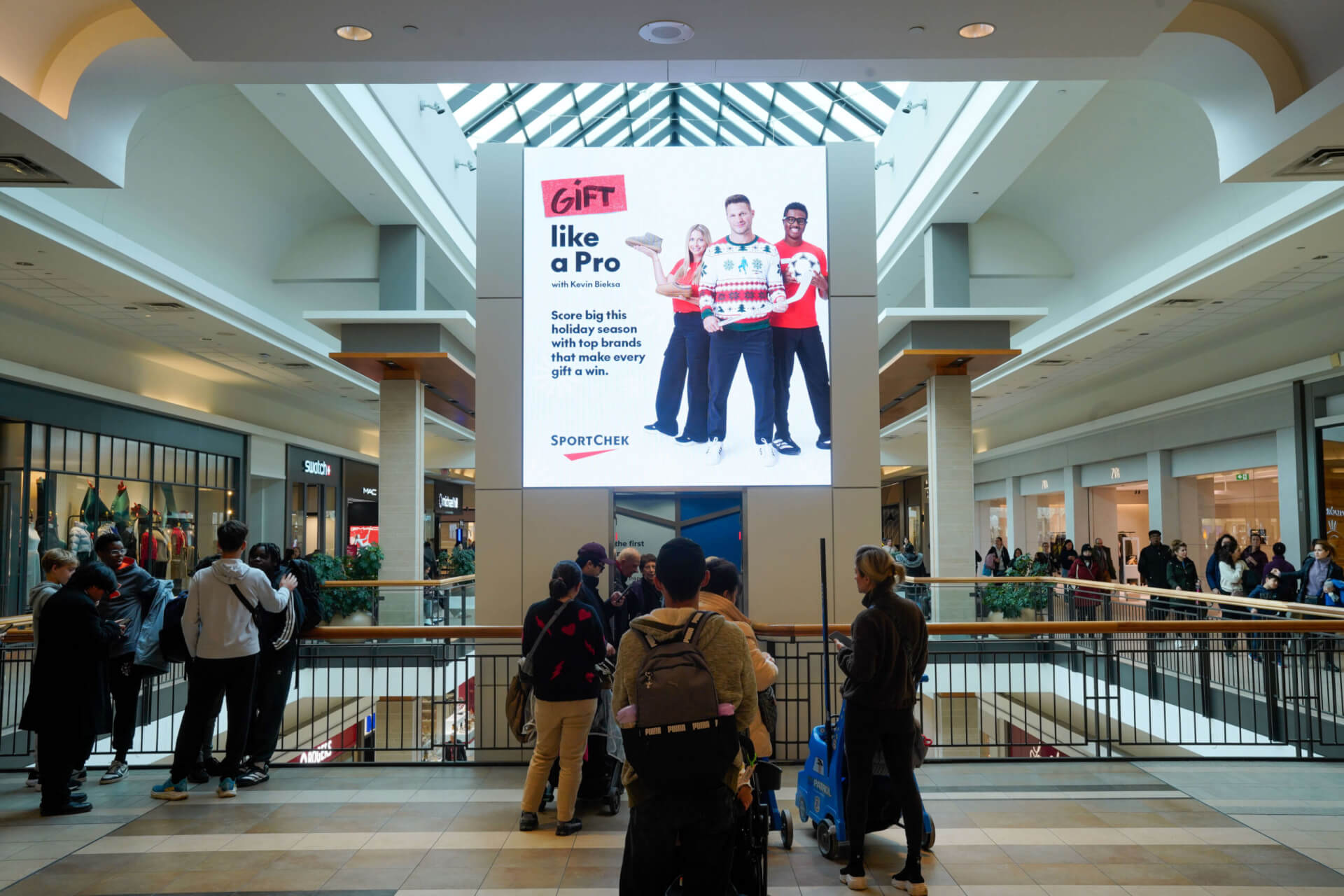
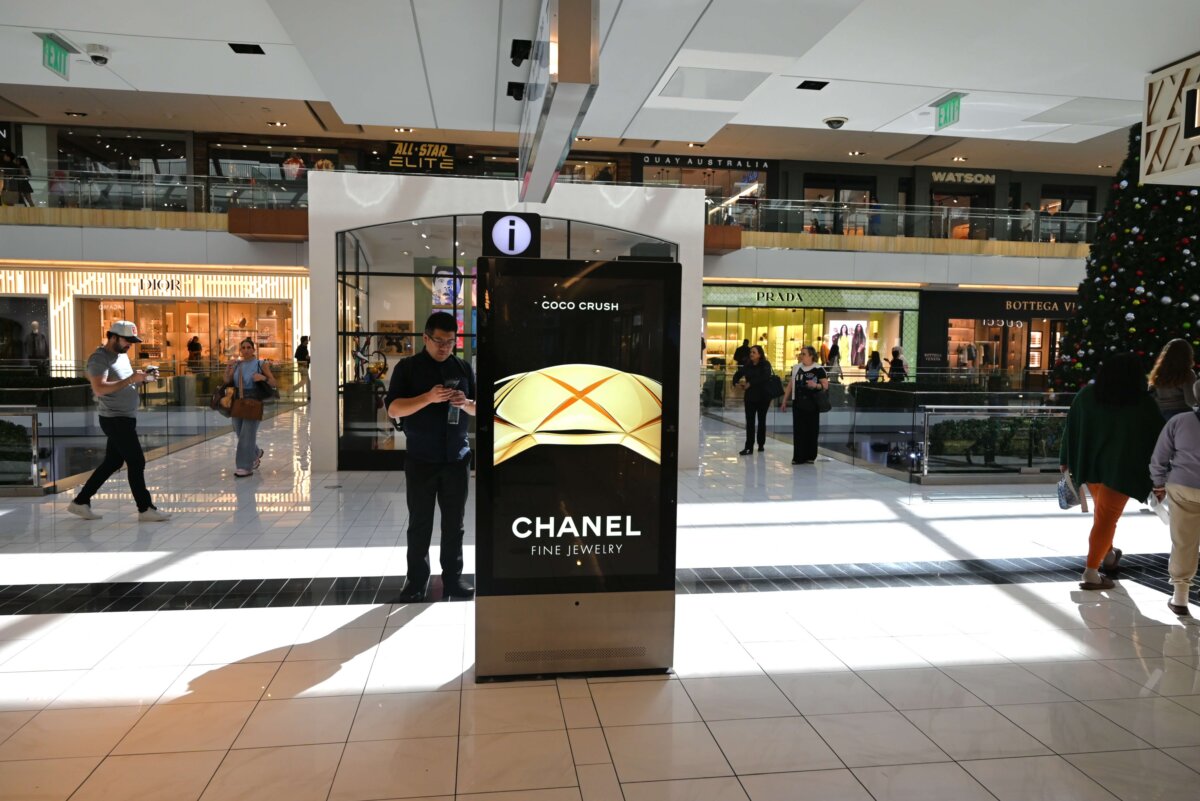
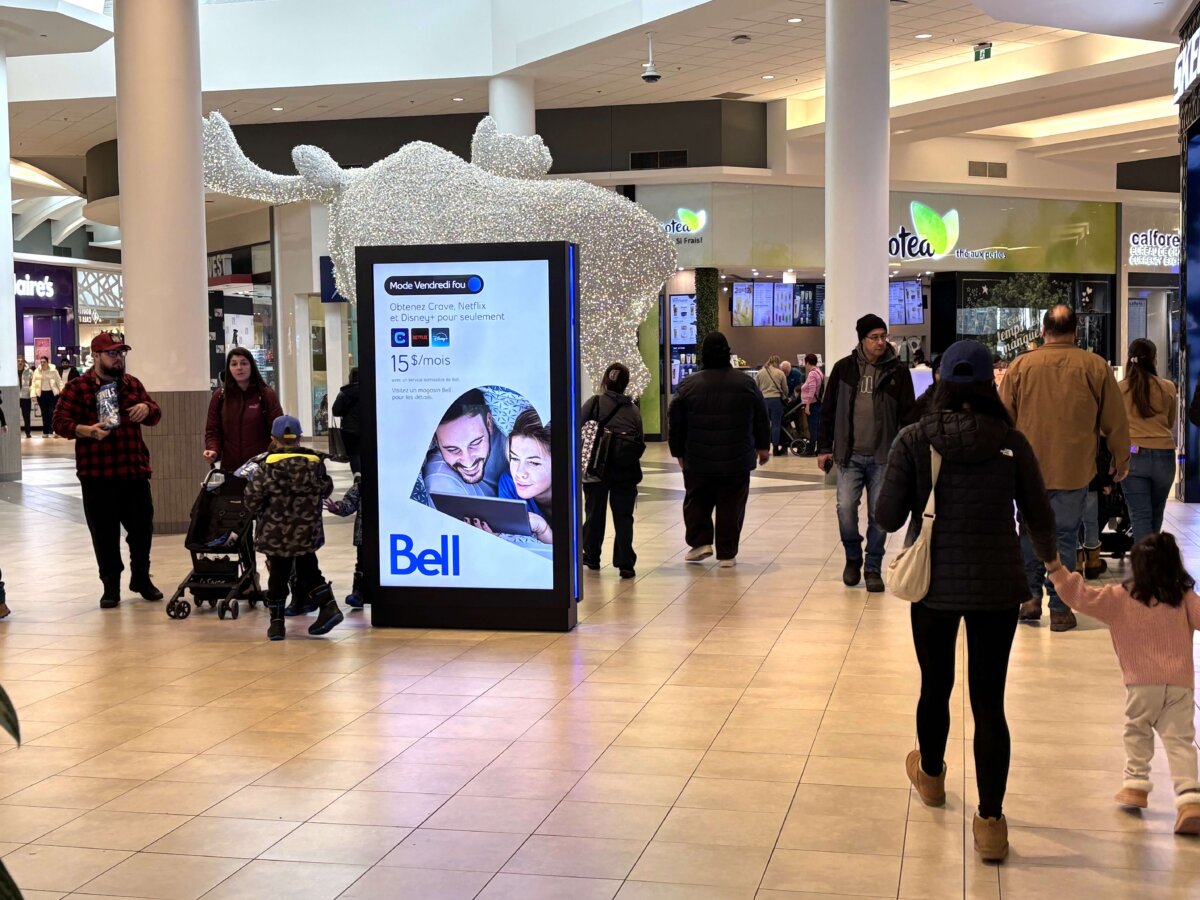
  • Place-based OOH (displays inside retail stores, malls, restaurants, gyms, and office buildings): Advertising displays located in environments where audiences gather for work, shopping, dining, and other activities, allowing brands to connect with people in contextually relevant settings and reach consumers along the path to purchase.

While these format categories help organize the OOH landscape, modern campaigns rarely rely on just one placement type. Most advertisers combine multiple formats and environments to build reach, reinforce messaging across locations, and connect with audiences throughout different moments of their daily routines.

Benefits of OOH advertising: Why advertisers still use OOH today

Out-of-home advertising has remained a core part of the media landscape for decades because it delivers something few channels can replicate: high-visibility brand exposure in real-world environments where audiences can’t skip, scroll past, or block the message.

Today, advertisers continue to invest in OOH for several key reasons:

  • OOH ads can offer unmatched size: Large-format billboards and big digital screens offer a lot of room to execute visually stunning ideas (see our favourite OOH and billboard ads) in a way you can’t match on personal devices. Research from Ocean Outdoor shows that premium large-format DOOH attracts five times more attention than online digital formats, with significantly longer viewing time. Even smaller placements — like totems and bus shelter displays — offer a larger creative canvas than most personal devices.
  • Outdoor advertising is unskippable and ad-block-proof: If people are around an OOH display, they’re going to see it. There are no ad blockers, no below-the-fold positions, and no issue with users switching to a different app or tab. And it’s effective: recent research from Solomon Partners found that OOH drives the highest consumer ad recall and strongest audience ROI across major media, delivering better CPM value than TV, print, and most digital channels.
  • Out-of-home media supercharges your other channels: Yes, digital out-of-home and traditional OOH advertising are impactful on their own, but they really shine when paired with other channels like social media and mobile advertising. Research from MRI-Simmons and the Outdoor Advertising Association of America (OAAA) found that adding OOH media to a campaign’s mix can boost audience reach by as much as 100% or more, depending on the medium.
  • (D)OOH drives real-world action: OOH doesn’t just build awareness — it’s also highly effective at driving consumer action. In a Harris Poll survey conducted in partnership with the OAAA, 76% of DOOH ad viewers reported taking some form of follow-on action — from watching a video (38%) or visiting a nearby restaurant (36%) to entering a store (29%), making a purchase (30%), or talking about the brand with others (30%).

How out-of-home advertising works today

Advances in first-party data integrations, automation-enabled transacting tools, and improved targeting and attribution capabilities have made the channel more flexible and data-informed, helping advertisers execute campaigns more efficiently and better understand how OOH contributes to broader omnichannel campaign performance.

Planning and buying OOH campaigns

In the past, buying out-of-home media meant negotiating placements directly with media owners — a time-consuming manual process involving back-and-forth RFPs, PDFs, and endless email chains. These slow, fragmented workflows often led to longer planning cycles and made it harder to integrate OOH into omnichannel digital campaigns.

Today, the buying landscape has expanded. Like online digital advertising, digital out-of-home can now be purchased programmatically. Known as programmatic digital out-of-home, or pDOOH, this approach allows advertisers to target specific audience demographics or trigger campaigns in real-time based on contextual signals such as weather conditions, live sports scores, or time of day — allowing messaging to align more closely with the context in which audiences encounter it.

At the same time, automation-enabled planning and transacting tools are helping streamline traditionally manual workflows across the broader OOH ecosystem. These platforms make it easier for buyers to discover inventory, evaluate options, and secure placements — whether campaigns run on digital screens or classic OOH formats.

For a deeper look at how automation is reshaping the OOH buying process, download Broadsign’s eBook, Automation in OOH Media Planning: Streamlining Transactions at Scale. It explores how new transaction paths are giving buyers additional ways to balance speed, flexibility, and delivery certainty.

Measurement and attribution in modern out-of-home campaigns

 As OOH planning and activation have become more flexible and data-driven, advertisers have also gained new ways to evaluate campaign performance. 

Once perceived as trailing behind digital channels in terms of measurement, advances in campaign analytics and attribution now provide deeper insight into how audiences respond to OOH exposure — and make it easier for advertisers to understand how out-of-home contributes to broader digital campaign performance and omnichannel outcomes.

Today, advertisers have a range of tools and methodologies to evaluate OOH performance and understand how campaigns influence audiences and outcomes, including:

  • Delivery metrics: Estimates of impressions, reach, and frequency help advertisers understand how many people were likely exposed to a campaign. In digital OOH, impressions are calculated using an impression multiplier — a screen-specific index that converts ad plays into estimated audience impressions based on real-world data provided by media owners. 
  • Engagement metrics: Interactions such as QR code scans, along with passive measurement methods like targeted mobile surveys, help advertisers evaluate audience response, brand perception, and interest generated by an OOH campaign. 
  • Attribution analysis: Attribution studies use anonymized location and behavioural signals to determine whether audiences exposed to an OOH campaign later visited a store, downloaded an app, or took another measurable action. 
  • Audience extension: Aggregated mobile data associated with OOH exposure can support retargeting strategies across digital channels, allowing advertisers to reinforce messaging and extend campaign reach beyond the physical display. 
  • Centralized reporting: Programmatic platforms that support multiple forms of digital media can consolidate campaign data and reporting across channels, helping advertisers understand how OOH contributes to omnichannel campaign performance.

For a deeper look at how modern OOH measurement and attribution work, explore our detailed marketer’s guide to OOH measurement, attribution, and audience extension.

Examples of out-of-home advertising in practice: OOH case studies and real-world campaigns

To see how these capabilities come together in practice, here are two real-world campaigns that demonstrate how brands have used out-of-home to reach audiences and drive measurable results.

Uber Eats: Driving purchase intention across the Netherlands 

Uber Eats launched a programmatic digital out-of-home (pDOOH) campaign in the Netherlands to increase brand awareness and purchase consideration while promoting its “No Delivery Fees” offer. The campaign was developed with agency partner EssenceMediacom and OOH technology partner Broadsign using the OutMoove demand-side platform (DSP). Ads were activated on digital screens in high-traffic locations across major cities like Rotterdam, Eindhoven, and Haarlem and ran alongside other channels like paid social and online video.

A brand lift study conducted with Happydemics showed strong results: ad interest nearly doubled among audiences who recalled the ads, and purchase consideration increased twofold, placing the campaign in the top 15% for purchase consideration within the food delivery category across all media platforms. Read the full Uber Eats case study to see how programmatic DOOH helped drive measurable brand and purchase intent outcomes.

Wisp: Building brand awareness and consideration in New York

As Wisp prepared for its next phase of growth, the women’s telehealth platform set out to increase awareness and familiarity among its target audience in the New York DMA. To reach consumers across the market at scale, it partnered with Broadsign on a high-impact programmatic digital out-of-home campaign using the OutMoove DSP, accessing premium inventory across 2,839 screens in the region.

The campaign combined large-format billboards for broad visibility with urban panels near high-traffic areas and pharmacies, along with in-pharmacy screens to deliver messaging in contextually relevant environments. The effort produced strong results, including a 4× lift in brand preference compared with top competitors. Read the full Wisp case study to see how targeted pDOOH also delivered a 3.8× increase in brand familiarity and a 107% lift in purchase consideration.

FAQs about OOH advertising

How do advertisers buy out-of-home media?

OOH advertising can be purchased in several ways depending on a campaign’s goals.

Traditionally, advertisers work directly with media owners or through specialized media agencies to secure placements at specific locations for a set period of time.

Today, many campaigns are also planned and transacted using technology-enabled buying tools that streamline how inventory is discovered, booked, and managed across multiple screens. This can include programmatic digital out-of-home (pDOOH) platforms as well as other forms of automated or platform-based transactions that simplify the planning and buying process. Both approaches remain widely used, and many campaigns combine them depending on the desired reach, flexibility, and level of control.

How is OOH advertising measured?

OOH measurement typically combines audience modelling, location data, and campaign analytics to estimate how many people are likely to see an ad and how those exposures influence consumer behaviour.

Historically, measurement relied on traffic counts and circulation studies to estimate potential impressions. Today, additional data sources such as mobile location data and movement patterns can help advertisers understand outcomes like store visits, website traffic, and brand lift associated with OOH exposure.

How much does OOH advertising cost?

The cost of OOH advertising varies widely depending on factors such as location, format, audience reach, and campaign duration.

Large-format placements in high-traffic locations typically command higher prices, while smaller or more localized placements can be more cost-efficient. On average, OOH advertising often delivers competitive CPMs compared with other media channels, making it an attractive option for brands looking to build awareness at scale. Billboard advertising costs, for example, can vary significantly depending on the market, placement, and format.

Ready to start planning your first OOH campaign? Browse Broadsign’s inventory catalog to explore high-impact out-of-home placements across the globe.

Product News | October 11, 2021

The Broadsign Platform: Powering revenue, growth and performance 

At our annual Broadsign Connect Summit in Barcelona, our VP of Product, Francois Hechme, and Senior Director of Product, Gavin Lee, presented this year’s roadmap for the Broadsign Platform. The presentation highlighted upcoming platform enhancements that aim to help media owners maximize revenue while making out-of-home (OOH) the easiest channel to buy. This year’s roadmap focuses on three strategic pillars: trading, monetization, and intelligence.

Connecting systems and automating workflows to trade faster

The acquisition of Place Exchange

Our journey in programmatic started a decade ago with the launch of our Broadsign supply-side platform (SSP), and we reached a pivotal milestone at the end of last year with the acquisition of Place Exchange. By joining forces with Place Exchange, Broadsign now has the largest aggregation of programmatic OOH supply in the world, with nearly 2 million screens connected and transacting. 

We also now have the largest programmatic demand ecosystem, with over 55 connected demand-side platforms (DSPs). One of the key benefits Place Exchange brings to our clients is its strong partnership with omnichannel leaders that control some of the world’s largest advertising budgets, including The Trade Desk and DV360.

In addition to technology, we’ve also gained a strong media sales organization with extensive agency and brand relationships, as well as expertise in driving demand from other channels to digital OOH (DOOH), including cinema, programmatic audio, CTV, and retail media. 

Looking ahead, our plan is to have a single SSP in-market that combines the best of Place Exchange and Broadsign’s technology. As we transition to a single SSP, our commitment remains to be transparent about the process and to make the migration as seamless as possible, ensuring no revenue loss for our clients. In the meantime, you can learn more about Place Exchange and what’s to come in this interview with our new Chief Strategy Officer, Ari Buchalter. 

Automating the OOH campaign lifecycle

As highlighted in Talon’s Thinking Outside in 2026 report and McKinsey’s State of Marketing Europe 2026 report, advertisers are returning to brand building in 2026, creating a massive opportunity for OOH, a channel inherently designed to deliver long-term brand impact. However, while advertisers are revisiting marketing fundamentals, they are doing so with modern tools.

To remain competitive and continue growing OOH’s share, the evolution of Broadsign’s technology is focused on making OOH the easiest channel to buy, plan, and measure. Central to this vision is automating the entire OOH campaign lifecycle by leveraging widely adopted products and platforms to reduce barriers to entry and drive the required change forward. 

While buyers could already leverage automated campaign execution and reporting through solutions like Programmatic Guaranteed (PG), the planning and buying of direct OOH deals still relied on a manual-heavy process. Last year, we closed this automation gap with Broadsign In-Advance, which allows buyers to discover inventory, plan a direct OOH campaign, and book it through a DSP. Here’s Gavin explaining how these two automated transactions complement each other and support the automation of the entire campaign lifecycle:

This year, our priority is to scale guaranteed demand by expanding its availability across all markets. To support this growth, we are collaborating with several DSP partners, including leading omnichannel platforms like DV360 and Yahoo, which have made PG a core focus, as well as The Trade Desk and StackAdapt, which have gone a step further by directly integrating Broadsign’s In-Advance capabilities.

Monetization: streamlining direct sales from proposal to booking

Integrated static 

Last year, we resolved a major inefficiency of legacy OOH workflows, which traditionally separate static and digital bookings into distinct systems, by introducing our unified campaign planning workflow in the Broadsign Platform. Today, users can plan and book static and digital inventory in a single proposal, increasing efficiency and operational flexibility while enhancing the OOH buying experience. 

We also launched the Static Operations module, enabling users to manage copy, work orders, and postings in one place. This is complemented by the Post app, which allows bill posters to receive, manage, and complete work orders directly in the field. These latest static enhancements have been rapidly adopted by media owners managing transit, roadside billboards, malls, and toll booth assets. 

This year’s roadmap for our static OOH capabilities will include support for transit operators by allowing them to sell bus faces in groups and further operational enhancements to our static operations module. We’re also looking to bring advanced digital campaign functionalities previously unavailable to static, including flexible, goal-based campaign types, our optimization engine, and API connections to external pricing engines.

Modernizing the campaign planning workflow

Another update we’re excited to announce is the complete redesign of our campaign planning window – the most frequently used workflow in the Broadsign Platform. The latest enhancements provide greater visibility into your inventory availability, allow you to tailor campaigns without leaving unsold inventory gaps, and make it much easier to onboard new employees. 

While the modernization of the campaign planning workflow includes over 50 new features, here are some of our favourites:

  • Match inventory to RFPs instantly – The new campaign planning window dynamically surfaces the most relevant inventory as you adjust campaign settings, helping you quickly build proposals aligned with client requirements. For users who prefer building out their campaign proposal visually, a map view of the inventory is also available.
  • Improved attribution to campaign goals – With real-time campaign metrics and a goal tracker indicating how selected inventory directly impacts campaign objectives, you can confidently build tailored plans that deliver measurable results. 
  • Easier access to key targeting tools – Commonly used targeting criteria, like geotargeting, points of interest (POIs) and environments, are now natively integrated into the campaign planning window, making it easier for you to use your favourite targeting criteria without manually maintaining and updating the criteria tags. 

What’s next for our campaign planning and management capabilities

In terms of enhancements coming in 2026 for our campaign planning and management capabilities, we intend to further close the gap on creative management in the platform, reducing the need for you to jump between Broadsign web workflows and desktop tools and allowing you to manage the campaign lifecycle in one place. 

We plan on evolving our optimization engine to support campaign delivery when changes are implemented mid-flight. Currently, if you change audience schedules or store hours for a particular screen while campaigns are running, you would need to manually re-adjust every affected campaign. The latest update to the optimization engine would automatically rebalance campaign delivery, ensuring you always hit your targets even when plans change.

We’re also bringing you more flexibility and customization to how you sell your inventory. Our upcoming UI updates will include packaged workflows, allowing you to group specific screens and sell them as a package. This not only gives you more control over how your inventory is presented and sold to advertisers, but also allows you to optimize your pricing and sales strategy to maximize fill rates and revenue. 

One of the biggest changes for campaign planning and how you monetize your screen will arrive in the second half of the year with our advanced planning capability. We’re adding a massive audience data layer to the platform, allowing you to index and score screens against specific demographic segments using either your own first-party data or partner data. This new capability will not only allow you to align campaigns perfectly with agency briefs, but also concretely demonstrate how your network is the best way to reach a brand’s target audience.

Intelligence: See performance, forecast revenue and optimize yield

We’re continuing to advance with our plans for a unified reporting module in the Broadsign Platform, which aims to consolidate visibility of forecasts, yield performance, and channel allocation into a single view. Our dashboard will be fully customizable, ensuring each user sees only what matters for their role. For instance, a campaign manager can focus on pacing and creative status, while leadership can track high-level trend analyses. 

The reporting module will also include a yield management view that focuses on revenue forecasting rather than screen occupancy. Using AI pattern recognition and trend analysis, the system analyzes your historical and projected bookings to predict future yield opportunities and recommend changes. 

One of the most common questions in yield optimization is how much inventory to allocate across sales channels and how that allocation would impact revenue. Our new channel allocation simulator makes that easy to answer and removes the guesswork by allowing you to run “what if” scenarios in a risk-free environment. You can test different strategies, like allocating more of your screens and effort to direct versus programmatic, and see the potential impact it has on your revenue before you commit. 

Finally, our reporting module will include AI insights. Acting as your personalized data analysts, it monitors your data around the clock to alert you of potential issues and provide recommendations, minimizing the impact on your network operations and advertisers’ experience. 

This latest series of updates is another step forward in Broadsign’s mission to transform how brands, agencies and media owners buy, sell and deliver OOH campaigns. For media owners, the latest evolution of the Broadsign Platform aims at removing any friction that stands between them and their revenue. 

Discover the platform that powers out-of-home here

Product News | October 11, 2021

Place Exchange by Broadsign Integrates with Eletromidia to Unlock Brazil’s Largest Programmatic Digital Out-of-Home Network

Advertisers gain programmatic access to more than 55,000 premium screens across Brazil’s residential, office, transit, retail, and street environments

New York, NY, March 9, 2026 – Place Exchange by Broadsign, the leading supply-side platform (SSP) for programmatic digital out-of-home (DOOH), today announced a new integration with Eletromidia, Brazil’s largest out-of-home media (OOH) company, expanding Place Exchange and Broadsign’s footprint across Latin America. The integration enables advertisers to programmatically access Eletromidia’s premium DOOH inventory at a national scale, transacting through the same workflows they use for other digital channels within their DSPs.

Through this partnership, Place Exchange buyers can reach audiences across 55,000 digital screens, spanning a variety of premium environments such as residential and office buildings, mass transit systems, airports, street furniture, and shopping malls, reaching consumers throughout their daily journeys. Eletromidia delivers unmatched scale in the Brazilian OOH market through its vast national reach of more than 53 million people monthly. With the majority of its inventory digitized, Eletromidia represents more than 80% of Brazil’s total DOOH market share.

“This integration gives global and regional advertisers programmatic access to the most comprehensive and digitally advanced OOH network in Brazil,” said Robert Loftus, VP of Supply Partnerships at Place Exchange by Broadsign. “Eletromidia’s scale and digital dominance within key urban environments make it an ideal partner as omnichannel demand for programmatic DOOH continues to accelerate in Latin America.”

“By partnering with Place Exchange by Broadsign, we’re making it easier for advertisers to access Eletromidia’s premium inventory with the same flexibility, automation, and transparency they expect from digital channels,” said Heitor Estrela Gomes, Growth and Product Director at Eletromidia. “This integration connects Brazil’s most powerful OOH environments to the global programmatic ecosystem.”

About Place Exchange by Broadsign

Place Exchange by Broadsign is the leading global SSP for programmatic out-of-home media, featuring the largest footprint of OOH media worldwide. As part of Broadsign’s family of OOH solutions, Place Exchange is integrated with omnichannel and OOH DSPs, and offers agencies and advertisers the opportunity to fully unify non-guaranteed and guaranteed programmatic buying and measurement of OOH media with other digital channels within their DSP of choice, leveraging the same workflows, creatives, reporting, and attribution as for online, mobile, and other forms of digital advertising. Place Exchange’s unmatched array of premium global OOH inventory adheres to its Place Exchange Clear certification program that delivers buyers quality, consistency, transparency, and compliance. For OOH media partners, Place Exchange offers the opportunity to access untapped programmatic ad spend with full transparency and control. For more information about Place Exchange, visit www.placeexchange.com.

About Eletromidia

Eletromidia engages monthly with more than 53 million people through nearly 90,000 touchpoints, including 55,000 active digital assets – the largest digital inventory in the country. We deliver content, services, and experiences with the purpose of generating a positive impact on society through the transformation of cities. We are the only company in the sector operating across all five Out Of Home verticals – streets, buildings, shopping malls, airports, and transportation – present in the 11 largest markets in Brazil. In 2024, we became part of Grupo Globo, expanding our ability to innovate and transform the advertising ecosystem.