How our Climate March DOOH messaging went from a simple idea to live on screens in two hours
The Climate March is happening today right outside our Montreal and Toronto offices, and with walking shoes in hand, the Broadsign team was ready to go. But with an early-morning creative spark, one Broadsigner thought we could do a little more: why not use outdoor screens to further promote the cause?
The Challenge
We had only a few hours before people started to head downtown for the march, but other than an exciting idea, we had nothing ready…no creative concept, no messaging, no screen time booked. So with rushed 8 AM phone calls and a Slack channel that wouldn’t stop buzzing, we set to work!
The solution
For rushed campaigns, social media is usually the way to go. But what many don’t realize is that programmatic DOOH can have a very similar result.
So once the marketing team had our creatives ready, we logged into the Broadsign Ads (formerly Campsite) DSP to check out what inventory was available. At this point, we only had about 20 minutes until we wanted the messaging to go live.
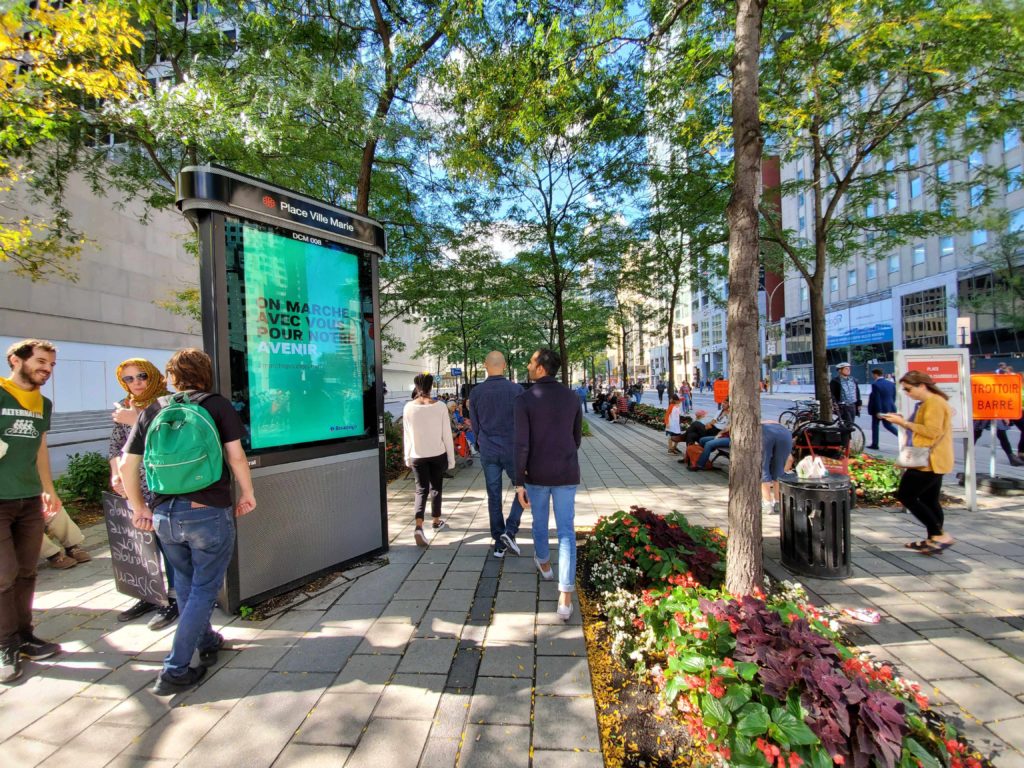
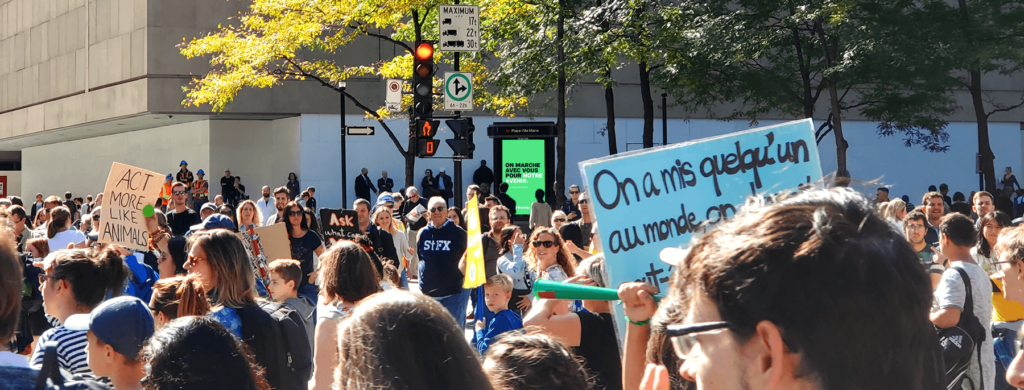
By comparing screen locations with the demonstration routes on both Montreal and Toronto, we booked every screen from publishers who had available inventory along the Climate March path.
The Results
With an estimated 300,000 people taking part in the march, the message definitely had decent reach. We’re pleased to have been able to execute the campaign in time to support the marchers who showed up for this important cause.
But there’s an extra reason we’re really excited about this campaign: this is what programmatic DOOH is all about.
From concept to execution, launching a DOOH campaign doesn’t need to be a laborious task. Instead, it can be a nimble and flexible process, resulting in timely and creative campaigns – even when an idea sparks with nearly no time to spare.
Our product owner, Matthew Mercuri, posing with the final result of his bright idea!
Product News | October 11, 2021
Digital out-of-home for holiday marketing: How to win high-intent shopping moments
If your holiday marketing strategy is still built around the same playbook from a few years ago, you’re already behind.
As agencies and marketers seek ways to connect digital discovery with brick-and-mortar purchasing behaviour, digital out-of-home (DOOH) inventory offers them a unique opportunity to reach consumers at key moments throughout their IRL holiday shopping journey. And with programmatic making campaigns faster and easier to launch and adjust, DOOH can play a vital role in an omnichannel holiday strategy — with the flexibility to meet campaign needs as they evolve.
Why holiday shopping micro-moments matter in 2026 — and how DOOH can help
Major sales events like Black Friday and Cyber Monday remain at the centre of the holiday shopping calendar, but they represent just a few moments in a purchase journey that now starts earlier and moves fluidly between digital and physical touchpoints. According to new Microsoft research, the average holiday conversion journey now takes 52 days, with 63% of U.S. shoppers starting before Halloween. That journey is also increasingly hybrid: per Salesforce, 42% of shoppers visit stores to buy products they previously researched online, while 79% use smartphones while shopping in-store.
It’s within this extended, omnichannel journey that holiday shopping micro-moments occur: reflexive, high-intent windows when consumers turn to a device or their surroundings to act on an immediate need, like:
Comparing gift ideas or researching products
Looking for a nearby store or point of sale
Seeking inspiration for holiday hosting, decorating, or gifting
Checking local product availability, promotions, or seasonal offers
Making a last-minute purchase
For advertisers, these moments create opportunities to reach shoppers with messages that reflect what they need in that moment. And because DOOH combines broad reach and repeated exposure with the ability to deliver relevant messaging in real-world contexts — often close to the point of purchase — it’s particularly well suited to making those moments count.
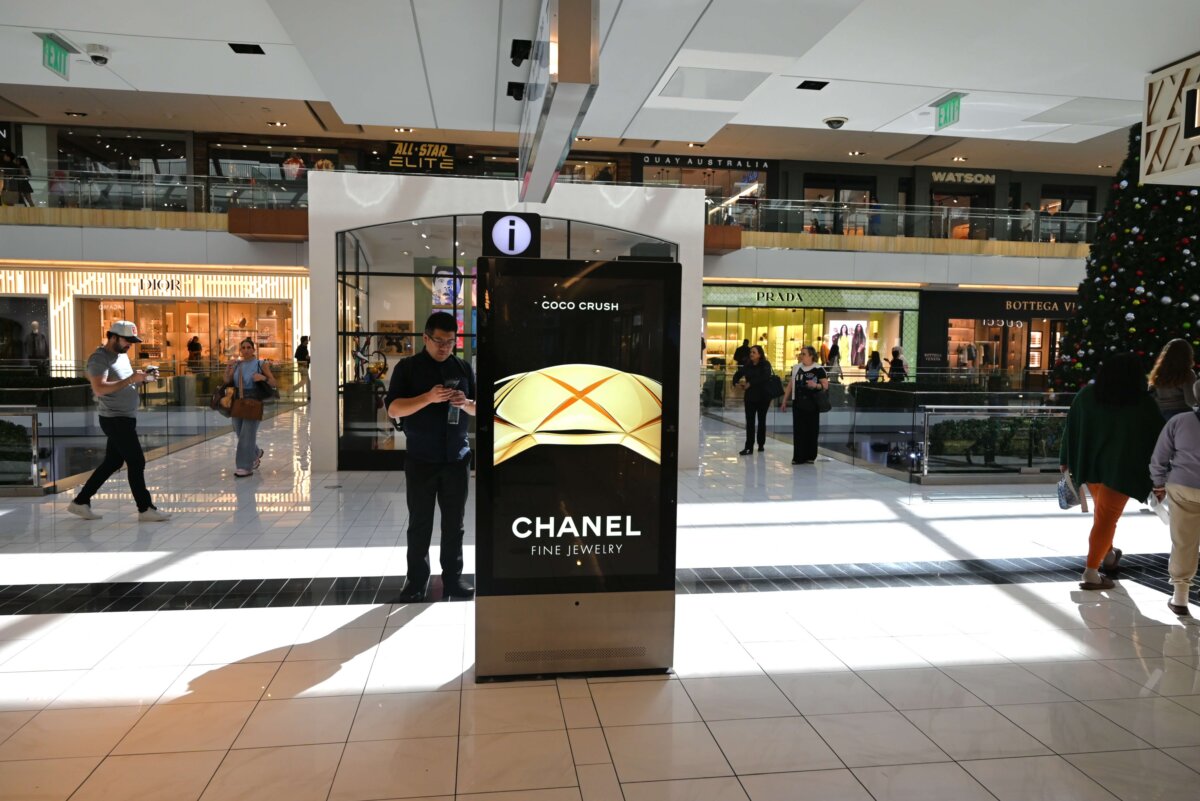
Chanel campaign displayed on Simon Media’s DOOH inventory at The Galleria in Houston, Texas
Strategy #1: Leverage advanced targeting to reach holiday shoppers at high-intent moments
Use advanced DOOH targeting to activate screens in and around the physical locations where your target customers are most likely to be — particularly when proximity to a store, venue, or other destination signals stronger purchase intent.
Depending on the campaign objective, advertisers can narrow their inventory using:
Location targeting: Go broad with nationwide or city-level campaigns, or get more granular with zip codes, POIs, custom geofences, and individual screens. A retailer promoting a Black Friday sale, for example, could prioritize screens within walking or driving distance of its stores.
Audience targeting: Use first-party data and third-party audience segments to identify screen locations where target customers are most likely to be present — whether that’s parents shopping for toys, beauty buyers looking for gifts, or travellers heading home for the holidays.
Venue and asset targeting: Match placements to the activity happening around them, from gift shopping at malls and stocking up at grocery stores to dining, celebrating, and travelling over the holidays.
Dayparting: Adjust when ads appear to align with relevant shopping and travel behaviours throughout the day.
Layered targeting: Combine multiple signals to get more precise. For example, target mall-adjacent inventory within a specific New York City geofence during peak afternoon and evening shopping hours.
De’Longhi recently put this kind of high-intent targeting into practice with a programmatic DOOH campaign promoting its Eletta Explore coffee machine during the competitive holiday shopping season in Poland. By activating inventory in high-traffic shopping malls, reaching gift-seekers close to the point of purchase, and using dayparting to align ad delivery with peak shopping hours, the campaign ultimately drove a 121% lift in brand preference and a 190% lift in intent to interact with the brand or visit its website.
For holiday campaigns focused on purchase-ready micro-moments, targeting can extend all the way into the store. According to Salesforce, 77% of consumers plan to shop in physical stores this holiday season, making in-store advertising a particularly valuable way to reach shoppers when they’re most likely to make a purchase. The same targeting principles still apply: advertisers can prioritize the stores, audiences, locations, and times most relevant to what they’re selling rather than treating all retail foot traffic equally.
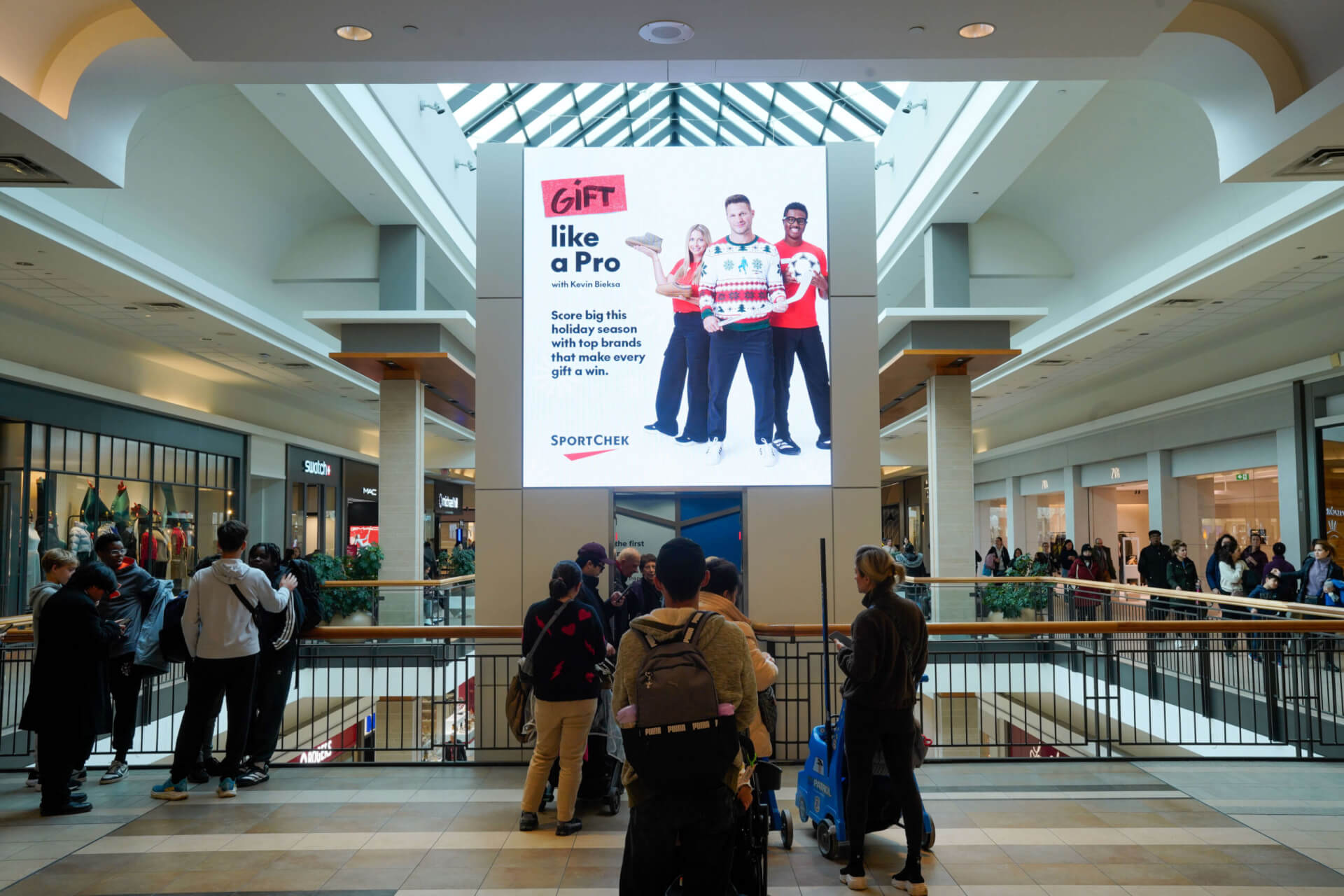
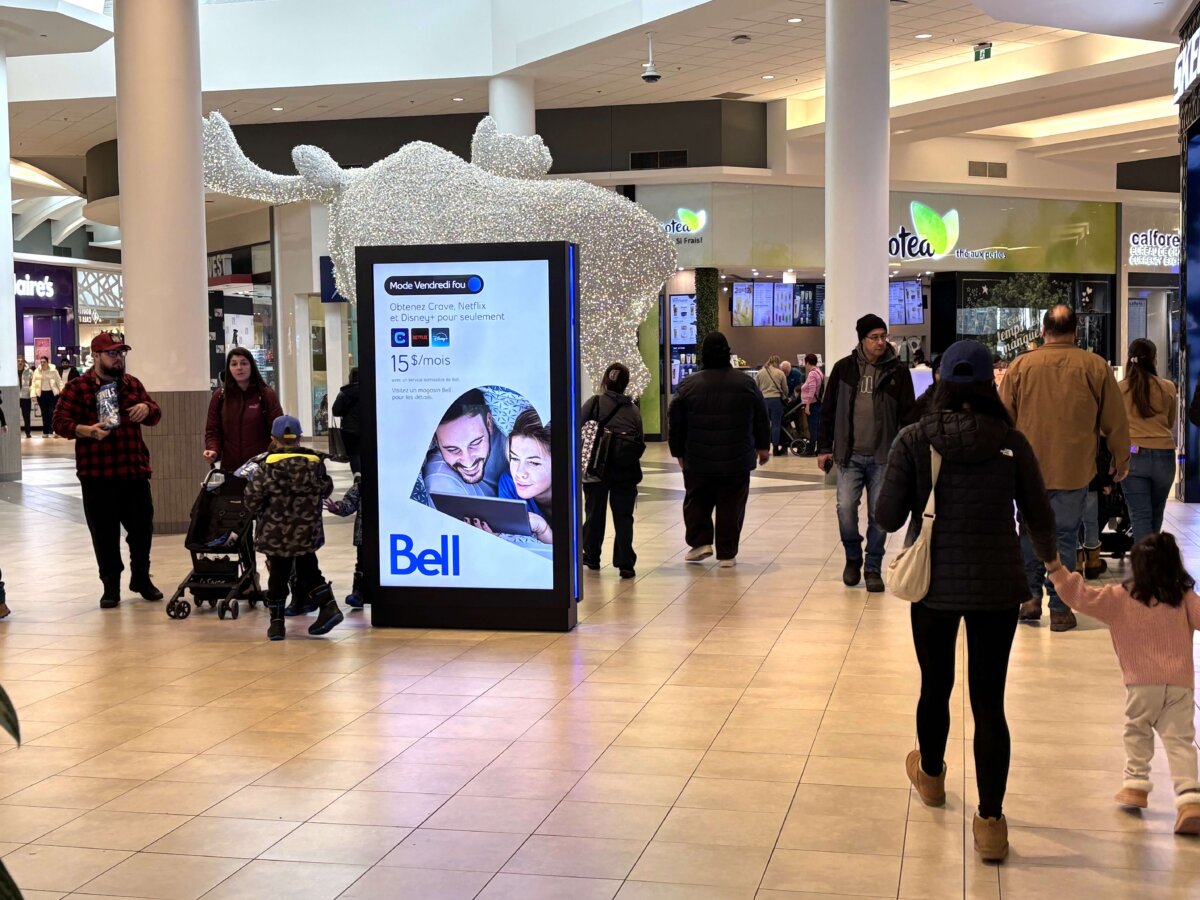
Cineplex Media DOOH screen at CF Carrefour Laval in Quebec, Canada, directs shoppers to nearby Bell stores
Strategy #2: Use dynamic creative and contextual triggers to match DOOH messaging to the moment
Targeting can help put a holiday ad in the right place at the right time. Dynamic creative in DOOH takes that relevance a step further by adapting the ad itself based on what’s happening in that moment. Using signals like time, weather, location, proximity, product availability, or other live data, advertisers can automatically serve the creative variation that best fits the current context.
For holiday campaigns, that opens up practical ways to make creative more useful and timely:
React to the weather: Promote coats, hot drinks, delivery, or indoor activities when temperatures drop, then switch creative as conditions change.
Make proximity useful: On screens near a store, dynamically show the closest location, distance, or a directional call to action.
Adapt as shipping deadlines approach: Shift from standard delivery messaging to expedited shipping, pickup, immediate availability, or digital gift cards as Christmas gets closer.
Build urgency around key sales moments: Use live countdowns to Black Friday, Cyber Monday, promotional deadlines, or other limited-time offers.
Respond to inventory levels: Feature products or offers based on what’s currently available at nearby locations rather than promoting something shoppers can’t buy.
The most effective dynamic DOOH creative strategies are built around signals that meaningfully change what’s useful or relevant to the shopper, allowing advertisers to adapt messaging at scale without manually building and trafficking every possible variation.
Strategy #3: Pair physical DOOH exposure with mobile activity to extend reach and drive action
Mobile plays a major role in holiday commerce, with eMarketer projecting that nearly 60% of online holiday purchases will happen on mobile devices in 2026. That makes mobile and DOOH a natural pairing, with each channel reinforcing the other across the shopping journey. OAAA research also found that 74% of mobile users took action on their devices after recent exposure to DOOH ads, while an Ocean Neuroscience study found consumers are 48% more likely to engage with a mobile ad after seeing the same campaign on a DOOH screen.
For holiday campaigns, advertisers can use that relationship in several practical ways:
Location-based retargeting: Extend a DOOH campaign with follow-up mobile ads served to audiences who were near campaign screens. A shopper who encounters a holiday campaign while out shopping, for example, could later see a mobile ad featuring the same product or promotion.
Mobile push notifications: For opted-in app users, use location signals like geofencing or beacons to deliver relevant notifications when they’re near a store or campaign location — for example, alerting loyalty members to an offer nearby.
Interactive QR codes: Give shoppers a direct path from a DOOH ad to an offer, coupon, product page, store locator, or other mobile experience. Dynamic QR codes are particularly useful on screens where consumers are close enough — and have enough dwell time — to scan.
In-app AR experiences: Use DOOH creative as an entry point to augmented reality experiences on a shopper’s phone, like virtual product try-ons, interactive holiday experiences, or content designed for social sharing.
The best approach depends on what you want the shopper to do next. QR codes, push notifications, and AR can encourage action while a shopper is still nearby, while mobile retargeting can reinforce the message later in the purchase journey.
Ready to make the most of this year’s holiday shopping micro-moments? Explore our inventory catalog to discover premium digital screens in high-impact locations.
Product News | October 11, 2021
How VAST Billboards is redefining out-of-home in New Zealand
In a market long shaped by a handful of dominant players, VAST Billboards has carved out a distinct identity as New Zealand’s independent, Kiwi-owned out-of-home (OOH) network. Headquartered in Christchurch, VAST has built its growth story not by trying to out-scale the biggest networks, but by complementing the broader OOH landscape with a strong presence across regional cities, suburban corridors, and strategically important locations.
We sat down with Gary Rosewarne, Head of Growth Strategy at VAST, to talk about the company’s rapid growth, its programmatic ambitions, and why Broadsign has become a core part of how VAST runs its media operations.
A network built on purposeful growth
VAST’s strategy is built on a simple but deliberate idea: the network doesn’t need to be the whole plan — it needs to be the right complement to it. “We don’t believe VAST needs to be the whole plan,” Rosewarne explains. “In Auckland, for example, we can provide a complementary layer around established networks; in Christchurch, we have significant strength across suburban and arterial environments; and regionally, we give brands access to audiences across a growing number of markets.”
That positioning shapes where VAST builds inventory and how it prices and packages it, with a focus on keeping the network competitively priced and easy to buy. Its predominantly digital, large-format footprint extends beyond New Zealand’s largest cities into regional markets including Tauranga, Hamilton, Napier, Hastings, Taupo, Nelson, Blenheim, Timaru, and Invercargill, across both landscape and portrait formats.
“The objective isn’t simply to accumulate screens, but to add locations that create useful geographic spread, strengthen coverage and give advertisers access to audiences they may not be reaching elsewhere,” says Rosewarne. “That combination of metro, suburban and regional inventory is really what defines the VAST network.”
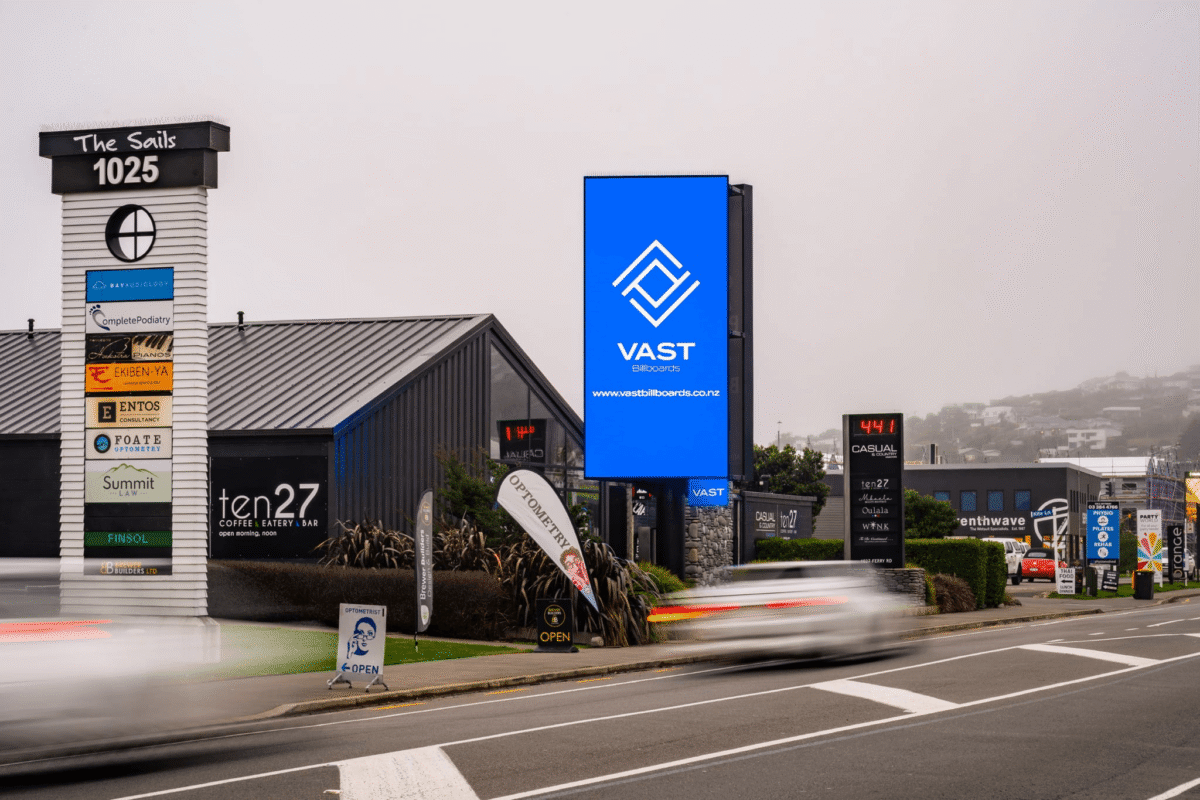
VAST digital billboard on Ferry Road in Christchurch, New Zealand
Serving national brands and local businesses alike
The company’s advertiser base spans national agency clients, major brands, and local direct advertisers. In 2025, its network saw strong growth across these segments, becoming an increasingly important part of national campaign plans while maintaining its strong connection to businesses looking to reach audiences in their local communities.
VAST has also used its own network to experiment with new ways of engaging audiences and demonstrating the potential of OOH. One example is Bill Is Bored, a campaign that used curiosity-driven billboard creative to capture attention and encourage people to continue the experience online. More recently, the Win A Grand – Your Region, Your Voice campaign invited New Zealanders to share what matters most in their local communities. The responses helped inform Beyond the Big Three, a research study examining the scale, value, and audience opportunity of regional New Zealand beyond the country’s three largest cities.
Together, these campaigns have given VAST a way to test ideas, gather audience insights, and demonstrate what OOH can achieve beyond simply delivering impressions. “These projects let us test ideas on our own network, learn from the response and build evidence that can ultimately help advertisers use OOH more creatively and effectively,” Rosewarne says.
That combination of clarity of purpose and consistent execution earned VAST recognition as Beacon’s 2026 Sales Team of the Year—one of New Zealand media’s leading industry awards, and a notable achievement for a relatively small team competing against some of the most established names in OOH.
“In 2025, VAST grew revenue at 5x the pace of the broader market, but the story was bigger than the numbers,” Rosewarne says. “We stopped thinking about ourselves as simply selling billboards and became much more focused on solving planning problems.”
Central to that shift was the “complete, not compete” philosophy, helping agencies see where regional and suburban audiences could add incremental value. Being a smaller, independent player also gave VAST room to move quickly. “Being small probably helped as well: we could be nimble, authentic, try things, have some fun and respond quickly when an opportunity emerged.”
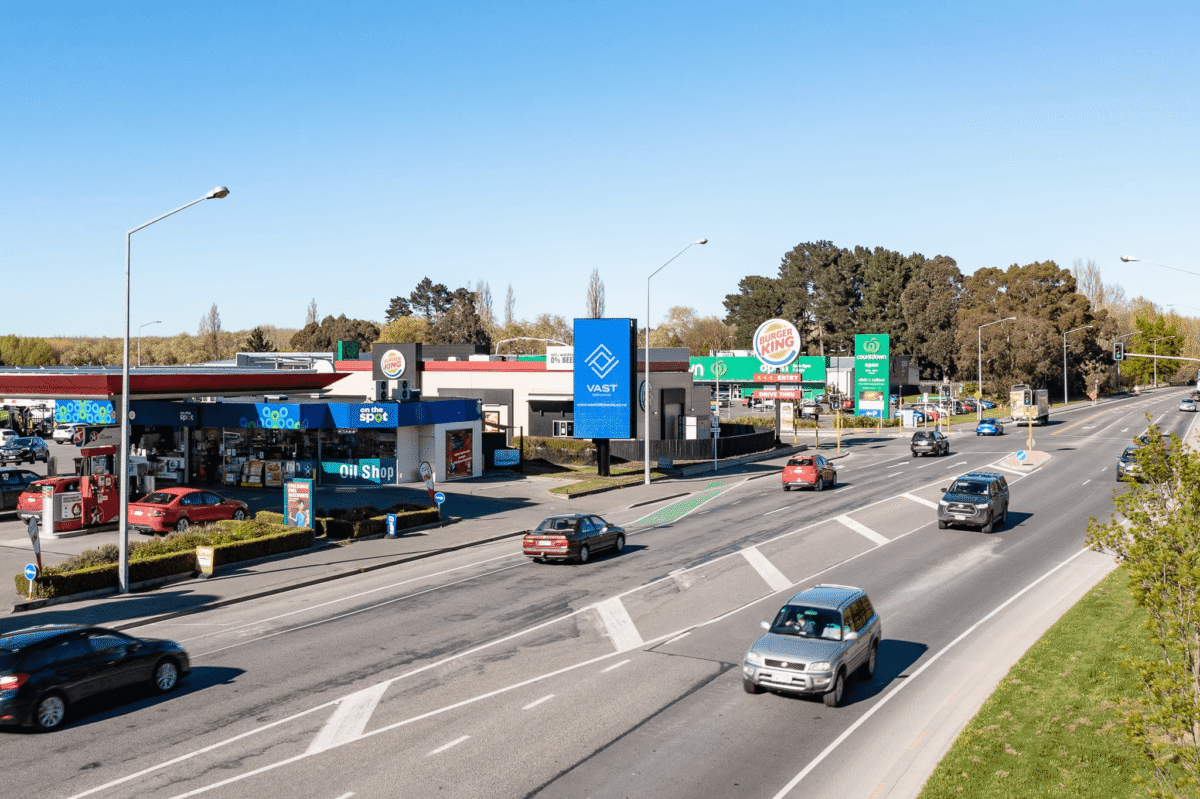
VAST roadside screen in Ashburton, New Zealand
Why VAST chose Broadsign
As both the network and ambitions have grown, so has the need for technology that can scale alongside them. That search led VAST to the Broadsign Platform.
“For us, Broadsign came down to trust, reliability and fit,” Rosewarne says. “We wanted an established platform with deep expertise in OOH, rather than something we would potentially outgrow. As we scale, the technology sitting underneath the network has to be dependable, but it also has to give us the flexibility to keep evolving how we package, manage and monetise inventory.”
Broadsign’s position within the programmatic DOOH ecosystem and its established relationships with major trading platforms and partners were other deciding factors, particularly as programmatic became a larger part of VAST’s business. “Broadsign brings experience, expertise and an established ecosystem that we can grow alongside.”
Programmatic as a new route to market
Programmatic buying has shifted how the media owner thinks about its inventory, moving the conversation beyond locations and weeks toward a more dynamic view of audiences, availability, and demand. “It creates another route into the VAST network and makes it easier for advertisers who may already be buying other digital media programmatically to include OOH within that ecosystem,” Rosewarne explains. “For a challenger network like ours, reducing that friction is particularly valuable.”
That shift has also prompted VAST to rethink how it values and packages inventory for programmatic buyers, treating it as a distinct buying pathway with its own use cases rather than a variation of direct bookings. Just as importantly, programmatic expertise has been embedded across the sales team, helping ensure the right buying approach is recommended for each campaign.
Looking ahead
VAST’s long-term vision centers on purposeful growth, not expansion for its own sake. Rosewarne describes the goal as building “a highly useful independent OOH network that has a clear role within the New Zealand market”, one that continues to strengthen its regional footprint, protect its position in Christchurch, and selectively add metropolitan inventory that creates genuine new audience opportunity.
Looking at the broader industry, Rosewarne sees OOH becoming increasingly measurable, connected, and flexible, with programmatic adoption and audience measurement both continuing to mature. “Our job is to combine those capabilities with the things that still make OOH powerful: great locations, simple creative, local relevance and real-world visibility,” he says. “If we can keep doing that while remaining independent, nimble and easy to work with, we think there is a very exciting future for VAST.”
Ready to scale your network without scaling your workload? Learn more about the Broadsign Platform here.