Product News | October 11, 2021

How Brapex Publicidad exterior delivers innovative DOOH across Lima
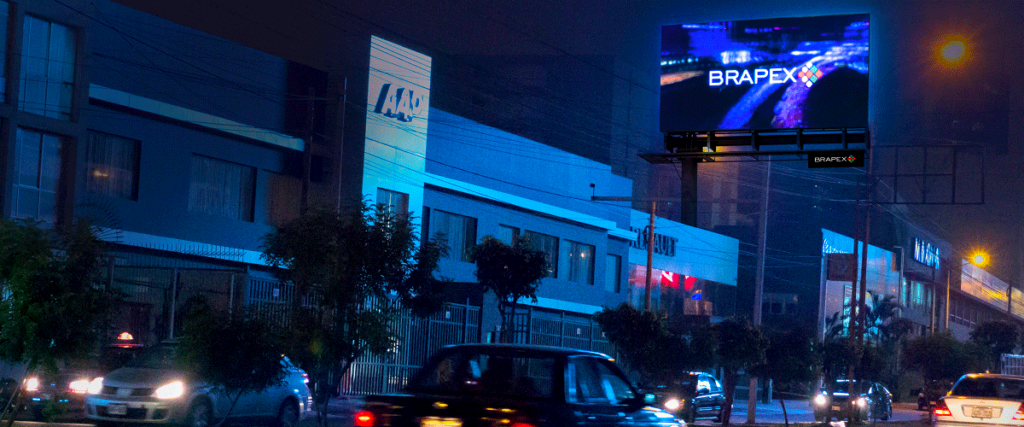
As the lines blur between out-of-home and online digital advertising, publishers are increasingly fielding demands for greater immediacy and pressure to create more innovative offerings for buyers. Investment in new tech can take a company so far in meeting these demands, but it takes careful planning and a dedication to service to take these aspirations to their fullest conclusions.

From its origins introducing new DOOH formats to Lima in 2014 through to today, Brapex Publicidad Exterior has achieved those goals. Today, it is known for offering a standout experience and excellent results to agencies looking to make a splash with DOOH.

DOOH in motion

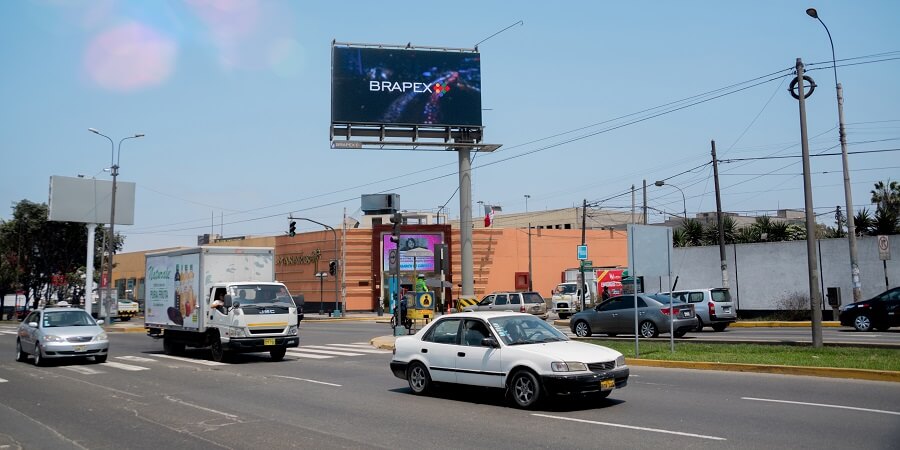
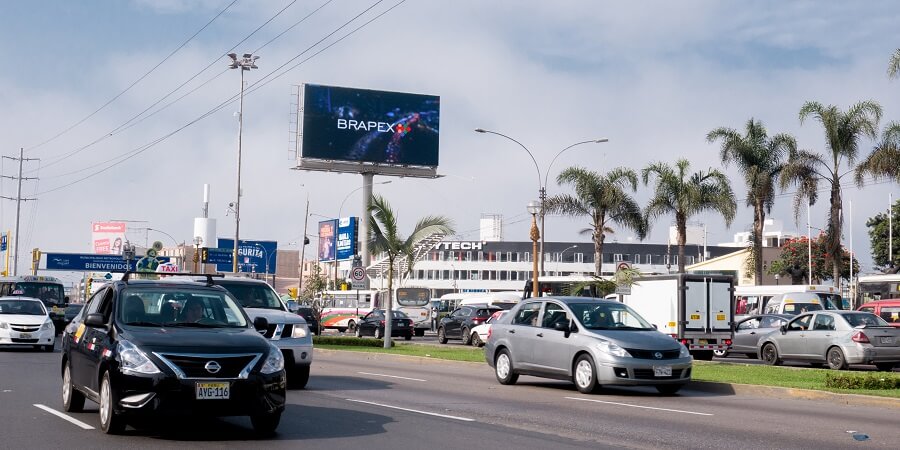
Starting with just two screens in 2014, Brapex made a name for itself in large part through its support of full-motion video content and location-based media selling. The competition, by contrast, sold static images in circuits until Brapex redefined the standard for DOOH in Lima.

The company maintains, however, that its backbone as a business lies in its dedication to quickly responding to customers and offering them the flexibility to truly buy according to their needs. Key to this undertaking is offering 24/7 customer service, something that none of its competitors do – and something its customers greatly appreciate.

Ads that Sell and Ads that Save

The main driver of business for Brapex is advertising for national and international brands looking to connect with consumers. This includes prominent airline, beverage, toy, and car brands, as well as large musical and cultural events in Lima and elsewhere in Peru.

Brapex also looks to put its screens to good use by supporting charity work that it believes in, typically offering screen time and assistance to a different charity each month. One significant example is the Kusimayo institution’s Warmth for Puno program, which insulates homes and distributes warm clothing to help vulnerable populations better cope with cold weather. The ads took a simple concept, comparing the temperatures in Lima with regions experiencing the coldest temperatures, and used it to encourage donations to assist people living in those areas. The campaign drove an increase in donations of more than 20% in 2018, at a time of year when the funds were badly needed.
Continued Innovation

As the market develops and Brapex’s network continues to grow, the company is seeking opportunities to build on its past successes by developing useful new products for its customers. Its Brapex interactive initiative looks to increase the development of interactive DOOH media for display on Brapex’s screens.

Meanwhile, buyers are also being granted the opportunity to supplement their DOOH advertising with Brapex’s location ads. These ads appear on Facebook and Instagram, geotargeted to users who have been in proximity to Brapex’s screens. It’s an ideal complement to the out-of-home advertising that buyers are distributing across Brapex’s screens, and is an offering that none of Brapex’s competitors can currently match.
Looking forward, Brapex is eager to jump into a programmatic future, something which will be key to unlocking a new level of immediacy for its buyers.

Brapex and Broadsign

It takes a good software platform to power an innovative, snappy, customer-first business model. This is especially true when the network is responsible for delivering 95,000 ads to as many as 45 million people each month, with more screens planned for deployment in the months and years ahead.

Seeking not only to set itself apart from the pack in Peru, but also to gain the capabilities required to run a world-class network, Brapex chose Broadsign.

With Broadsign Control, Brapex has the foundation for delivering many kinds of media to its screens, with scheduling and delivery automated by the system. Broadsign Direct, meanwhile, provides the real-time inventory management and proposal generation tools that allow Brapex to achieve the highest level of synchronization and efficiency possible. Finally, Broadsign’s position as a world leader in programmatic DOOH means that as soon as the region is ready to start transacting programmatically, Brapex will be ready to jump in with the world’s best solution.
Product News | October 11, 2021

3 strategies for planning smarter programmatic DOOH campaigns: Data-backed tips from our new industry report

LinkNYC digital advertising kiosk on a busy New York City street corner, surrounded by pedestrians, cyclists, and storefronts.

As the programmatic digital out-of-home (pDOOH) market matures, the question for many advertisers is no longer whether to use it, but how to make it work harder. At the same time, the rise of new targeting signals, creative formats, and deal models means buyers are navigating a more complex landscape — one where maximizing ROAS and aligning DOOH outcomes with broader campaign goals are top of mind.

To better understand how these shifts are shaping advertiser investment and planning strategies, we analyzed aggregated transaction data from the Broadsign and Place Exchange SSPs — together representing the world’s largest independent programmatic OOH ecosystem, with more than 1.7 million programmatically-enabled screens.

Drawing on the findings published in our new 2026 Programmatic DOOH Trends Report, this article highlights three practical strategies buyers can use to plan smarter, allocate budgets more effectively, and get more value from their programmatic DOOH campaigns.

Understanding today’s programmatic DOOH marketplace: Insights for agencies and advertisers

No longer limited to a small group of early adopters, today’s category mix — spanning sectors associated with everyday consumer purchase decisions as well as those with longer consideration cycles — shows programmatic OOH being used across a wide range of business contexts.

Top spending advertiser categories

Global, full-year 2025 | Categorized by IAB category

The diversity of advertiser investment reinforces programmatic DOOH’s growing role as a mainstream media channel rather than a specialist one. It also reflects increasing confidence in the channel’s ability to support a wide range of campaign objectives across different industries. But as the market matures, buyers are navigating a more sophisticated programmatic landscape — one where performance is increasingly shaped by the planning decisions made before a campaign ever goes live.

3 strategies for planning smarter programmatic DOOH campaigns

Whether you’re launching your first programmatic OOH campaign or looking to level up your pDOOH performance at scale, we’ve got you covered with practical insights — backed by real transaction data from activations across the globe.

1. Think beyond core outdoor environments 

Advertisers have long relied on out-of-home to reach audiences in busy public spaces like city centres and along major highways. And digital OOH — especially when transacted programmatically — gives buyers a faster, more flexible way to activate campaigns in those same high-traffic settings. But as digital screens extend into a wider array of everyday environments, buyers have an opportunity to think beyond traditional outdoor settings and choose inventory based not just on visibility, but on its potential to align messaging with audience mindset.

 Spend distribution by venue category

Global, full-year 2025

Our transaction data reflects this reality. Outdoor remains the largest venue category, accounting for nearly half (48.4%) of all programmatic OOH spend. But meaningful investment across other context-rich environments like Retail (18.5%) and Transit (12.7%) points to strong buyer demand to reach audiences in relevant moments throughout the physical world.

Today’s strongest programmatic OOH plans evaluate the role different environments can play in achieving campaign objectives and use those insights to guide more intentional, performance-oriented allocation decisions. In many cases, that means combining high-reach environments for foundational coverage and layering in more targeted or context-driven placements to meaningfully engage audiences as they move about their days.

2. Check whether you can repurpose existing creative before commissioning new assets

Programmatic OOH gives buyers the flexibility to activate campaigns at scale across a growing mix of digital inventory. While different file specs across networks can take a little extra coordination, it’s getting easier as the channel evolves. pDOOH video and display creative is increasingly aligning around a few common formats, making it simpler to activate across networks, repurpose creative from other channels, and spend less time building custom assets.

The findings in our Programmatic DOOH Trends Report illustrate just how concentrated creative specifications have become. For example, two asset sizes — 1080×1920 (vertical portrait) and 1920×1080 (landscape) — together accounted for 77% of all programmatic video spend in 2025. And the top three display ad sizes — 1080×1920 (31.4%), 1920×1080 (23.3%), and 1400×400 (24.2%) — made up 79% of total display spend.

For buyers, it’s easier than ever to scale creative across screens, with technology simplifying activation across a wider range of formats through automated reformatting. That gives brands more flexibility to focus their resources where they can have the most impact, whether that’s exploring unique formats or investing in capabilities like dynamic creative optimization (DCO), which allows messaging to adapt automatically based on changing real-world conditions.

3. Match your deal type to your campaign objectives

Advertisers are taking a more considered approach to buying digital out-of-home programmatically, using different transaction models depending on campaign requirements. Real-time bidding via the open exchange (oRTB) provides a fast and flexible way to activate DOOH campaigns at scale, while private marketplace (PMP) deals provide access to curated inventory through pre-established deal structures.

Spend by transaction type

Global, full-year 2025 | Place Exchange transactions only

Our data shows that PMP transactions accounted for more than 86% of programmatic OOH spend in 2025. This includes Custom PMPs, which allow buyers to build deals around specific inventory and audience criteria, and Always-on PMPs, which provide turnkey access to curated inventory without requiring new agreements.

This distribution doesn’t suggest that one transaction model is inherently better suited to programmatic DOOH. Each serves a different purpose depending on campaign objectives: open auction can support scale, flexibility and speed; PMPs can address specific inventory, audience or contextual requirements; and programmatic guaranteed can provide delivery commitments or secure specific placements.

Transaction model selection should therefore be driven by campaign requirements as part of the broader planning process, rather than by a preference for one buying method over another.

Explore more data-backed findings in our 2026 Programmatic DOOH Trends Report

Access additional benchmarks, regional trends, and category-level insights drawn from aggregated transaction data from the world’s largest independent programmatic OOH ecosystem.

Download the 2026 Programmatic DOOH Trends Report

Product News | October 11, 2021

A sneak peek at the data-backed findings in our 2026 Programmatic DOOH Trends Report

Cover of the "Programmatic DOOH Trends 2026 Report" featuring a nighttime cityscape with digital billboards in Times Square and Broadsign branding.

Programmatic digital out-of-home (pDOOH) is thriving, bringing digital speed and accountability to a medium built on real-world reach. But as the channel’s capabilities expand and campaigns become more sophisticated, so do the investment strategies behind them. 

To better understand the trends and shifts defining today’s programmatic OOH marketplace, we analyzed aggregated transaction data from the Broadsign and Place Exchange SSPs — together representing the world’s largest independent programmatic OOH ecosystem, with more than 1.7 million programmatically-enabled screens and over 1.5 trillion available impressions each month. 

The result is Broadsign’s new 2026 Programmatic DOOH Trends Report: a comprehensive global snapshot of programmatic digital out-of-home activity. Drawing on full-year 2025 and Q1 2026 internal transaction data, it surfaces useful signals about what today’s buyers value — and how media owners can use those signals to inform inventory positioning and packaging strategies.

Read on for a sneak peek of some of the key findings you’ll find inside.

The programmatic digital out-of-home market is maturing

Programmatic DOOH is no longer limited to a small group of early adopters. Today’s advertiser mix reflects a channel that has proven its value across a wide range of business contexts and use cases — a clear sign of a maturing market.

Top Spending Advertiser Categories

Global, full-year 2025 | Categorized by IAB category

Food & Drink, at 18.5%, remained the largest advertiser category by spend share in 2025, followed by Shopping at 11.8% — reinforcing the channel’s strong fit for brands looking to influence consumer decisions close to the point of purchase. Meanwhile, Personal Finance (10.5%) and Technology (8.9%), the third- and fourth-largest categories, together accounted for nearly a fifth of all programmatic OOH spend last year, highlighting OOH’s appeal among categories with longer consideration cycles.

A diverse mix of demand is a strategic advantage for media owners. It reduces dependence on any single industry’s budget cycles while creating more opportunities to grow revenue across a range of advertiser categories and campaign objectives.

Programmatic DOOH spend extends beyond core outdoor environments

The broad-reach outdoor environments that out-of-home has long been known for continue to anchor programmatic OOH spend. But advertisers are also investing across a diverse range of other context-rich venue types, indicating strong demand to reach audiences in relevant moments throughout the physical world.

Spend distribution by venue category

Global, full-year 2025

Outdoor accounted for nearly half (48.4%) of all 2025 spend, reflecting its unmatched ability to deliver wide coverage and cost-effective reach. Retail (18.5%) also occupies a distinct position in the mix thanks to its proximity to real-world purchase decisions. Transit (12.7%) and Entertainment (10.4%) venues followed, demonstrating strong buyer demand for high-dwell environments.

Reach is still the foundation of programmatic DOOH, but buyers aren’t taking a one-size-fits-all approach. They’re investing across a wide mix of venues to support different marketing objectives, making it more important than ever for media owners to highlight what makes each environment unique. The clearer the value proposition, the more opportunities to win new campaigns.

The market is rallying around a few key formats

Programmatic OOH creative — both video and display — is converging around a relatively small number of dominant formats, making cross-network activation (and cross-channel repurposing of creative assets) more straightforward for buyers and giving media owners a clear picture of what creative specs to prioritize.

For example, just two asset sizes — 1080×1920 (vertical portrait) and 1920×1080 (landscape) — collectively accounted for 77% of all programmatic video spend in 2025. Similarly, the top three display ad sizes — 1080×1920 (31.4%), 1920×1080 (23.3%), and 1400×400 (24.2%) — made up 79% of total display spend.

Increasing standardization around creative specifications gives media owners a clear benchmark for the creative capabilities their network should support. Clearly communicating those capabilities — including supported formats, resolutions, and dynamic triggers — can simplify campaign activation and strengthen inventory positioning.

Buyers want curated, negotiated access to premium inventory

Similar to other programmatic channels, private marketplaces are the dominant transaction mechanism in programmatic OOH.

Global, full-year 2025 | Place Exchange transactions only

Custom Private Marketplace (PMP) deals — offering buyers the ability to construct deals against specific inventory and audience criteria — were the dominant transaction type in 2025, accounting for 65.8% of all programmatic OOH spend. Always-on PMP deals represented the second-highest share of overall spend (20.5%), highlighting strong demand for turnkey access to curated inventory without the need to establish new agreements.

While open auction remains an efficient way for media owners to make inventory broadly available to programmatic demand, buyers have shown a clear preference for negotiated exchanges and more controlled buying. To remain competitive, media owners should offer inventory through a range of transaction models — including Custom PMPs, Always-on PMPs, and Programmatic Guaranteed deals — to support different campaign requirements.

Explore more in-depth findings in our 2026 Programmatic DOOH Trends Report

Access additional benchmarks, regional trends, and category-level insights drawn from aggregated transaction data from the world’s largest independent programmatic OOH ecosystem.

Download the 2026 Programmatic DOOH Trends Report