Product News | October 11, 2021

How BMW Sweden’s first programmatic digital out-of-home campaign drove a 68% increase in dealership visits
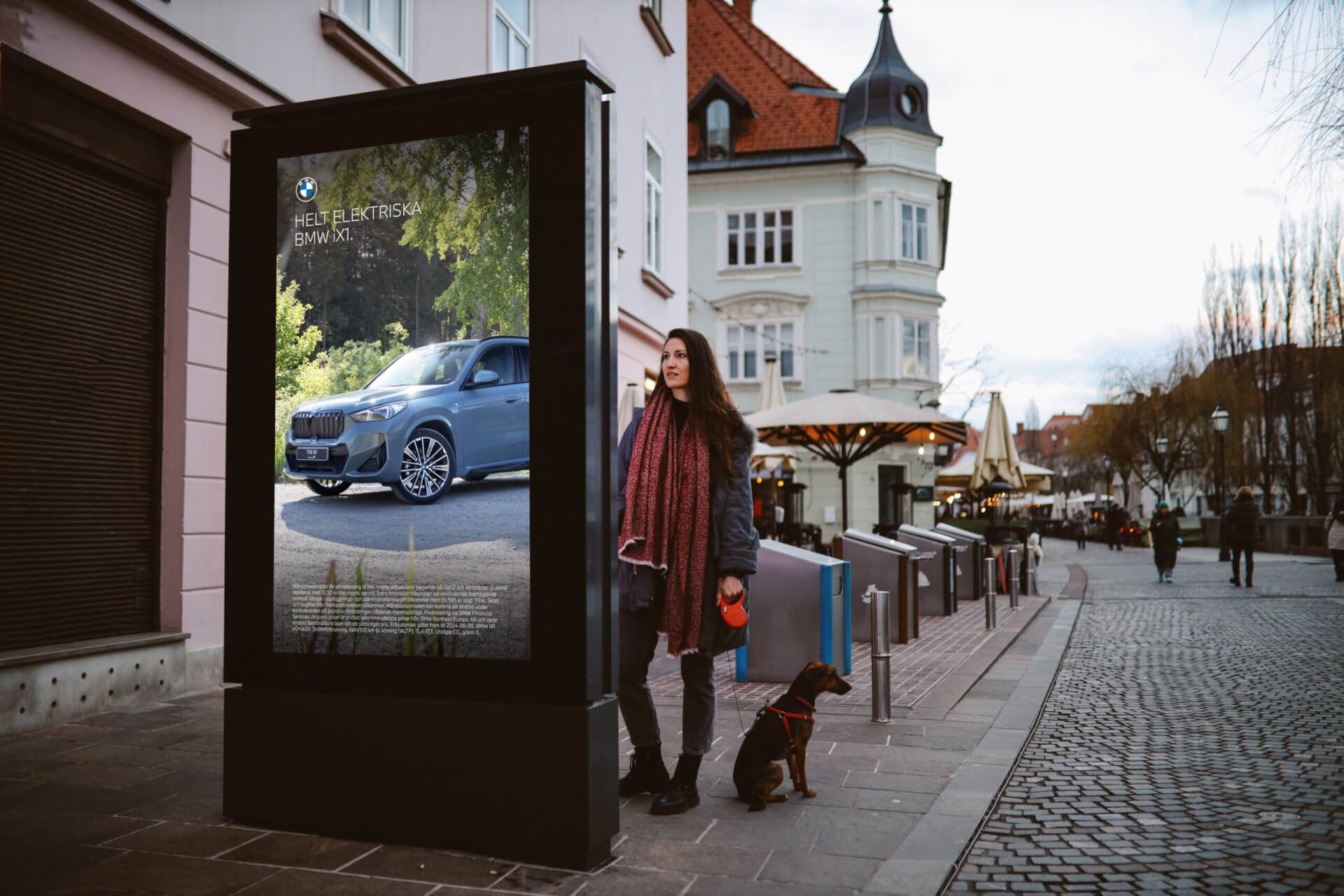
German-based automotive brand BMW, known for its luxury vehicles and commitment to innovation, launched its first programmatic digital out-of-home (pDOOH) campaign in Sweden. The initiative was a strategic move to elevate the brand’s presence in this priority market and drive measurable results for its plug-in hybrid BMW 330e Touring.

Objective

The campaign aimed to boost awareness of BMW’s limited-time leasing offer while driving foot traffic to 29 dealerships across Sweden. To measure the campaign’s effectiveness on KPIs like ad recall, brand preference, attribution, brand image and action, a comprehensive brand lift study was conducted in collaboration with Broadsign and Happydemics. Additionally, a foot traffic attribution study, executed in partnership with Broadsign and Spotzi, provided insights into the uplift in showroom visits directly attributable to the campaign.

Strategy 

Screens were strategically activated in high-traffic malls, subways, and urban panels near BMW dealerships, maximizing visibility among professionals likely to visit the showrooms. Orchestrated by Mediaplus, the campaign seamlessly integrated DOOH ads via Broadsign’s SSP and Vistar Media DSP, unlocking access to premium Clear Channel Sweden inventory. Mediaplus’ expertise in planning and execution, combined with Broadsign and Vistar Media’s advanced technology for targeting and optimization, ensured the campaign delivered maximum reach and meaningful engagement across key locations. 

Results 

To assess the campaign’s impact on brand metrics, a brand lift study was conducted in partnership with Broadsign and Happydemics, focusing on key brand metrics. Audiences within a viewable area near campaign screens were surveyed, with uplift measured by comparing responses from non-ad-recallers (control group) and ad-recallers (exposed group). 

Boost in brand preference

The campaign significantly boosted brand preference, delivering a 156% uplift when comparing ad recallers to non-recallers. Overall, 41% of those who recalled the ads indicated a preference for BMW over its key competitors, highlighting the campaign’s effectiveness in swaying consumer opinion.

Powerful ad recall 

The strategic placement of ads in malls, subways and urban panels resulted in repeated exposure, leaving a lasting impression on the target audience. The campaign achieved 6.9M impressions and 4.5M ad plays, with 53% of ad recallers reporting that they saw the ad multiple times, reinforcing the message and enhancing brand recognition.

Significant Brand Attribution

BMW’s strong visual identity played a crucial role in the campaign’s success, with 61% of ad recallers correctly attributing the ad to the brand. The campaign’s impact was further underscored by an 11% uplift in attribution, demonstrating the ads’ ability to capture and retain consumer attention. These attribution results ranked in the top 15% worldwide for Automotive DOOH campaigns measured by Happydemics. 

Big Impact on positive brand image 

The campaign successfully shifted ambivalent perceptions, with a notable decrease of 28% among neutral consumers. 48% of ad recallers now hold a positive or very positive impression of the brand — a 188% uplift. According to Happydemics, the campaign ranked in the top 10% for brand image uplift among DOOH campaigns in the Automotive category. 

Inspired consumer action 

Beyond raising brand awareness, 55% of ad-recallers intended to take action on what they saw, representing a 450% uplift. Specifically, 17% of ad recallers expressed intent to purchase BMW products, while 15% planned to look up reviews, showcasing the campaign’s effectiveness in driving both interest and intent.

DOOH drove customers to dealerships

A foot traffic study was conducted in collaboration with Broadsign and Spotzi to measure the impact of the campaign on dealership visitation. An exposure radius was applied to collect a sample of mobile devices exposed to the DOOH ads that subsequently appeared in a BMW dealership location.

The campaign led to a 68% increase in visits to BMW dealerships among exposed consumers, with about half of the visits occurring the day after exposure and the remainder within 10 days. 

Nearly every dealership measured saw a rise in foot traffic, demonstrating the campaign’s powerful influence on consumer behaviour. While larger, high-traffic dealerships experienced the most significant gains, several mid- and lower-volume locations rose to the top. Moreover, DOOH assets closest to dealerships had the strongest impact. The campaign’s success was evident across the dealership network, highlighting programmatic DOOH’s ability to deliver consistent results in multiple regions. 
Want the campaign highlights? Check out the infographic below.


Product News | October 11, 2021

Meet Manuel Ameneiros, Broadsign’s Head of Media Sales and Service, LATAM

Out-of-home advertising across Latin America is gaining strong momentum, driven by expanding digital infrastructure, ongoing innovation, and growing demand from brands seeking high-impact audience reach. As the market evolves, there is a clear opportunity to bring greater efficiency, scale, and flexibility to how OOH is planned and transacted across the region.

To support this next phase of growth, Broadsign has appointed Manuel Ameneiros as Head of Media Sales & Service for LATAM. Based in Mexico City, he will focus on driving sustainable growth across the region while building a strong, scalable commercial foundation. This includes managing strategic relationships with agencies, advertisers, and media owners, and advancing market education as programmatic DOOH adoption continues to evolve.

Manuel brings over a decade of experience across the advertising ecosystem, spanning brand, agency, and adtech roles throughout LATAM. Most recently, he served as Chief Commercial Officer at OLA Media, where he focused on scaling revenue and driving market expansion. Earlier, he held roles across brands, agencies, and adtech companies, including Retargetly and Boletia, building expertise in data-driven marketing, programmatic adoption, and go-to-market strategy.

We caught up with Manuel to learn more about his background, what drew him to Broadsign, and his perspective on the opportunities ahead in LATAM.

Welcome to Broadsign. What drew you to the team, and what excites you most about your new role leading Media Sales & Service for LATAM?

I’ve always been drawn to the intersection of media, technology and data, and that’s exactly what makes this opportunity so compelling for me. Broadsign has built a strong reputation as one of the companies helping modernize OOH by giving media owners and advertisers the tools to plan, transact and scale more intelligently. What excited me most about joining the team is the chance to help accelerate that momentum across Latin America, a region where markets are evolving quickly and where there is real appreciation for innovation.

How would you describe the current state of the OOH market in Latin America, and where do you see the biggest growth opportunities?

The OOH market in Latin America is in a dynamic phase. It continues to benefit from strong reach and visibility, particularly in urban areas, but it’s also evolving quickly as digital infrastructure expands and advertisers demand more accountability and flexibility around their campaigns.

Having worked both in adtech and more recently in the OOH space, I’ve seen firsthand how the conversation is shifting from static inventory and broad reach to more data-driven planning, audience segmentation, and integration with digital channels.

The biggest opportunity lies in accelerating that transition. There is still a gap between DOOH’s potential and how it’s currently bought and sold in many markets. Bridging that gap through better data use, automation, and programmatic transactions is where much of the next wave of growth will come from.

Programmatic DOOH is gaining momentum globally. How is this evolving in Latin America, and what’s needed to accelerate adoption across the region?

Programmatic DOOH in Latin America is moving from early adoption into a growth stage. Buyers are looking for more flexibility, more precise activation, and easier connections between OOH and broader omnichannel campaigns. Media owners, in turn, are recognizing that programmatic can help open inventory to new demand sources, improve fill rate, and make digital assets easier to transact.

To accelerate adoption further, the region needs continued progress in a few areas: more digital inventory, stronger education across buyers and sellers, and better tools for targeting and measurement. 

What role do you see Broadsign playing in the future of OOH across LATAM, and what are you most excited to build or accomplish in the region over the next few years?

I see Broadsign as a key enabler of the next phase of growth for OOH in Latin America. The company is uniquely positioned because it operates across the entire ecosystem: a CMS, SSP and DSP, which allows it to support both media owners and buyers in a very holistic way.

For media owners, Broadsign can help modernize operations, increase efficiency, and open up new revenue streams. For advertisers and agencies, it simplifies access to OOH and makes it easier to integrate into omnichannel strategies.

What excites me most is the opportunity to help build a more connected, scalable, and performance-driven OOH ecosystem across LATAM. In practical terms, that means expanding programmatic adoption, strengthening relationships with key agencies and advertisers, and helping media owners unlock more value from their inventory. It’s also about making DOOH a more consistent part of media strategies rather than a complementary channel.

From a market perspective, Brazil and Mexico are critical due to their scale and level of sophistication, but I also see strong potential in Colombia, Chile and Argentina, as well as in emerging segments like mobility and retail media, which I’ve been closely involved with in recent years.

Product News | October 11, 2021

Broadsign partners with JB Hi-Fi to accelerate Retail Media Network

Retailer launches scalable in-store digital signage network to enhance customer experience and increase brand amplification opportunities

SYDNEY, April 22, 2026 –Broadsign announced that leading Australian consumer electronics retailer JB Hi-Fi is deploying the Broadsign Platform to build and scale its in-store retail media network (RMN), which spans over 200 stores across Australia. The technology will streamline operations, enabling JB Hi-Fi to seamlessly plan, execute, optimise, and measure in-store media and ad campaigns across locations from one central hub.  

With the Broadsign Platform providing real-time availability, intuitive ad serving, and robust campaign reporting out-of-the-box, JB Hi-Fi will be able to unlock impactful in-store opportunities and deliver measurable results across its network. An open API also allows JB Hi-Fi to integrate with its preferred retail systems, platforms, and processes, while still maintaining complete ownership and control over its network. 

“We’re seeing strong interest in retail media from advertisers and brands who want to reach local audiences where purchase intent is high. We already had the screens to deliver in-store, and now with Broadsign, we have access to the same advertising toolset that major media owners use, and the ability to scale,” explained Gary Siewert, Director of Marketing and e-commerce, JB Hi-Fi. “Broadsign’s open API has also proved more valuable, allowing us to select the partners we want to work with as we build our omnichannel RMN, such as Retail Media Works and Criteo.”  

“As Australia’s leading consumer electronics retailer, JB Hi-Fi is home to some of the world’s biggest brands. By partnering with best-in-class solutions such as Broadsign, JB Hi-Fi are not only maximising the potential of their retail media network, they’re setting the strongest possible foundation for themselves in an increasingly competitive space,” said Ben Allman, Regional VP of Platform Sales at Broadsign. 

For more information about Broadsign’s in-store media network offering, visit: https://broadsign.com/retail-digital-signage/

About Broadsign

Broadsign is the leading out-of-home (OOH) advertising technology platform, transforming how retailers, OOH media owners, and ad buyers reach and connect with audiences. More than 2.8 million static and digital signs along roadways and in shopping malls, grocery and convenience stores, airports, transit systems, and other OOH venues run on Broadsign. The Broadsign platform helps customers seamlessly plan, deliver, and optimize dynamic, data-driven in-store and OOH campaigns. 

Through Broadsign’s programmatic SSP, Place Exchange, and integrations with 50+ omnichannel and OOH DSPs, the company offers advertisers and media buying agencies the largest footprint of global OOH inventory, enabling them to intuitively execute guaranteed and non-guaranteed OOH campaigns across a variety of OOH formats. Interoperability with retail POS systems, loyalty programs, and omnichannel media platforms allows retailers to create engaging, measurable in-store experiences that tie into on- and off-site campaign strategies. https://broadsign.com/retail-digital-signage/

Product News | October 11, 2021

Why in-store retail media can’t scale without automation

Retail media is maturing quickly, with retailers building more sophisticated networks across onsite and offsite channels. In-store, one of the most valuable environments at the point of purchase, is now gaining momentum as the next area of focus.

While investment is increasing and screen networks continue to scale, in-store is still evolving from infrastructure into a fully realized media channel and hasn’t yet reached the same level of automation, measurement, and integration as other digital channels.

That gap is where automation comes in.

Automation has already reshaped how retail media campaigns are planned, bought, and optimized across digital environments. Bringing those same capabilities into in-store is the next step toward making it a seamless part of the media mix.

With the right foundations, automation can connect in-store with the broader ecosystem, enabling more efficient activation, stronger alignment in how in-store performance is measured, and a more unified retail media strategy.

The barriers to scaling in-store media

Retailers often believe they’re operating with automation, but in practice, it remains fragmented across channels and teams. While certain workflows like scheduling or couponing may be automated, they rarely connect to a unified system. At the same time, trade, shopper, and media teams continue to operate independently, each with its own objectives, budgets, and processes.

This fragmentation shows up in how campaigns are executed. Many in-store activations still rely on manual planning and static placements, with limited visibility into inventory and performance. In many cases, looped, time-based content remains the standard, restricting the ability to deliver more dynamic, contextually relevant messaging.

At the same time, expectations have shifted. Media buyers now expect real-time access to inventory, faster activation, and unified reporting across channels. As trade and media budgets begin to converge, so does the need for greater accountability and measurable outcomes. Without automation, in-store media can’t keep pace. Campaigns can’t be planned or optimized against outcomes like sales, reach, or incrementality, and the channel remains disconnected from broader retail media strategies.

The realities are becoming clear: manual operations can’t scale in a data-driven, outcome-based environment, breaking down silos requires connected systems rather than added processes, and meeting modern expectations for speed, flexibility, and measurement depends on automation.

What automation really means for in-store media

At its core, automation operates across three connected layers that shift in-store media from a manual channel to one that scales and delivers against defined outcomes.

  • Operational automation: Removes manual workflows from planning, booking, and scheduling. Instead of relying on time-intensive coordination and service layers, campaigns can be activated more efficiently and run at scale across networks.
  • Data and decisioning automation: By bringing in first-party signals like loyalty, transaction, and foot traffic data, campaigns can be informed by real performance inputs rather than assumptions. This also enables more dynamic delivery, where messaging can adapt based on factors like time of day, store inventory or shopper behaviour.
  • Commercial automation: Aligns in-store with broader media expectations. This includes centralized planning, unified reporting, and more consistent buying experiences across channels, making in-store easier to integrate into omnichannel strategies.

Today, many in-store networks remain entirely static, while others rely on manual playlist management and fixed placements, limiting both flexibility and performance. Automation changes that by enabling campaigns to be planned and optimized against outcomes like sales uplift, audience reach, or product-level goals.

Instead of deciding what plays on a screen and when, retailers can define what they want to achieve and allow automated systems to dynamically allocate inventory and optimize delivery based on real-time data.

Building a more connected retail media strategy

For retailers, the shift to automation doesn’t happen all at once. It starts with connecting existing capabilities to enable more streamlined execution and outcome-driven planning. Many already have strong foundations across in-store screens, data, and media operations, but these systems often operate independently. Prioritizing integration through APIs and shared workflows helps bring in-store into the broader retail media ecosystem without requiring a full rebuild.

From there, focus on making in-store inventory accessible within existing media-buying workflows, so campaigns can be planned alongside on- and off-site channels rather than treated separately. Additionally, data should be applied more intentionally. Using first-party signals like loyalty, transaction, and store traffic data enables more accurate targeting, optimization, and measurement, moving beyond proxy metrics.

Execution also needs to evolve. Shifting from manual placements to goal-based delivery allows campaigns to be optimized against outcomes like sales, reach, or product-level performance, rather than fixed schedules. Technology partners can support this shift by enabling automation, measurement, and optimization, while providing the visibility needed for performance tracking and attribution.

Finally, internal alignment is key. As trade and media budgets converge, aligning teams around shared outcomes ensures in-store media is planned and executed as part of a cohesive strategy.

In-store is no longer a future opportunity; it’s an immediate one. As retail media continues to evolve, automation will be key to turning in-store into a scalable, measurable, and fully integrated channel. Retailers that invest in connecting systems, data, and teams now will be best positioned to unlock their full value.

Ready to unlock the full value of your in-store media? Discover how Broadsign helps retailers automate execution, connect data, and drive measurable performance.