Product News | October 11, 2021

Discover Broadsign’s Header Bidder, the smarter way to work with multiple programmatic partners

There’s been an industry-wide shift and pDOOH adoption is on the rise. This is in large part due to how the format facilitates and automates the buying and selling of programmatic ads. We’re seeing more media owners embracing pDOOH transacting and incorporating programmatic platforms like Broadsign’s programmatic SSP (and other SSPs) into their revenue mix, a move that usually equals greater profits.

The catch? Usually, to work with multiple supply-side platforms (SSPs), media owners must split their ad slots between different SSPs. But this can be an inefficient way to go about things, and sometimes different SSPs don’t always work well together. Besides, media owners shouldn’t have to run their programmatic business across three different SSPs or block inventory from guaranteed buys. To minimize complications, Broadsign is introducing a smarter way for media owners to work with multiple programmatic partners.

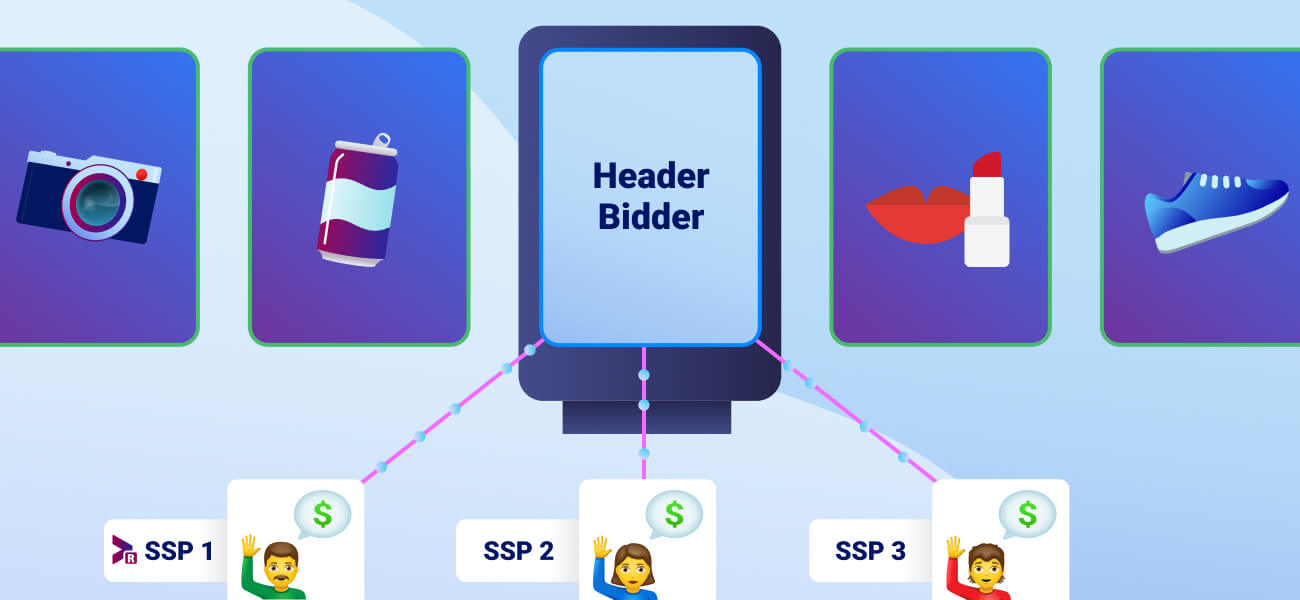
The Broadsign Header Bidder acts as an ad exchange between multiple SSPs and a single host SSP. So rather than sticking to the current (and clunky) process, which sees media owners reserving a dedicated slot for each SSP partner, Broadsign Header Bidder offers a one-to-many programmatic solution. It’s all backed by our fair play auction, so the highest bid wins.

Check out the video below to see how it works:

Why this solution? 

With programmatic growth on the rise, increased efficiency and optimization yield management is only going to help fuel the pDOOH wave taking over the industry. As the saying goes, it takes a village and in order to stimulate programmatic growth — our ultimate goal — industry-wide collaboration needs to happen. 

That’s where Broadsign’s Header Bidder comes in. This solution is especially beneficial because we’re seeing more media owners work with multiple SSPs —but to do so, they are required to reserve a separate HTML wrapper or container in an ad loop for reach, thus reducing the overall yield on their inventory. The Header Bidder combines pDOOH demand from multiple SSPs into one slot and chooses the winning bid to play based on Broadsign’s fair play auction logic. Furthermore, it’s natively integrated with Broadsign’s CMS creating a smoother ad viewing experience for audiences. Broadsign media owners can enjoy features like gapless playback, screen synchronization, preemptible campaigns, and pre-caching for faster ad loading and optimization. 

Who benefits? 

Media owners running Broadsign’s programmatic SSP who are looking to consolidate their programmatic demand will undoubtedly benefit from this solution. Not only does it help streamline the process, but it also removes the need to work with multiple HTML5 wrappers. It frees up more ad space to create more guaranteed ad opportunities. It’s yet another way we’ve got media owners’ best interests in mind.

All sounds pretty great, right? Contact us today to schedule a demo and see how Broadsign can help open your inventory available to new buyers across the globe. 

Product News | October 11, 2021

Digital transformation in out-of-home with Broadsign’s Burr Smith

The out-of-home industry is in the middle of a major transformation. As automation, programmatic buying, audience data, and more reshape how campaigns are planned and transacted, the industry is moving toward a more connected and scalable future.

Few people have had a front-row seat to that evolution quite like Burr Smith, Chairman, President, and CEO of Broadsign. Under his leadership, Broadsign has evolved from a digital signage CMS provider into one of the industry’s leading global OOH advertising platforms, helping unify the buy and sell sides of the market through automation, programmatic technology, and strategic acquisitions.

That impact was recently recognized by the Out of Home Advertising Association of America (OAAA), which honoured Burr with its inaugural Digital Transformation Award at the 2026 OAAA Honors Circle Awards. The award celebrates leaders driving the modernization of OOH through innovation, automation, and technological advancement.

We sat down with Burr to discuss how OOH has evolved, why unification matters, and what needs to happen next to keep the industry growing.

You’ve been focused on modernizing out-of-home for years. What did digital transformation in OOH look like when you first started, and how has that vision evolved over time?

When I became CEO, Broadsign was primarily a content management system (CMS) company. At the time, there was an internal discussion about whether we should remain focused solely on CMS technology, but it became clear to me that it wasn’t a sustainable long-term strategy. So we decided to evolve beyond content management and move closer to where the advertising dollars were actually originating: the demand side. 

That meant building products across the ecosystem to better connect buyers, sellers, and media owners and, ultimately, reduce friction across the industry. That shift marked the beginning of Broadsign’s broader transformation and shaped the vision we continue to build toward today.

You’ve led Broadsign through multiple waves of transformation. How do you prioritize where to invest as the industry continues to evolve?

We invest in two ways: through products and through acquisitions. When we see an opportunity to acquire and integrate a company that can accelerate progress faster than building organically, we’ll often take that approach. It allows us to move more quickly and bring capabilities to market sooner. 

Traditionally, we’ve focused our investments on technologies and capabilities that help connect different parts of the ecosystem more effectively over time. Sometimes, the fastest way to move the industry forward isn’t always the most obvious or direct one. It can mean building complementary products or investing in areas that help create a more connected and scalable market overall. Ultimately, the goal has always been the same: reducing friction across the industry and making it easier for advertising dollars to flow into out-of-home.

Where do you see the biggest disconnect between how OOH is perceived and what the medium is actually capable of?

I’d say the biggest challenge is that OOH still hasn’t reached the point where it’s as easy to buy as some other advertising channels. The industry has evolved quickly, and many companies are bringing new ideas and technologies to market, creating a wide range of workflows and solutions across the ecosystem.

Over the years, Broadsign has focused on building technology that helps create more seamless connections between the demand side and supply side. Publishers, agencies, and technology partners will always have their own approaches, and innovation is important, but the industry also needs more standardized and connected transaction paths that can scale efficiently.

The industry talks a lot about collaboration and growth. What does real collaboration actually look like across OOH?

OOH represents roughly 5% of the overall advertising market, and the focus is on how to continue growing that share. But the way to grow the industry isn’t by competing for incremental share within the existing programmatic market. Rather than competing for share within OOH or pDOOH, the bigger opportunity is growing the broader OOH market across both digital and static.

As the industry becomes more connected and standardized, OOH increasingly operates like other major media channels, making it easier for larger advertising investments to flow into the space. That’s one of the reasons we acquired Place Exchange. We’re committed to long-term industry growth, and over time, industries naturally consolidate as it becomes less practical for multiple companies to keep building the same technologies in parallel.

The acquisition strengthened our ability to help unify the ecosystem and create a more connected path between the demand side and supply side of the industry. We’re already seeing stronger momentum toward that kind of unification through greater consolidation and integration across the ecosystem, which is naturally attracting more investment and attention from the broader advertising industry.

What does the next phase of digital transformation in OOH look like over the next few years, and how do you hope it ultimately shapes the future of the industry?

The next phase of digital transformation really comes back to unification. A lot of people focus on growing the industry incrementally, but the most important thing is building a more connected market. That’s been a major focus for Broadsign for a long time, and it’s why we continue investing across different parts of the ecosystem, including static.

AI will also play an important role, particularly in improving operational efficiency. It can help streamline workflows, campaign planning, and many day-to-day processes. But at this stage, there’s a significant role for technology providers to support the end-to-end transaction infrastructure and the broader flow of ad dollars. Beyond that, any technology, trend, or opportunity that broadens the market ultimately accelerates industry growth. That’s part of the reason we’re also interested in areas like retail media and audience analytics.

Audience measurement will be especially important moving forward. OOH already has unique strengths as a medium because it exists so close to the point of purchase, but the industry still needs stronger audience analytics and measurement capabilities to fully demonstrate that value to advertisers. 

You’ve emphasized culture as a core part of transformation. What role has it played in enabling meaningful change across the business?

Culture has been a huge part of Broadsign’s success. A lot of that comes back to our values and the fact that people genuinely believe in them. We try to make decisions based on doing the right thing for the business, our customers, and the industry overall. There’s very little internal politics because the focus has always been on building something better together.

That mindset becomes especially important during acquisitions and periods of transformation. When new teams come in, we don’t approach it from a place of protecting turf. If another company is doing something better, we want to learn from it and embrace it. That’s one of the reasons the Place Exchange acquisition worked so well. The two companies had very complementary strengths with very little overlap, so it wasn’t about duplicating efforts; it was about bringing together capabilities that made the combined business stronger.

What does the Digital Transformation recognition mean to you personally, and what impact are you most proud of?

I’m proud of what Broadsign has become and the role it’s played in moving the industry forward. Over the years, we’ve continued investing in products and acquisitions we believed would improve the industry, even when it sometimes took time for the market to fully adopt them.

We may not always move as quickly as some other industries, but we’ve always had a relentless focus on getting better and helping push the industry forward along the way. I think Broadsign has earned its position in the industry because our motivations have always been rooted in building something meaningful and creating long-term value for the ecosystem. I’m grateful to the OAAA for the honour because it reflects the collective effort behind everything we’ve built. We’re committed to this industry for the long term, and we’ll keep working to help it evolve, grow, and improve.

Product News | October 11, 2021

The next chapter of OOH: Insights from Broadsign’s Burr Smith and Ari Buchalter

At this year’s Independent Billboard Operators (IBO) panel discussion, one theme emerged consistently throughout the conversation: the next phase of OOH growth will depend on making the medium easier to buy, sell, and measure for operators of all sizes.

Broadsign CEO Burr Smith and Chief Strategy Officer Ari Buchalter shared their perspectives on the forces reshaping OOH advertising, from automation and programmatic transactions to audience-driven buying and measurement, while also discussing what those shifts mean for independent operators navigating an increasingly digital and data-driven landscape.

Out-of-home is entering its next evolution

The global advertising market is now roughly $1 trillion, with OOH accounting for approximately $50 billion worldwide and programmatic transactions representing a fast-growing portion of that spend. Throughout the panel, Ari emphasized that the industry may be approaching a tipping point, as improvements in automation, measurement, and accessibility continue attracting greater interest from major omnichannel buying platforms and advertisers.

That opportunity is driven by many of the qualities that have long made OOH valuable: strong real-world audience connection, proximity to the point of purchase, high visibility, and immunity from the bot fraud that plagues many digital channels. At the same time, advances in data, automation, and audience-based measurement are making the medium more flexible, measurable, and accessible to advertisers.

As campaigns become more dynamic, data-driven, and omnichannel, many OOH transactions still rely on fragmented planning, buying, and operational workflows that create friction across the campaign lifecycle. Simplifying those processes is becoming increasingly important as advertisers expect the same speed, flexibility, and interoperability they experience across other digital channels. For independent operators, that evolution could help reduce operational complexity and make it easier to participate in audience-based and programmatic buying environments.

Programmatic DOOH is accelerating that shift. While still early in its maturity compared to broader digital advertising, adoption continues to grow as more transactions move through DSPs and programmatic platforms. As a result, OOH has an opportunity to capture a larger share of media budgets while giving independent billboard operators greater visibility within national and regional media buys alongside larger networks.

“Our objective at Broadsign is to try and unify, automate, and simplify that entire $50 billion slice of the market, because if we make OOH as simple to buy as other media channels, with the same efficiency, transparency, and visibility into audiences, we should be able to grow that $50 billion market to capture more share,” says Burr. “There are certain aspects of OOH that are much better: it’s closer to purchase, there’s less fraud, and there are inherent strengths in the medium if we do what we need to do.”

Building a more connected ecosystem with Broadsign and Place Exchange

A recurring theme throughout the IBO panel was that OOH’s continued growth will depend on stronger collaboration across the ecosystem. As advertisers increasingly expect unified workflows, audience-based buying, and easier access to inventory, operators, platforms, and buyers all play a role in modernizing OOH transactions.

That broader industry shift is reflected in the combination of Broadsign and Place Exchange. While Broadsign has long focused on the infrastructure and operational side of OOH, including content management, ad serving, and campaign management tools, Place Exchange brings expertise in programmatic transactions, SSP capabilities, and established buy-side relationships, particularly in the US market. Together, the companies support a more connected workflow spanning inventory management, campaign delivery, programmatic monetization, and audience-based activation.

For independent operators, that broader ecosystem creates new opportunities to participate in programmatic DOOH and access regional and national demand flowing through programmatic platforms. While larger operators may integrate directly with SSPs and buying platforms, smaller media owners can work through aggregators such as Screenverse, Vengo, Adkom, and Billboard Planet, to collectively expand their reach and make inventory more accessible to buyers.

The discussion also reinforced that independent operators remain a critical part of OOH’s broader ecosystem. Their local market expertise, unique inventory, and community presence continue to offer meaningful value to advertisers seeking more contextual and geographically diverse ways to reach audiences.

“I got into out-of-home because I was excited not just by the power of the channel as an advertising medium, but by its growth potential and its ability to leverage data and technologies like programmatic to grow beyond the relatively small share of advertising spend it represents today, roughly 5% globally and only 2% in the US,” says Ari. “That remains our North Star. We’re focused on OOH at a time when many competitors are shifting toward areas like CTV and search. That focus on OOH defines who we are.”

Product News | October 11, 2021

Broadsign’s Sell-Side AI Agent Joins With Global Netherlands and Draft Digital to Deliver First-Ever End-to-End Agentic AI-Powered OOH Campaign

Collaboration paves the way to faster, more automated, and data-driven OOH buys

MONTREAL (May 27, 2026) –  Broadsign, the leading global platform for managing and monetizing out-of-home (OOH) media, today announced that its sell-side AI agent and digital marketing agency Draft Digital’s buy-side agent, planned, booked, and executed the first-ever fully agentic AI OOH ad campaign. The agentic AI solutions enabled the end-to-end media buy for Lot of Happiness on premium OOH inventory in collaboration with media owner Global Netherlands

Agentic AI powered the buy from beginning to end, using the brand’s campaign goals to inform audience and venue targeting, media selection, campaign setup, creative workflow and approvals, and execution. The AI agentic solutions used the AdCP protocol and Broadsign’s industry-leading OOH sell-side technology and data infrastructure. Moving beyond chatbots layered over existing tools, the collaboration proved the power of agentic AI in enhancing the effectiveness and efficiency of OOH campaigns from start to finish. Together, the buy and sell-side agents rapidly coordinated complex tasks across parties, with human oversight and guardrails.

With the largest global OOH media supply – including the largest aggregation of video-enabled displays, in-store media, and on-screen cinema inventory – Broadsign’s goal with this campaign is to unlock the power of agentic trading for OOH. The company is committed to bringing greater scale, data, and efficiency to buyers and opening up more demand for sellers. 

“Agentic AI allows us to double down on our value proposition of leveraging technology to support media owners in achieving their business goals,” explained Bryan Mongeau, CTO, Broadsign. “Overlaying AI atop our global static and digital OOH supply, in concert with advanced data and execution capabilities, such as screen-level audience indexes, dynamic creative, guaranteed in-advance buying, and more, sets the stage for a paradigm shift that will transform the OOH business. This innovative collaboration is only the beginning.”

“A number of us at Draft Digital were early adopters of programmatic DOOH years ago, so being first to move on this next leap, fully agentic OOH, is genuinely exciting. Agentic advertising lets us build true multichannel experiences for our clients, backed by first-party performance data and a much cleaner ecosystem,” shared Aliks Röling, Digital Marketing Consultant, Draft Digital. “It pushes us into tighter collaboration with quality publishers and partners and ultimately delivers sharper strategic impact for brands like Lot of Happiness.”

As a growing charity lottery with around 100,000 participants and over €50 million donated to good causes, Lot of Happiness is always looking for smarter ways to expand its reach. Without the media budgets of larger lottery players, the organization relies on creativity and innovation to fuel its growth. “As a growing organization, we have to be creative and find efficiencies that larger players simply take for granted. Agentic DOOH is one of those opportunities where we want to be at the forefront, and we’re excited to see where it takes us.” Leo Nijs, Online Marketer, Lot of Happiness

“In today’s competitive media landscape, digital out-of-home must be as easy to discover, plan, buy, and measure as any other channel, and this collaboration proves it’s possible,” said Mink Zwolsman, Business Development Director, Global Netherlands. “What excites us most is that no single party could have done this alone. By combining Broadsign’s infrastructure with buy-side intelligence, Draft Digital’s ambition and our diverse digital out-of-home offering, we’ve shown that outdoor can be planned, bought, and activated with the same speed and data-driven precision as any digital channel. For Global Netherlands, this is a meaningful step toward making our inventory more accessible to buyers who want seamless, omnichannel campaigns and we’ve only just begun to uncover the advantages.”

Marketers and media owners looking to learn more about Broadsign’s sell-side agentic solution can get in touch with the company

About Broadsign

Broadsign develops the leading global platform for managing and monetizing out-of-home (OOH) media. The company, which also operates Place Exchange by Broadsign, the largest independent SSP for Digital OOH, empowers media owners, media buyers, and retailers to harness the power and reach of out-of-home to connect with audiences in ways unlike any other advertising channel. More than 2.8 million static and digital signs along roadways and in airports, shopping malls, grocery and convenience stores, health clinics, transit systems, and more run on Broadsign. https://broadsign.com

About Draft Digital

At Draft Digital, we are setting the new standard in marketing and media. We believe that standing still is falling behind; an organization that isn’t growing is already losing. Built on a foundation of relevance and trust, we guide clients through a digital journey that never ends. We are leading the transition to Agentic Advertising, where intelligent Agents handle the operational burden of media buying. This shifts our focus from execution to pure strategy and innovation. By merging classic marketing theory with AI, we deliver scalable creativity and perfected measurement. We are not just service providers; we are the architects of digital growth.

About Global Netherlands

Global is a media operator and market leader in the (Digital) Out-of-Home sector, offering advertisers the opportunity to advertise in high streets, supermarkets, shopping centres, at railway stations, petrol stations and along motorways. With a nationwide digital network, Global meets advertisers’ needs to reach their target audience at precise times and locations. Thanks to these exclusive concessions across these diverse networks, advertisers can reach the masses or, conversely, target specific audiences very precisely in a wide variety of locations.

About Lot of Happiness

We believe in a better world for everyone. Charities, both big and small, drive this mission, they all deserve our support. By playing in our lottery, we together contribute to their missions. Playing = impact. You choose which charity receives half of your contribution. We are flexible: you decide how often you play and with what amount. This makes Lot of Happiness the lottery where your voice counts and your impact is big. And you can win fantastic prizes, from €1 million in the bank to a brand-new electric cargo bike. A true win-win. 

Product News | October 11, 2021

How Osmow’s achieved a 33.9% lift in restaurant visits with programmatic DOOH

To support its next phase of national growth, Osmow’s, a leader in the Canadian quick-service restaurant (QSR) space, launched a high-impact programmatic digital out-of-home (pDOOH) campaign to reach its target audience at scale. Specializing in modern Middle Eastern and Mediterranean cuisine, the brand sought to strengthen its position as a category leader and drive measurable foot traffic to restaurant locations across the country.

Objective

The campaign aimed to increase brand awareness and category share for Osmow’s, leveraging three tailored executions to support its diverse product offering. A core objective was to drive in-restaurant visits across urban, suburban, and rural markets, while positioning the brand as a value leader during the competitive post-holiday period.

Strategy

Osmow’s partnered with Involved Media and Broadsign to launch a data-driven programmatic digital out-of-home (pDOOH) campaign, activating premium inventory across 4,912 screens. The campaign leveraged a diverse mix of placements, including large-format billboards, transit shelters, and campus screens, to deliver broad reach and sustained frequency.

Using the OutMoove DSP, the campaign employed programmatic triggers to engage consumers at high-intent moments throughout their daily routines. To maximize relevance and efficiency, ads were programmatically dayparted to peak during lunch (11 am–2 pm) and dinner (5 pm–7 pm) consideration windows. By utilizing proximity targeting near restaurant locations across Canada, the campaign ensured that tailored messaging reached audiences at the moment of choice.

Results

  • Foot Traffic Lift: Achieved a 33.9% lift in visits across 30 restaurant locations compared to the non-exposed control group
  • Sales Impact: Delivered a 5% contribution to total sales throughout the campaign period

“With over 240 locations, we are always looking for ways Osmow’s can stay top-of-mind while driving traffic to restaurants. Programmatic DOOH gave us the flexibility to do both at once. We were able to maintain a massive presence across the country, but with the additional layer of dayparting and proximity tools needed to reach the right people during the key lunch and dinner windows. It’s been a very effective way to bridge our digital strategy with the physical restaurant locations,” says Effie Ambida, Director Strategy & Planning at Involved Media.

Want the campaign highlights? Check out the infographic below.