Product News | October 11, 2021

What is programmatic DOOH (pDOOH) advertising?
Programmatic digital out-of-home, often shortened to programmatic DOOH or pDOOH, refers to the automated buying, selling, and delivery of out-of-home (OOH) ads via real-time bidding on digital screens. Instead of booking fixed placements, advertisers set the conditions under which media should run, and ads are served automatically when those conditions are met.

Once a niche buying method, pDOOH is now a core part of modern media plans, as automation-enabled OOH planning workflows and faster, data-driven decision-making reshape a medium that has traditionally relied on slower, manual processes. This momentum is reflected in forecasts for leading markets like the U.S., where pDOOH spend is expected to account for 65% of national DOOH spending by 2029, up from just 24% in 2024. 

Read on for a closer look at what programmatic DOOH is, how it works, and why it’s gaining traction with today’s advertisers.

Jump to:

What is programmatic digital out-of-home (pDOOH)?

Programmatic DOOH applies programmatic buying technology to digital screens in public, shared environments such as city streets, transit hubs, and retail locations. While it uses many of the same tools and data sources as other programmatic channels, the key distinction lies in where ads appear and how impressions are defined. 

As a form of out-of-home (OOH) advertising, pDOOH operates in one-to-many physical settings. Each ad exposure may be seen by multiple people viewing the same screen at the same time, rather than a single logged-in user or device. This changes how reach, exposure, and measurement are approached compared to online programmatic media.

In practical terms, this means advertisers plan around real-world moments, environments, and aggregated audience signals, shifting decision-making from fixed placements (as in traditional OOH) or individual-level identifiers (like in online advertising) to data-driven eligibility across shared physical spaces.

Programmatic DOOH (pDOOH) vs traditional DOOH: Understanding the difference

At a high level, programmatic DOOH doesn’t change the channel or environments where ads appear — it’s still digital out-of-home (DOOH) media. That means the strengths that make DOOH appealing to advertisers, including its high-impact creative formats, unskippable exposure, and proven ability to drive real-world action, also apply to pDOOH.

What it does change is how DOOH campaigns are planned, activated, and adjusted over time. Instead of locking in every decision upfront, programmatic DOOH introduces automation and rules-based buying that can influence which screens run ads, when they run, and under what conditions.

Here’s what actually changes when DOOH becomes programmatic:

Traditional DOOH
  • Direct buying through manual negotiations and insertion orders
  • Fixed schedules planned in advance
  • Manual planning focused on locations and durations
  • Periodic reporting after or between campaign flights
Programmatic DOOH (pDOOH)
  • Automated buying via real-time bidding on programmatic platforms, either through open exchange (oRTB) or private marketplace (PMP) deals
  • Real-time optimization based on availability, conditions, or performance
  • Data-driven activation using signals like time, location, and external data
  • Dynamic delivery potential with creative updates triggered by conditions
  • Automated reporting with faster access to delivery and performance insights

NOTE: While many buyers associate “automation in OOH” with programmatic ad buying — i.e., via real-time bidding — automation has expanded beyond bidding models to include newer transaction paths that complement pDOOH. 

Download Broadsign’s eBook, Automation in OOH Media Planning: Streamlining Transactions at Scale, to learn how Programmatic Guaranteed (PG) and Automated Direct, Broadsign’s term for a fully automated version of the direct-sold process, give buyers additional ways to balance speed, flexibility, and delivery certainty.

Benefits of programmatic DOOH advertising

Now take everything that’s great about DOOH and layer in extra data, better targeting, and easy access. Those are the added benefits you’re looking at with programmatic DOOH.

Programmatic DOOH enables faster planning, activation, and in-flight flexibility

Programmatic flexibility is a key driver of pDOOH adoption, with 75% of agencies citing flexible buying as a major reason for use, according to a 2025 report from IAB Australia. By replacing manual negotiations and insertion orders with software-driven buying, teams can move from planning to launch more quickly and make in-flight adjustments based on campaign delivery and performance insights.

Programmatic DOOH supports more precise, context-driven targeting

Instead of relying on broad-reach, fixed buys, advertisers can use aggregated data signals to target audiences and moments with far greater precision. Contextual and real-time environmental data, like weather, time of day, or nearby events, can also inform creative delivery, helping brands dynamically align messaging with real-world moments for increased relevance without relying on personal identifiers.

READ ALSO: How data is helping to deliver personalized digital out-of-home advertising

Programmatic DOOH improves measurement and reporting

With streamlined access to centralized delivery data and automated reporting, pDOOH provides clearer visibility into campaign performance and enables more strategic decision-making. Using technology like in-screen sensors, device ID passback, and geo-fencing, advertisers can more accurately measure digital OOH ad exposure and strengthen attribution for downstream actions such as store visits or website activity, bringing DOOH closer to the precision of online advertising.

READ ALSO: Out-of-home data capabilities: A marketer’s guide to measurement, attribution, and audience extension

Programmatic DOOH integrates more easily into omnichannel strategies

As more and more DSPs get on board with programmatic DOOH, planning DOOH alongside channels like social media and mobile advertising as part of a multichannel strategy is becoming more straightforward. Advertisers can often adapt existing online or mobile creative for DOOH displays, while cross-channel insights and shared planning logic make it easier to extend reach and retarget audiences across connected digital channels. 

READ ALSO: Using pDOOH for a faster and more targeted way of adding OOH to your omnichannel campaigns

How does programmatic DOOH work?

If your agency or brand uses online advertising, you may already know the basics of programmatic ad buying or have even set up a campaign using a demand-side platform (DSP). But even if the technology is similar, a few features of programmatic DOOH are unique compared to other digital formats.

The same is true from a traditional OOH perspective. While the environments and formats will feel familiar, programmatic DOOH changes how campaigns are planned, activated, and adjusted.

How targeting works

In traditional OOH and directly bought DOOH, targeting is defined upfront through fixed placements, environments, and schedules. Programmatic DOOH separates targeting logic from specific screens, allowing eligibility to be determined by predefined criteria rather than locked-in placement lists.

Targeting in programmatic DOOH is driven by contextual and aggregated signals, including:

  • Time-based criteria (time of day, day of week)
  • Location and environment (screen type, venue category, proximity to POIs)
  • Weather and situational factors (local events, traffic or transit conditions)

On top of this, programmatic DOOH supports a shift toward audience-based targeting. Instead of selecting screens directly, advertisers use aggregated audience signals like movement patterns or first-party data to inform where and when ads are eligible to run based on who is likely present in a given place and moment. These signals guide delivery without identifying or targeting individuals.

The same targeting logic can also support dynamic activation and dynamic creative optimization (DCO), allowing different approved creative variations to run based on audience context and real-world conditions, rather than serving a single static message throughout a campaign.

Platforms and DSPs: How advertisers access programmatic DOOH 

In programmatic DOOH, the DSP is the central interface where buyers define campaign rules, budgets, and eligibility criteria, rather than selecting individual screens. For digital teams, this extends familiar DSP workflows into out-of-home; for OOH teams, it replaces screen-level booking with a single control layer that governs delivery across multiple environments.

DOOH inventory can be accessed either through a purpose-built DSP for out-of-home or via integration with the DSP your team already uses for other digital channels. In both cases, the DSP manages how and when eligible inventory is activated, supporting a range of buying methods from open auctions to more structured, pre-arranged deals.

Real-world examples

Looking for inspiration? Here are two pDOOH advertising examples that show how different agencies and brands have leveraged the medium. Explore our full case study catalogue for more programmatic success stories.

Visit Arizona: Inspiring travel planning with nationwide programmatic DOOH
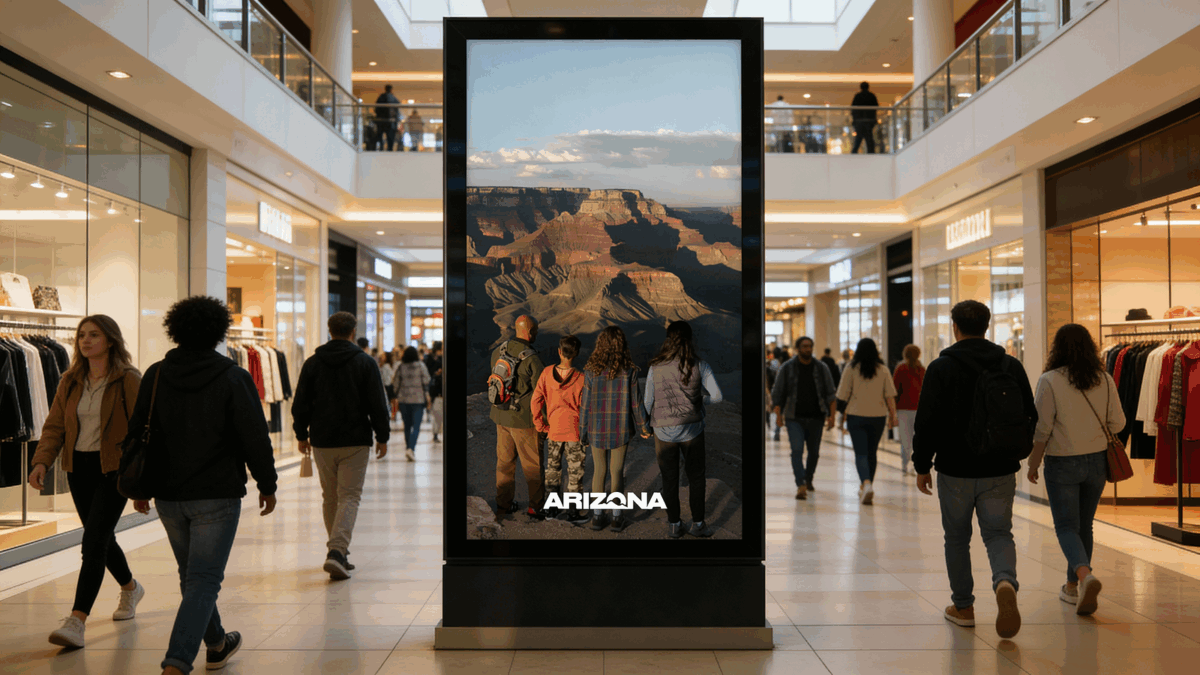
Visit Arizona, the state’s official tourism organization, set out to influence travel consideration and planning among high-intent audiences across the U.S. Using programmatic DOOH, the campaign activated high-traffic screens in key markets and paired on-screen exposure with mobile retargeting to stay connected beyond the initial impression.

By combining DOOH with arrival-based measurement, the campaign linked media exposure to real-world travel behaviour and delivered strong mobile engagement. The result was a 30% lift in arrivals, outperforming national benchmarks for comparable tourism campaigns. Read the full Visit Arizona case study to see how programmatic DOOH supported measurable travel outcomes at scale.

HP: Building brand impact and driving sales with programmatic DOOH in Dubai

HP used programmatic DOOH to support awareness and consideration for its Smart Tank printer range in Dubai, a highly competitive and high-value media market. The campaign focused on reaching family households through frequent exposure on premium digital screens in malls, transit hubs, and other high-traffic, family-oriented environments.

By aligning screen environments with its core audience and measuring impact beyond impressions, the campaign delivered strong brand and business results. Exposure drove a 12% year-over-year sales lift, a 42% increase in purchase consideration for the Smart Tank 585, and a twofold increase in positive brand perception among exposed audiences. Read the full HP case study to see how programmatic DOOH supported both brand and sales outcomes in a key regional market.

See how HP leveraged programmatic DOOH to drive incremental sales in Dubai

FAQs about pDOOH advertising

How does programmatic DOOH differ from traditional OOH or DOOH advertising?

The difference lies in how the media is bought and managed, not where ads appear. Traditional OOH and DOOH campaigns are typically planned and booked upfront using fixed locations and schedules, while programmatic DOOH uses software-based buying to apply targeting rules, budgets, and conditions that determine when and where ads are eligible to run. The screens and environments remain the same — programmatic simply introduces more flexible, data-informed decision-making.

Is programmatic DOOH privacy-safe?

Yes. Programmatic DOOH does not rely on cookies, mobile ad IDs, or individual user tracking. Instead, targeting and delivery are informed by aggregated, privacy-safe signals such as location context, time of day, environmental factors, and anonymized audience insights. Because ads are delivered in shared, one-to-many public environments, programmatic DOOH aligns well with evolving privacy expectations and regulations.
Ready to turn data-driven decisions into real-world impact? Learn more about launching your programmatic DOOH campaign with Broadsign — or browse our inventory catalog to explore a global network of high-impact digital screens. 

Product News | October 11, 2021

Why in-store retail media can’t scale without automation

Retail media is maturing quickly, with retailers building more sophisticated networks across onsite and offsite channels. In-store, one of the most valuable environments at the point of purchase, is now gaining momentum as the next area of focus.

While investment is increasing and screen networks continue to scale, in-store is still evolving from infrastructure into a fully realized media channel and hasn’t yet reached the same level of automation, measurement, and integration as other digital channels.

That gap is where automation comes in.

Automation has already reshaped how retail media campaigns are planned, bought, and optimized across digital environments. Bringing those same capabilities into in-store is the next step toward making it a seamless part of the media mix.

With the right foundations, automation can connect in-store with the broader ecosystem, enabling more efficient activation, stronger alignment in how in-store performance is measured, and a more unified retail media strategy.

The barriers to scaling in-store media

Retailers often believe they’re operating with automation, but in practice, it remains fragmented across channels and teams. While certain workflows like scheduling or couponing may be automated, they rarely connect to a unified system. At the same time, trade, shopper, and media teams continue to operate independently, each with its own objectives, budgets, and processes.

This fragmentation shows up in how campaigns are executed. Many in-store activations still rely on manual planning and static placements, with limited visibility into inventory and performance. In many cases, looped, time-based content remains the standard, restricting the ability to deliver more dynamic, contextually relevant messaging.

At the same time, expectations have shifted. Media buyers now expect real-time access to inventory, faster activation, and unified reporting across channels. As trade and media budgets begin to converge, so does the need for greater accountability and measurable outcomes. Without automation, in-store media can’t keep pace. Campaigns can’t be planned or optimized against outcomes like sales, reach, or incrementality, and the channel remains disconnected from broader retail media strategies.

The realities are becoming clear: manual operations can’t scale in a data-driven, outcome-based environment, breaking down silos requires connected systems rather than added processes, and meeting modern expectations for speed, flexibility, and measurement depends on automation.

What automation really means for in-store media

At its core, automation operates across three connected layers that shift in-store media from a manual channel to one that scales and delivers against defined outcomes.

  • Operational automation: Removes manual workflows from planning, booking, and scheduling. Instead of relying on time-intensive coordination and service layers, campaigns can be activated more efficiently and run at scale across networks.
  • Data and decisioning automation: By bringing in first-party signals like loyalty, transaction, and foot traffic data, campaigns can be informed by real performance inputs rather than assumptions. This also enables more dynamic delivery, where messaging can adapt based on factors like time of day, store inventory or shopper behaviour.
  • Commercial automation: Aligns in-store with broader media expectations. This includes centralized planning, unified reporting, and more consistent buying experiences across channels, making in-store easier to integrate into omnichannel strategies.

Today, many in-store networks remain entirely static, while others rely on manual playlist management and fixed placements, limiting both flexibility and performance. Automation changes that by enabling campaigns to be planned and optimized against outcomes like sales uplift, audience reach, or product-level goals.

Instead of deciding what plays on a screen and when, retailers can define what they want to achieve and allow automated systems to dynamically allocate inventory and optimize delivery based on real-time data.

Building a more connected retail media strategy

For retailers, the shift to automation doesn’t happen all at once. It starts with connecting existing capabilities to enable more streamlined execution and outcome-driven planning. Many already have strong foundations across in-store screens, data, and media operations, but these systems often operate independently. Prioritizing integration through APIs and shared workflows helps bring in-store into the broader retail media ecosystem without requiring a full rebuild.

From there, focus on making in-store inventory accessible within existing media-buying workflows, so campaigns can be planned alongside on- and off-site channels rather than treated separately. Additionally, data should be applied more intentionally. Using first-party signals like loyalty, transaction, and store traffic data enables more accurate targeting, optimization, and measurement, moving beyond proxy metrics.

Execution also needs to evolve. Shifting from manual placements to goal-based delivery allows campaigns to be optimized against outcomes like sales, reach, or product-level performance, rather than fixed schedules. Technology partners can support this shift by enabling automation, measurement, and optimization, while providing the visibility needed for performance tracking and attribution.

Finally, internal alignment is key. As trade and media budgets converge, aligning teams around shared outcomes ensures in-store media is planned and executed as part of a cohesive strategy.

In-store is no longer a future opportunity; it’s an immediate one. As retail media continues to evolve, automation will be key to turning in-store into a scalable, measurable, and fully integrated channel. Retailers that invest in connecting systems, data, and teams now will be best positioned to unlock their full value.

Ready to unlock the full value of your in-store media? Discover how Broadsign helps retailers automate execution, connect data, and drive measurable performance.

Product News | October 11, 2021

Why in-store retail media is essential to an omnichannel RMN strategy

Retail is no longer defined by individual channels, as consumers move seamlessly between digital and physical environments, they expect a connected, consistent experience at every touchpoint.

Omnichannel retail connects ecommerce, mobile, marketplaces, and physical stores into a single, seamless experience across the customer journey. Shoppers can browse on their phones, check local inventory, receive personalized offers, and complete purchases in-store with consistent pricing and messaging. For retailers, this means unifying customer experience, data, and operations to improve engagement, build loyalty, and drive efficiency.

With 80% of shopping still happening in-store, physical retail continues to play a central role across North America. Rather than just another channel, it acts as a high-impact environment that amplifies the entire retail media mix.

The evolving role of in-store in an omnichannel RMN

As retailers advance their omnichannel strategies, digital channels have taken the lead, driven by stronger targeting, measurement, and automation. At the same time, the physical store is evolving from a point of transaction into a critical moment where digital intent turns into real-world action.

This shift is reflected in retailer priorities, with 46% focused on enhancing omnichannel experiences and 36% investing in loyalty programs to deliver more personalized value, signalling a push to better align data, touchpoints, and customer interactions.

In-store environments sit closest to purchase, where messaging can directly influence decisions from discovery to conversion. Yet they often remain disconnected from broader retail media efforts, limiting true omnichannel alignment.

When fully integrated, in-store media strengthens the entire strategy. It reinforces digital messaging, creates a more consistent experience, and engages shoppers at the moments that matter most. By linking in-store environments with signals like online behaviour, purchase history, and audience data, retailers can move from isolated tactics to coordinated, full-funnel execution across onsite, offsite, and in-store.

Technology and data are transforming in-store media

Technology and data are transforming in-store media into a more measurable, responsive, and connected part of the retail media ecosystem. Real-time analytics enable retailers to adjust messaging, promotions, and placements based on live shopper behaviour, while dynamic content adapts to context like time of day, location, and audience signals.

Tools like dwell time analysis help identify high- and low-engagement zones, optimizing store layouts and improving both the customer experience and campaign performance. At the same time, more immersive formats, including touchscreens and augmented reality, are increasing engagement, turning stores into active media environments.

The real impact comes from how these capabilities are connected. By combining in-store signals with online behaviour, purchase history, and customer data, retailers can build a more complete view of the customer. This enables more precise targeting, stronger value for brand partners, and coordinated campaign execution across channels, while improving measurement and tying digital engagement to in-store outcomes.

In-store drives more RMN revenue

In-store media expands both what retailers can sell and how they sell it. It introduces new, high-intent inventory within owned environments, from digital screens in high-traffic areas to placements tied to specific aisles, categories, and products. Unlike traditional digital formats, this inventory sits at the point of decision, where budgets are often larger and tied more directly to sales outcomes.

It also enables more commercial, retailer-driven monetization models. Beyond standard ad placements, retailers can package sponsored product campaigns, category exclusivity, and seasonal takeovers that align with merchandising priorities. In-store media can also be used to drive private-label visibility, turning media into a lever for margin, not just ad revenue.

Where this becomes more powerful is in how it’s packaged. On its own, in-store is valuable. But when bundled with onsite and offsite media, it allows retailers to move from selling placements to selling outcomes. Campaigns can be positioned around influencing the full path to purchase, which supports larger, more strategic investments from brand partners.

It also changes the economics of measurement. With in-store in the mix, retailers can connect media exposure to actual transactions, strengthening closed-loop attribution and making performance easier to prove. This is increasingly critical as brands scrutinize retail media spend and shift budgets toward channels that demonstrate real impact.

Without in-store, RMNs risk becoming overly reliant on digital formats that are easier to compare and commoditize. With it, they can differentiate through exclusive access to shoppers, richer data, and the ability to influence and measure outcomes at the shelf.

Practical steps to activate in-store in an omnichannel strategy

Operationalizing in-store media within an omnichannel RMN requires the right foundation across data, infrastructure, and activation.

  • Invest in integrated data platforms: Consolidate in-store and digital data to create a unified customer view. Connecting in-store interactions, online behaviour, and purchase history supports better targeting, measurement, and planning, while aligning online, merchant, and retail media teams around shared performance.
  • Upgrade in-store media infrastructure: Ensure your store environment can support dynamic, scalable media. This includes deploying digital signage and screen networks that can deliver flexible, real-time content across locations and formats.
  • Implement advanced analytics tools: Use analytics to understand how shoppers move, engage, and convert in-store. Insights like dwell time, traffic patterns, and product interaction can inform both media strategy and store optimization.
  • Enable programmatic buying and activation: Integrate in-store inventory into programmatic workflows so buyers can plan, purchase, and activate campaigns alongside other channels. Retailers can activate specific parts of the store (like POS systems, vestibule screens, or gas pumps) to support programmatic demand without introducing competing or misaligned brands. This reduces friction while maintaining control over the in-store experience and aligning with how media is bought today.
  • Continuously monitor and optimize performance: Treat in-store media like any other performance channel. Track results in real time, measure against business outcomes, and refine campaigns based on what is driving engagement and sales.

In-store is the foundation of omnichannel

Omnichannel success depends on connecting every touchpoint into a single, cohesive system, including the store. The path forward is clear: treat in-store as media, not infrastructure. Integrate it into your retail media strategy, connect it to your data and buying workflows, and package it alongside digital channels. Retailers that do this will unlock new revenue, stronger performance, and a more differentiated offering.

Ready to make your in-store signage a seamless part of your RMN? Learn more about how Broadsign can help you unlock the full value of your in-store presence.

Product News | October 11, 2021

What is out-of-home? A marketer’s guide to OOH media and outdoor advertising

Out-of-home (OOH) advertising, also known as out-of-home media or outdoor advertising, refers to ads displayed outside the home in public spaces. It includes billboards, transit advertising, and digital or static displays in retail locations and other high-traffic spaces.

While OOH was once associated primarily with traditional roadside formats, it now spans a wide range of physical environments and everyday moments — reaching audiences along commuting routes, at shopping destinations, and in travel hubs. The rise of digital screens, improved measurement, and more efficient, automation-enabled planning and buying processes has transformed how campaigns are executed and integrated into omnichannel marketing strategies. As a result, advertiser investment in the channel continues to rise, with global out-of-home ad spend expected to surpass $71.5 billion by 2030.

Keep reading for a closer look at what out-of-home advertising is, where it appears, and how brands use it today.

Types of out-of-home (OOH) advertising & outdoor media

When people think of outdoor advertising, they often picture massive billboards along busy highways. While those displays are certainly a key part of the channel, one of the defining characteristics of out-of-home advertising today is the sheer variety of placements and display types.
From small static posters to large digital screens, today’s OOH media offers brands an incredible range of ways to connect with audiences in real-world environments.

Discover real-world OOH placements that align with your campaign goals

What is OOH and DOOH marketing?

Broadly speaking, today’s out-of-home advertising falls into two categories: traditional (i.e., static) OOH or digital OOH.

Traditional OOH refers to printed placements like billboards, posters, and transit wraps that display the same creative for a fixed period. These formats remain widely used thanks to their scale, prominent placements, and ability to deliver continuous brand visibility. Digital out-of-home (DOOH) is a subset of OOH that delivers advertising through digital screens rather than printed displays. Instead of showing a single static creative for the duration of a campaign, these screens rotate multiple ads and can support motion graphics, video, and dynamic content that responds to contextual signals like time of day or weather.

Traditional (static) OOH

  • Printed billboards, posters, and wall murals
  • One creative displayed for the duration of a campaign (100% share of voice)
  • Messaging remains fixed while the campaign is live
  • Long-term placements designed for sustained visibility and broad reach
  • Cost-effective CPMs that have been shown to outperform TV, print, and most digital channels on value
Static OOH billboard promoting Canva’s graphic design tool

Digital OOH (DOOH)

  • Digital billboards, screens, kiosks, and menu boards
  • Multiple creatives rotate on the same screen
  • Content can be scheduled or updated via digital software
  • Flexible execution well-suited to time-sensitive or context-aware campaigns
  • Can be more expensive than static OOH, but programmatic buying (pDOOH) enables more targeted activation and dynamic budget allocation
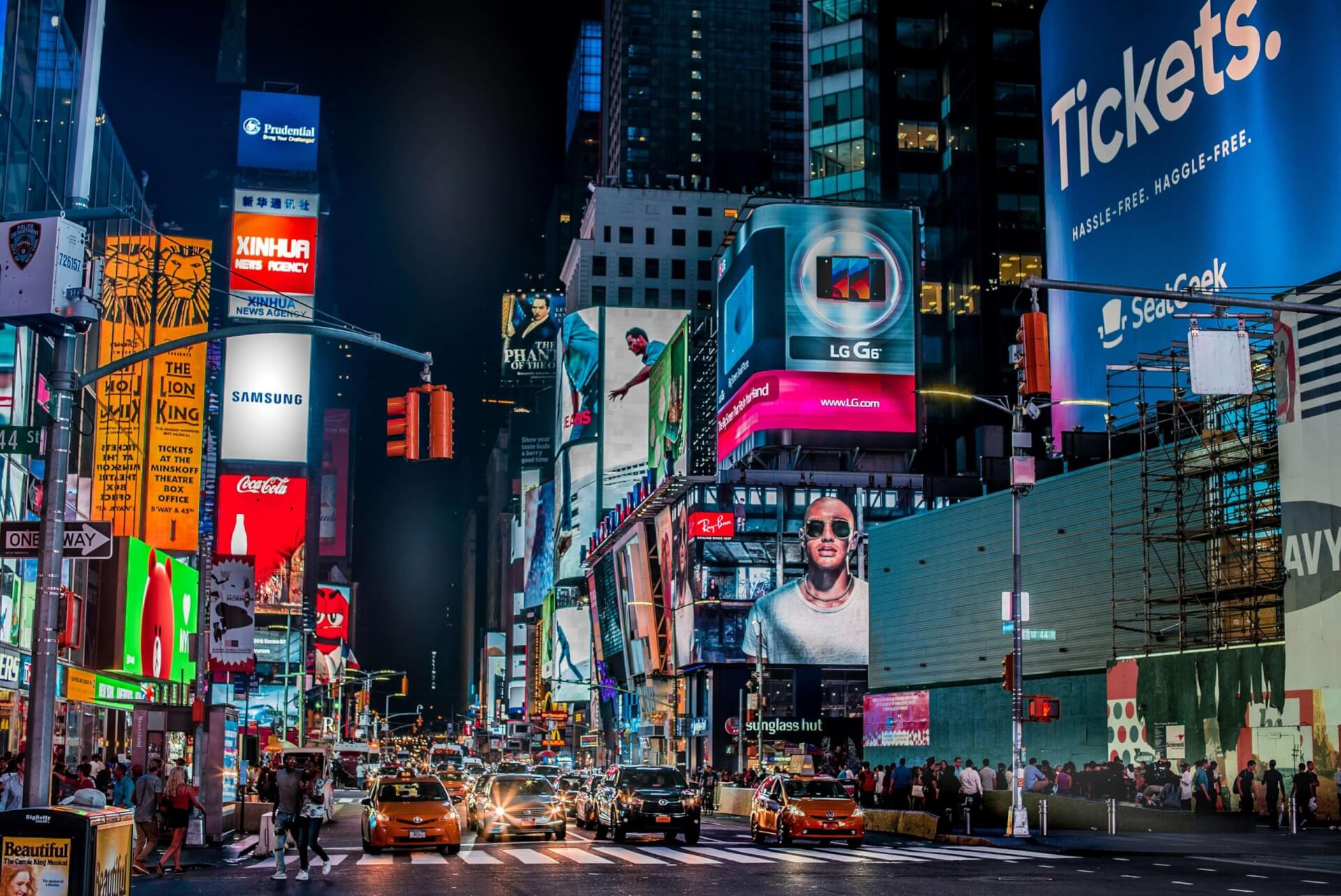
Digital billboards in Times Square, New York City

Both traditional and digital OOH have demonstrated their effectiveness, and many marketing teams combine them to leverage their respective strengths depending on their campaign’s overarching strategy and goals.

READ ALSO: Why static billboards thrive in the digital age: Insights for advertisers

OOH placements & formats

Out-of-home advertising appears across a wide range of environments where people move through their daily lives. Historically, OOH media has been grouped broadly by format, with the Out of Home Advertising Association of America (OAAA) defining four primary categories of standard OOH media formats:

  • Billboards (bulletins, posters, wall murals, and spectaculars): Large-format advertising displays positioned along highways and major roadways, designed for long-distance visibility and broad reach.
  • Street furniture (bus shelter panels, kiosk displays, urban panels, and bench ads): Advertising displays integrated into public infrastructure — often providing a civic amenity — and typically positioned for eye-level viewing in dense urban areas and pedestrian-heavy corridors. 
  • Transit advertising (vehicle wraps, station posters, and platform displays): Ads affixed to moving vehicles such as buses, trains, and taxis, or placed in the common areas of transit environments like stations, terminals, and airports, allowing advertisers to reach commuters and travellers throughout their daily journeys.
  • Place-based OOH (displays inside retail stores, malls, restaurants, gyms, and office buildings): Advertising displays located in environments where audiences gather for work, shopping, dining, and other activities, allowing brands to connect with people in contextually relevant settings and reach consumers along the path to purchase.

While these format categories help organize the OOH landscape, modern campaigns rarely rely on just one placement type. Most advertisers combine multiple formats and environments to build reach, reinforce messaging across locations, and connect with audiences throughout different moments of their daily routines.

Benefits of OOH advertising: Why advertisers still use OOH today

Out-of-home advertising has remained a core part of the media landscape for decades because it delivers something few channels can replicate: high-visibility brand exposure in real-world environments where audiences can’t skip, scroll past, or block the message.

Today, advertisers continue to invest in OOH for several key reasons:

  • OOH ads can offer unmatched size: Large-format billboards and big digital screens offer a lot of room to execute visually stunning ideas (see our favourite OOH and billboard ads) in a way you can’t match on personal devices. Research from Ocean Outdoor shows that premium large-format DOOH attracts five times more attention than online digital formats, with significantly longer viewing time. Even smaller placements — like totems and bus shelter displays — offer a larger creative canvas than most personal devices.
  • Outdoor advertising is unskippable and ad-block-proof: If people are around an OOH display, they’re going to see it. There are no ad blockers, no below-the-fold positions, and no issue with users switching to a different app or tab. And it’s effective: recent research from Solomon Partners found that OOH drives the highest consumer ad recall and strongest audience ROI across major media, delivering better CPM value than TV, print, and most digital channels.
  • Out-of-home media supercharges your other channels: Yes, digital out-of-home and traditional OOH advertising are impactful on their own, but they really shine when paired with other channels like social media and mobile advertising. Research from MRI-Simmons and the Outdoor Advertising Association of America (OAAA) found that adding OOH media to a campaign’s mix can boost audience reach by as much as 100% or more, depending on the medium.
  • (D)OOH drives real-world action: OOH doesn’t just build awareness — it’s also highly effective at driving consumer action. In a Harris Poll survey conducted in partnership with the OAAA, 76% of DOOH ad viewers reported taking some form of follow-on action — from watching a video (38%) or visiting a nearby restaurant (36%) to entering a store (29%), making a purchase (30%), or talking about the brand with others (30%).

How out-of-home advertising works today

Advances in first-party data integrations, automation-enabled transacting tools, and improved targeting and attribution capabilities have made the channel more flexible and data-informed, helping advertisers execute campaigns more efficiently and better understand how OOH contributes to broader omnichannel campaign performance.

Planning and buying OOH campaigns

In the past, buying out-of-home media meant negotiating placements directly with media owners — a time-consuming manual process involving back-and-forth RFPs, PDFs, and endless email chains. These slow, fragmented workflows often led to longer planning cycles and made it harder to integrate OOH into omnichannel digital campaigns.

Today, the buying landscape has expanded. Like online digital advertising, digital out-of-home can now be purchased programmatically. Known as programmatic digital out-of-home, or pDOOH, this approach allows advertisers to target specific audience demographics or trigger campaigns in real-time based on contextual signals such as weather conditions, live sports scores, or time of day — allowing messaging to align more closely with the context in which audiences encounter it.

At the same time, automation-enabled planning and transacting tools are helping streamline traditionally manual workflows across the broader OOH ecosystem. These platforms make it easier for buyers to discover inventory, evaluate options, and secure placements — whether campaigns run on digital screens or classic OOH formats.

For a deeper look at how automation is reshaping the OOH buying process, download Broadsign’s eBook, Automation in OOH Media Planning: Streamlining Transactions at Scale. It explores how new transaction paths are giving buyers additional ways to balance speed, flexibility, and delivery certainty.

Measurement and attribution in modern out-of-home campaigns

 As OOH planning and activation have become more flexible and data-driven, advertisers have also gained new ways to evaluate campaign performance. 

Once perceived as trailing behind digital channels in terms of measurement, advances in campaign analytics and attribution now provide deeper insight into how audiences respond to OOH exposure — and make it easier for advertisers to understand how out-of-home contributes to broader digital campaign performance and omnichannel outcomes.

Today, advertisers have a range of tools and methodologies to evaluate OOH performance and understand how campaigns influence audiences and outcomes, including:

  • Delivery metrics: Estimates of impressions, reach, and frequency help advertisers understand how many people were likely exposed to a campaign. In digital OOH, impressions are calculated using an impression multiplier — a screen-specific index that converts ad plays into estimated audience impressions based on real-world data provided by media owners. 
  • Engagement metrics: Interactions such as QR code scans, along with passive measurement methods like targeted mobile surveys, help advertisers evaluate audience response, brand perception, and interest generated by an OOH campaign. 
  • Attribution analysis: Attribution studies use anonymized location and behavioural signals to determine whether audiences exposed to an OOH campaign later visited a store, downloaded an app, or took another measurable action. 
  • Audience extension: Aggregated mobile data associated with OOH exposure can support retargeting strategies across digital channels, allowing advertisers to reinforce messaging and extend campaign reach beyond the physical display. 
  • Centralized reporting: Programmatic platforms that support multiple forms of digital media can consolidate campaign data and reporting across channels, helping advertisers understand how OOH contributes to omnichannel campaign performance.

For a deeper look at how modern OOH measurement and attribution work, explore our detailed marketer’s guide to OOH measurement, attribution, and audience extension.

Examples of out-of-home advertising in practice: OOH case studies and real-world campaigns

To see how these capabilities come together in practice, here are two real-world campaigns that demonstrate how brands have used out-of-home to reach audiences and drive measurable results.

Uber Eats: Driving purchase intention across the Netherlands 

Uber Eats launched a programmatic digital out-of-home (pDOOH) campaign in the Netherlands to increase brand awareness and purchase consideration while promoting its “No Delivery Fees” offer. The campaign was developed with agency partner EssenceMediacom and OOH technology partner Broadsign using the OutMoove demand-side platform (DSP). Ads were activated on digital screens in high-traffic locations across major cities like Rotterdam, Eindhoven, and Haarlem and ran alongside other channels like paid social and online video.

A brand lift study conducted with Happydemics showed strong results: ad interest nearly doubled among audiences who recalled the ads, and purchase consideration increased twofold, placing the campaign in the top 15% for purchase consideration within the food delivery category across all media platforms. Read the full Uber Eats case study to see how programmatic DOOH helped drive measurable brand and purchase intent outcomes.

Wisp: Building brand awareness and consideration in New York

As Wisp prepared for its next phase of growth, the women’s telehealth platform set out to increase awareness and familiarity among its target audience in the New York DMA. To reach consumers across the market at scale, it partnered with Broadsign on a high-impact programmatic digital out-of-home campaign using the OutMoove DSP, accessing premium inventory across 2,839 screens in the region.

The campaign combined large-format billboards for broad visibility with urban panels near high-traffic areas and pharmacies, along with in-pharmacy screens to deliver messaging in contextually relevant environments. The effort produced strong results, including a 4× lift in brand preference compared with top competitors. Read the full Wisp case study to see how targeted pDOOH also delivered a 3.8× increase in brand familiarity and a 107% lift in purchase consideration.

FAQs about OOH advertising

How do advertisers buy out-of-home media?

OOH advertising can be purchased in several ways depending on a campaign’s goals.

Traditionally, advertisers work directly with media owners or through specialized media agencies to secure placements at specific locations for a set period of time.

Today, many campaigns are also planned and transacted using technology-enabled buying tools that streamline how inventory is discovered, booked, and managed across multiple screens. This can include programmatic digital out-of-home (pDOOH) platforms as well as other forms of automated or platform-based transactions that simplify the planning and buying process. Both approaches remain widely used, and many campaigns combine them depending on the desired reach, flexibility, and level of control.

How is OOH advertising measured?

OOH measurement typically combines audience modelling, location data, and campaign analytics to estimate how many people are likely to see an ad and how those exposures influence consumer behaviour.

Historically, measurement relied on traffic counts and circulation studies to estimate potential impressions. Today, additional data sources such as mobile location data and movement patterns can help advertisers understand outcomes like store visits, website traffic, and brand lift associated with OOH exposure.

How much does OOH advertising cost?

The cost of OOH advertising varies widely depending on factors such as location, format, audience reach, and campaign duration.

Large-format placements in high-traffic locations typically command higher prices, while smaller or more localized placements can be more cost-efficient. On average, OOH advertising often delivers competitive CPMs compared with other media channels, making it an attractive option for brands looking to build awareness at scale. Billboard advertising costs, for example, can vary significantly depending on the market, placement, and format.

Ready to start planning your first OOH campaign? Browse Broadsign’s inventory catalog to explore high-impact out-of-home placements across the globe.

Product News | October 11, 2021

The Broadsign Platform: Powering revenue, growth and performance 

At our annual Broadsign Connect Summit in Barcelona, our VP of Product, Francois Hechme, and Senior Director of Product, Gavin Lee, presented this year’s roadmap for the Broadsign Platform. The presentation highlighted upcoming platform enhancements that aim to help media owners maximize revenue while making out-of-home (OOH) the easiest channel to buy. This year’s roadmap focuses on three strategic pillars: trading, monetization, and intelligence.

Connecting systems and automating workflows to trade faster

The acquisition of Place Exchange

Our journey in programmatic started a decade ago with the launch of our Broadsign supply-side platform (SSP), and we reached a pivotal milestone at the end of last year with the acquisition of Place Exchange. By joining forces with Place Exchange, Broadsign now has the largest aggregation of programmatic OOH supply in the world, with nearly 2 million screens connected and transacting. 

We also now have the largest programmatic demand ecosystem, with over 55 connected demand-side platforms (DSPs). One of the key benefits Place Exchange brings to our clients is its strong partnership with omnichannel leaders that control some of the world’s largest advertising budgets, including The Trade Desk and DV360.

In addition to technology, we’ve also gained a strong media sales organization with extensive agency and brand relationships, as well as expertise in driving demand from other channels to digital OOH (DOOH), including cinema, programmatic audio, CTV, and retail media. 

Looking ahead, our plan is to have a single SSP in-market that combines the best of Place Exchange and Broadsign’s technology. As we transition to a single SSP, our commitment remains to be transparent about the process and to make the migration as seamless as possible, ensuring no revenue loss for our clients. In the meantime, you can learn more about Place Exchange and what’s to come in this interview with our new Chief Strategy Officer, Ari Buchalter. 

Automating the OOH campaign lifecycle

As highlighted in Talon’s Thinking Outside in 2026 report and McKinsey’s State of Marketing Europe 2026 report, advertisers are returning to brand building in 2026, creating a massive opportunity for OOH, a channel inherently designed to deliver long-term brand impact. However, while advertisers are revisiting marketing fundamentals, they are doing so with modern tools.

To remain competitive and continue growing OOH’s share, the evolution of Broadsign’s technology is focused on making OOH the easiest channel to buy, plan, and measure. Central to this vision is automating the entire OOH campaign lifecycle by leveraging widely adopted products and platforms to reduce barriers to entry and drive the required change forward. 

While buyers could already leverage automated campaign execution and reporting through solutions like Programmatic Guaranteed (PG), the planning and buying of direct OOH deals still relied on a manual-heavy process. Last year, we closed this automation gap with Broadsign In-Advance, which allows buyers to discover inventory, plan a direct OOH campaign, and book it through a DSP. Here’s Gavin explaining how these two automated transactions complement each other and support the automation of the entire campaign lifecycle:

This year, our priority is to scale guaranteed demand by expanding its availability across all markets. To support this growth, we are collaborating with several DSP partners, including leading omnichannel platforms like DV360 and Yahoo, which have made PG a core focus, as well as The Trade Desk and StackAdapt, which have gone a step further by directly integrating Broadsign’s In-Advance capabilities.

Monetization: streamlining direct sales from proposal to booking

Integrated static 

Last year, we resolved a major inefficiency of legacy OOH workflows, which traditionally separate static and digital bookings into distinct systems, by introducing our unified campaign planning workflow in the Broadsign Platform. Today, users can plan and book static and digital inventory in a single proposal, increasing efficiency and operational flexibility while enhancing the OOH buying experience. 

We also launched the Static Operations module, enabling users to manage copy, work orders, and postings in one place. This is complemented by the Post app, which allows bill posters to receive, manage, and complete work orders directly in the field. These latest static enhancements have been rapidly adopted by media owners managing transit, roadside billboards, malls, and toll booth assets. 

This year’s roadmap for our static OOH capabilities will include support for transit operators by allowing them to sell bus faces in groups and further operational enhancements to our static operations module. We’re also looking to bring advanced digital campaign functionalities previously unavailable to static, including flexible, goal-based campaign types, our optimization engine, and API connections to external pricing engines.

Modernizing the campaign planning workflow

Another update we’re excited to announce is the complete redesign of our campaign planning window – the most frequently used workflow in the Broadsign Platform. The latest enhancements provide greater visibility into your inventory availability, allow you to tailor campaigns without leaving unsold inventory gaps, and make it much easier to onboard new employees. 

While the modernization of the campaign planning workflow includes over 50 new features, here are some of our favourites:

  • Match inventory to RFPs instantly – The new campaign planning window dynamically surfaces the most relevant inventory as you adjust campaign settings, helping you quickly build proposals aligned with client requirements. For users who prefer building out their campaign proposal visually, a map view of the inventory is also available.
  • Improved attribution to campaign goals – With real-time campaign metrics and a goal tracker indicating how selected inventory directly impacts campaign objectives, you can confidently build tailored plans that deliver measurable results. 
  • Easier access to key targeting tools – Commonly used targeting criteria, like geotargeting, points of interest (POIs) and environments, are now natively integrated into the campaign planning window, making it easier for you to use your favourite targeting criteria without manually maintaining and updating the criteria tags. 

What’s next for our campaign planning and management capabilities

In terms of enhancements coming in 2026 for our campaign planning and management capabilities, we intend to further close the gap on creative management in the platform, reducing the need for you to jump between Broadsign web workflows and desktop tools and allowing you to manage the campaign lifecycle in one place. 

We plan on evolving our optimization engine to support campaign delivery when changes are implemented mid-flight. Currently, if you change audience schedules or store hours for a particular screen while campaigns are running, you would need to manually re-adjust every affected campaign. The latest update to the optimization engine would automatically rebalance campaign delivery, ensuring you always hit your targets even when plans change.

We’re also bringing you more flexibility and customization to how you sell your inventory. Our upcoming UI updates will include packaged workflows, allowing you to group specific screens and sell them as a package. This not only gives you more control over how your inventory is presented and sold to advertisers, but also allows you to optimize your pricing and sales strategy to maximize fill rates and revenue. 

One of the biggest changes for campaign planning and how you monetize your screen will arrive in the second half of the year with our advanced planning capability. We’re adding a massive audience data layer to the platform, allowing you to index and score screens against specific demographic segments using either your own first-party data or partner data. This new capability will not only allow you to align campaigns perfectly with agency briefs, but also concretely demonstrate how your network is the best way to reach a brand’s target audience.

Intelligence: See performance, forecast revenue and optimize yield

We’re continuing to advance with our plans for a unified reporting module in the Broadsign Platform, which aims to consolidate visibility of forecasts, yield performance, and channel allocation into a single view. Our dashboard will be fully customizable, ensuring each user sees only what matters for their role. For instance, a campaign manager can focus on pacing and creative status, while leadership can track high-level trend analyses. 

The reporting module will also include a yield management view that focuses on revenue forecasting rather than screen occupancy. Using AI pattern recognition and trend analysis, the system analyzes your historical and projected bookings to predict future yield opportunities and recommend changes. 

One of the most common questions in yield optimization is how much inventory to allocate across sales channels and how that allocation would impact revenue. Our new channel allocation simulator makes that easy to answer and removes the guesswork by allowing you to run “what if” scenarios in a risk-free environment. You can test different strategies, like allocating more of your screens and effort to direct versus programmatic, and see the potential impact it has on your revenue before you commit. 

Finally, our reporting module will include AI insights. Acting as your personalized data analysts, it monitors your data around the clock to alert you of potential issues and provide recommendations, minimizing the impact on your network operations and advertisers’ experience. 

This latest series of updates is another step forward in Broadsign’s mission to transform how brands, agencies and media owners buy, sell and deliver OOH campaigns. For media owners, the latest evolution of the Broadsign Platform aims at removing any friction that stands between them and their revenue. 

Discover the platform that powers out-of-home here