Product News | October 11, 2021

Let’s talk programmatic DOOH: Insights from Adform
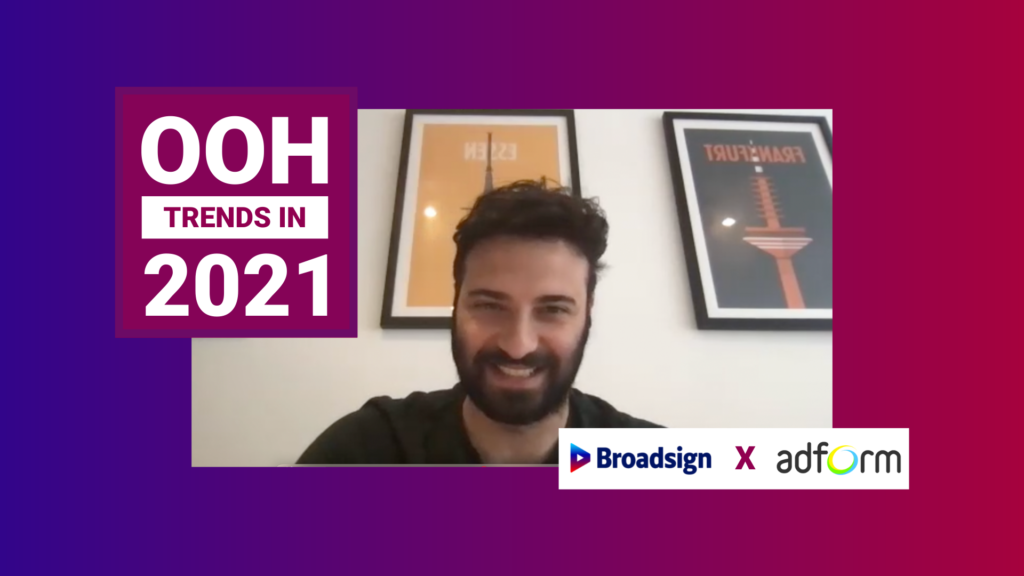
For a long time, Adform has extolled the virtues of digital out-of-home. This company believes firmly in the medium’s power to communicate brand messaging to broad audiences and its capabilities in delivering precise audience metrics.

Adform, a global advertising platform headquartered in Copenhagen, is known across the industry for providing a flexible solution that services the whole campaign lifecycle. With its fully integrated advertising platform, Adform FLOW, and global reach – it’s easy to see why customers continue to gravitate towards the company’s unique offering.

How does DOOH fit into the business’s media plans? Adform’s Partner Development Manager Vittorio Capasso has some thoughts on the subject. We reached him in London to discuss this and why he thinks digital out-of-home needs to be a fixture in the media budgets for businesses of all sizes.

What do you think are some of the barriers or challenges that a digital marketer faces as they start exploring, planning and integrating DOOH in their omnichannel campaigns?

One of the main challenges is that clients don’t realize the scale of DOOH, which impacts how they plan their campaigns. Reach, screen availability, where screens are located, types of screens and the environment where the ad will be displayed—if it’s in a mall, highway, or supermarket, this can all make a difference.

We also notice that clients wonder how they can reach their audiences through DOOH. I think marketers are also used to running traditional campaigns with third-party cookies available, and it’s pretty easy nowadays to pick and choose their audiences. With DOOH, the story’s different, and we find that it’s more about educating clients, agencies, advertisers on how audiences can be reached through DOOH and the best ways they can achieve that.

And the third part is the measurement. Clients can measure the impact of their campaigns. Traditional campaigns require specific tools to measure many aspects of the campaign but with DOOH, how you measure your campaign is a little different, and I think there’s more education that needs to be done here as well.

What do you think is DOOH’s role in a media plan? Has it changed over the last couple of years?

As we settle into this “new normal,” there seems to be an evident appetite for OOH media and programmatic DOOH. What would you say are the main drivers of that?

With restrictions being lifted in many countries, we’re starting to see an increase in demand for DOOH. In the next few years, we think DOOH is a channel that needs to always be on media plans. In every campaign, a DOOH piece should be included because it can make a difference. For brand campaigns, this needs to be there—it’s so impactful as a channel. You can reach many people at the same time and have the opportunity to be creative with campaigns you run, campaigns that have the potential to grab people’s attention and stay with them.

In light of the upcoming withdrawal of third-party cookies and the renewed attention on contextual advertising, what do you see the role of programmatic DOOH being? 

For several years, we’ve been working on proposing solutions for our clients, enabling them to run campaigns similarly, without third-party cookies. I think clients are used to talking about first-party data and thinking about the world without third-party cookies, but I think this will help boost the DOOH and allow it to stand out from the other channels. With Google recent announcement regarding the withdrawal of third-party cookies being pushed to 2023, the industry will have more time to adapt and DOOH can help the transition as it is a cookie-less environment by nature.

Knowing that there are more strict privacy policies and fewer opt-in location-based users and mobile data, how do you think this will impact DOOH execution and is this a concern? 

Do you think marketers fully understand the programmatic DOOH opportunity? Is more education needed? 

In general, I think there is a good understanding of the basics, but it depends on the specific markets and clients. Some markets are advanced in DOOH because it’s already been a part of the landscape, while some still need to be educated on the basics. But I believe a good portion of the market needs to learn about the real opportunities and capabilities of DOOH, such as measurement and audience-targeting, which needs to be made more clear to clients, and that’s one of Adform’s goals. Marketers want to run sophisticated campaigns, and DOOH needs to adapt to that. DOOH has made progress in recent years, with many capabilities that I don’t think are fully used by clients. 

Do you see more clients wanting to leverage dynamic creative?

That’s something we see more of lately, though this is something clients are requesting as I don’t think dynamic capabilities are being used as broadly as they should be. But I believe in the future that dynamic creative campaigns will be increasingly deployed in the DOOH channel, as programmatic makes it even easier. But the market needs to be educated. Clients want to be reassured that their campaigns are going to be executed with no issue. 

What is essential for you when choosing a DOOH supply-side platform (SSP), and where do you think the opportunities are from an SSP perspective? 

What role does Broadsign Reach SSP play in your supply? 

I think Reach is a great tool. It gives us the flexibility to get the information and details that we need whenever we need them. I think about it from the planning perspective so that I can secure the info easily. Troubleshooting is one key differentiator of Reach as we can troubleshoot things much quicker with your SSP and of course, the great support offered by the team at Broadsign makes everything much easier.
Product News | October 11, 2021

Meet Manuel Ameneiros, Broadsign’s Head of Media Sales and Service, LATAM

Out-of-home advertising across Latin America is gaining strong momentum, driven by expanding digital infrastructure, ongoing innovation, and growing demand from brands seeking high-impact audience reach. As the market evolves, there is a clear opportunity to bring greater efficiency, scale, and flexibility to how OOH is planned and transacted across the region.

To support this next phase of growth, Broadsign has appointed Manuel Ameneiros as Head of Media Sales & Service for LATAM. Based in Mexico City, he will focus on driving sustainable growth across the region while building a strong, scalable commercial foundation. This includes managing strategic relationships with agencies, advertisers, and media owners, and advancing market education as programmatic DOOH adoption continues to evolve.

Manuel brings over a decade of experience across the advertising ecosystem, spanning brand, agency, and adtech roles throughout LATAM. Most recently, he served as Chief Commercial Officer at OLA Media, where he focused on scaling revenue and driving market expansion. Earlier, he held roles across brands, agencies, and adtech companies, including Retargetly and Boletia, building expertise in data-driven marketing, programmatic adoption, and go-to-market strategy.

We caught up with Manuel to learn more about his background, what drew him to Broadsign, and his perspective on the opportunities ahead in LATAM.

Welcome to Broadsign. What drew you to the team, and what excites you most about your new role leading Media Sales & Service for LATAM?

I’ve always been drawn to the intersection of media, technology and data, and that’s exactly what makes this opportunity so compelling for me. Broadsign has built a strong reputation as one of the companies helping modernize OOH by giving media owners and advertisers the tools to plan, transact and scale more intelligently. What excited me most about joining the team is the chance to help accelerate that momentum across Latin America, a region where markets are evolving quickly and where there is real appreciation for innovation.

How would you describe the current state of the OOH market in Latin America, and where do you see the biggest growth opportunities?

The OOH market in Latin America is in a dynamic phase. It continues to benefit from strong reach and visibility, particularly in urban areas, but it’s also evolving quickly as digital infrastructure expands and advertisers demand more accountability and flexibility around their campaigns.

Having worked both in adtech and more recently in the OOH space, I’ve seen firsthand how the conversation is shifting from static inventory and broad reach to more data-driven planning, audience segmentation, and integration with digital channels.

The biggest opportunity lies in accelerating that transition. There is still a gap between DOOH’s potential and how it’s currently bought and sold in many markets. Bridging that gap through better data use, automation, and programmatic transactions is where much of the next wave of growth will come from.

Programmatic DOOH is gaining momentum globally. How is this evolving in Latin America, and what’s needed to accelerate adoption across the region?

Programmatic DOOH in Latin America is moving from early adoption into a growth stage. Buyers are looking for more flexibility, more precise activation, and easier connections between OOH and broader omnichannel campaigns. Media owners, in turn, are recognizing that programmatic can help open inventory to new demand sources, improve fill rate, and make digital assets easier to transact.

To accelerate adoption further, the region needs continued progress in a few areas: more digital inventory, stronger education across buyers and sellers, and better tools for targeting and measurement. 

What role do you see Broadsign playing in the future of OOH across LATAM, and what are you most excited to build or accomplish in the region over the next few years?

I see Broadsign as a key enabler of the next phase of growth for OOH in Latin America. The company is uniquely positioned because it operates across the entire ecosystem: a CMS, SSP and DSP, which allows it to support both media owners and buyers in a very holistic way.

For media owners, Broadsign can help modernize operations, increase efficiency, and open up new revenue streams. For advertisers and agencies, it simplifies access to OOH and makes it easier to integrate into omnichannel strategies.

What excites me most is the opportunity to help build a more connected, scalable, and performance-driven OOH ecosystem across LATAM. In practical terms, that means expanding programmatic adoption, strengthening relationships with key agencies and advertisers, and helping media owners unlock more value from their inventory. It’s also about making DOOH a more consistent part of media strategies rather than a complementary channel.

From a market perspective, Brazil and Mexico are critical due to their scale and level of sophistication, but I also see strong potential in Colombia, Chile and Argentina, as well as in emerging segments like mobility and retail media, which I’ve been closely involved with in recent years.

Product News | October 11, 2021

Broadsign partners with JB Hi-Fi to accelerate Retail Media Network

Retailer launches scalable in-store digital signage network to enhance customer experience and increase brand amplification opportunities

SYDNEY, April 22, 2026 –Broadsign announced that leading Australian consumer electronics retailer JB Hi-Fi is deploying the Broadsign Platform to build and scale its in-store retail media network (RMN), which spans over 200 stores across Australia. The technology will streamline operations, enabling JB Hi-Fi to seamlessly plan, execute, optimise, and measure in-store media and ad campaigns across locations from one central hub.  

With the Broadsign Platform providing real-time availability, intuitive ad serving, and robust campaign reporting out-of-the-box, JB Hi-Fi will be able to unlock impactful in-store opportunities and deliver measurable results across its network. An open API also allows JB Hi-Fi to integrate with its preferred retail systems, platforms, and processes, while still maintaining complete ownership and control over its network. 

“We’re seeing strong interest in retail media from advertisers and brands who want to reach local audiences where purchase intent is high. We already had the screens to deliver in-store, and now with Broadsign, we have access to the same advertising toolset that major media owners use, and the ability to scale,” explained Gary Siewert, Director of Marketing and e-commerce, JB Hi-Fi. “Broadsign’s open API has also proved more valuable, allowing us to select the partners we want to work with as we build our omnichannel RMN, such as Retail Media Works and Criteo.”  

“As Australia’s leading consumer electronics retailer, JB Hi-Fi is home to some of the world’s biggest brands. By partnering with best-in-class solutions such as Broadsign, JB Hi-Fi are not only maximising the potential of their retail media network, they’re setting the strongest possible foundation for themselves in an increasingly competitive space,” said Ben Allman, Regional VP of Platform Sales at Broadsign. 

For more information about Broadsign’s in-store media network offering, visit: https://broadsign.com/retail-digital-signage/

About Broadsign

Broadsign is the leading out-of-home (OOH) advertising technology platform, transforming how retailers, OOH media owners, and ad buyers reach and connect with audiences. More than 2.8 million static and digital signs along roadways and in shopping malls, grocery and convenience stores, airports, transit systems, and other OOH venues run on Broadsign. The Broadsign platform helps customers seamlessly plan, deliver, and optimize dynamic, data-driven in-store and OOH campaigns. 

Through Broadsign’s programmatic SSP, Place Exchange, and integrations with 50+ omnichannel and OOH DSPs, the company offers advertisers and media buying agencies the largest footprint of global OOH inventory, enabling them to intuitively execute guaranteed and non-guaranteed OOH campaigns across a variety of OOH formats. Interoperability with retail POS systems, loyalty programs, and omnichannel media platforms allows retailers to create engaging, measurable in-store experiences that tie into on- and off-site campaign strategies. https://broadsign.com/retail-digital-signage/

Product News | October 11, 2021

Why in-store retail media can’t scale without automation

Retail media is maturing quickly, with retailers building more sophisticated networks across onsite and offsite channels. In-store, one of the most valuable environments at the point of purchase, is now gaining momentum as the next area of focus.

While investment is increasing and screen networks continue to scale, in-store is still evolving from infrastructure into a fully realized media channel and hasn’t yet reached the same level of automation, measurement, and integration as other digital channels.

That gap is where automation comes in.

Automation has already reshaped how retail media campaigns are planned, bought, and optimized across digital environments. Bringing those same capabilities into in-store is the next step toward making it a seamless part of the media mix.

With the right foundations, automation can connect in-store with the broader ecosystem, enabling more efficient activation, stronger alignment in how in-store performance is measured, and a more unified retail media strategy.

The barriers to scaling in-store media

Retailers often believe they’re operating with automation, but in practice, it remains fragmented across channels and teams. While certain workflows like scheduling or couponing may be automated, they rarely connect to a unified system. At the same time, trade, shopper, and media teams continue to operate independently, each with its own objectives, budgets, and processes.

This fragmentation shows up in how campaigns are executed. Many in-store activations still rely on manual planning and static placements, with limited visibility into inventory and performance. In many cases, looped, time-based content remains the standard, restricting the ability to deliver more dynamic, contextually relevant messaging.

At the same time, expectations have shifted. Media buyers now expect real-time access to inventory, faster activation, and unified reporting across channels. As trade and media budgets begin to converge, so does the need for greater accountability and measurable outcomes. Without automation, in-store media can’t keep pace. Campaigns can’t be planned or optimized against outcomes like sales, reach, or incrementality, and the channel remains disconnected from broader retail media strategies.

The realities are becoming clear: manual operations can’t scale in a data-driven, outcome-based environment, breaking down silos requires connected systems rather than added processes, and meeting modern expectations for speed, flexibility, and measurement depends on automation.

What automation really means for in-store media

At its core, automation operates across three connected layers that shift in-store media from a manual channel to one that scales and delivers against defined outcomes.

  • Operational automation: Removes manual workflows from planning, booking, and scheduling. Instead of relying on time-intensive coordination and service layers, campaigns can be activated more efficiently and run at scale across networks.
  • Data and decisioning automation: By bringing in first-party signals like loyalty, transaction, and foot traffic data, campaigns can be informed by real performance inputs rather than assumptions. This also enables more dynamic delivery, where messaging can adapt based on factors like time of day, store inventory or shopper behaviour.
  • Commercial automation: Aligns in-store with broader media expectations. This includes centralized planning, unified reporting, and more consistent buying experiences across channels, making in-store easier to integrate into omnichannel strategies.

Today, many in-store networks remain entirely static, while others rely on manual playlist management and fixed placements, limiting both flexibility and performance. Automation changes that by enabling campaigns to be planned and optimized against outcomes like sales uplift, audience reach, or product-level goals.

Instead of deciding what plays on a screen and when, retailers can define what they want to achieve and allow automated systems to dynamically allocate inventory and optimize delivery based on real-time data.

Building a more connected retail media strategy

For retailers, the shift to automation doesn’t happen all at once. It starts with connecting existing capabilities to enable more streamlined execution and outcome-driven planning. Many already have strong foundations across in-store screens, data, and media operations, but these systems often operate independently. Prioritizing integration through APIs and shared workflows helps bring in-store into the broader retail media ecosystem without requiring a full rebuild.

From there, focus on making in-store inventory accessible within existing media-buying workflows, so campaigns can be planned alongside on- and off-site channels rather than treated separately. Additionally, data should be applied more intentionally. Using first-party signals like loyalty, transaction, and store traffic data enables more accurate targeting, optimization, and measurement, moving beyond proxy metrics.

Execution also needs to evolve. Shifting from manual placements to goal-based delivery allows campaigns to be optimized against outcomes like sales, reach, or product-level performance, rather than fixed schedules. Technology partners can support this shift by enabling automation, measurement, and optimization, while providing the visibility needed for performance tracking and attribution.

Finally, internal alignment is key. As trade and media budgets converge, aligning teams around shared outcomes ensures in-store media is planned and executed as part of a cohesive strategy.

In-store is no longer a future opportunity; it’s an immediate one. As retail media continues to evolve, automation will be key to turning in-store into a scalable, measurable, and fully integrated channel. Retailers that invest in connecting systems, data, and teams now will be best positioned to unlock their full value.

Ready to unlock the full value of your in-store media? Discover how Broadsign helps retailers automate execution, connect data, and drive measurable performance.

Product News | October 11, 2021

Why in-store retail media is essential to an omnichannel RMN strategy

Retail is no longer defined by individual channels, as consumers move seamlessly between digital and physical environments, they expect a connected, consistent experience at every touchpoint.

Omnichannel retail connects ecommerce, mobile, marketplaces, and physical stores into a single, seamless experience across the customer journey. Shoppers can browse on their phones, check local inventory, receive personalized offers, and complete purchases in-store with consistent pricing and messaging. For retailers, this means unifying customer experience, data, and operations to improve engagement, build loyalty, and drive efficiency.

With 80% of shopping still happening in-store, physical retail continues to play a central role across North America. Rather than just another channel, it acts as a high-impact environment that amplifies the entire retail media mix.

The evolving role of in-store in an omnichannel RMN

As retailers advance their omnichannel strategies, digital channels have taken the lead, driven by stronger targeting, measurement, and automation. At the same time, the physical store is evolving from a point of transaction into a critical moment where digital intent turns into real-world action.

This shift is reflected in retailer priorities, with 46% focused on enhancing omnichannel experiences and 36% investing in loyalty programs to deliver more personalized value, signalling a push to better align data, touchpoints, and customer interactions.

In-store environments sit closest to purchase, where messaging can directly influence decisions from discovery to conversion. Yet they often remain disconnected from broader retail media efforts, limiting true omnichannel alignment.

When fully integrated, in-store media strengthens the entire strategy. It reinforces digital messaging, creates a more consistent experience, and engages shoppers at the moments that matter most. By linking in-store environments with signals like online behaviour, purchase history, and audience data, retailers can move from isolated tactics to coordinated, full-funnel execution across onsite, offsite, and in-store.

Technology and data are transforming in-store media

Technology and data are transforming in-store media into a more measurable, responsive, and connected part of the retail media ecosystem. Real-time analytics enable retailers to adjust messaging, promotions, and placements based on live shopper behaviour, while dynamic content adapts to context like time of day, location, and audience signals.

Tools like dwell time analysis help identify high- and low-engagement zones, optimizing store layouts and improving both the customer experience and campaign performance. At the same time, more immersive formats, including touchscreens and augmented reality, are increasing engagement, turning stores into active media environments.

The real impact comes from how these capabilities are connected. By combining in-store signals with online behaviour, purchase history, and customer data, retailers can build a more complete view of the customer. This enables more precise targeting, stronger value for brand partners, and coordinated campaign execution across channels, while improving measurement and tying digital engagement to in-store outcomes.

In-store drives more RMN revenue

In-store media expands both what retailers can sell and how they sell it. It introduces new, high-intent inventory within owned environments, from digital screens in high-traffic areas to placements tied to specific aisles, categories, and products. Unlike traditional digital formats, this inventory sits at the point of decision, where budgets are often larger and tied more directly to sales outcomes.

It also enables more commercial, retailer-driven monetization models. Beyond standard ad placements, retailers can package sponsored product campaigns, category exclusivity, and seasonal takeovers that align with merchandising priorities. In-store media can also be used to drive private-label visibility, turning media into a lever for margin, not just ad revenue.

Where this becomes more powerful is in how it’s packaged. On its own, in-store is valuable. But when bundled with onsite and offsite media, it allows retailers to move from selling placements to selling outcomes. Campaigns can be positioned around influencing the full path to purchase, which supports larger, more strategic investments from brand partners.

It also changes the economics of measurement. With in-store in the mix, retailers can connect media exposure to actual transactions, strengthening closed-loop attribution and making performance easier to prove. This is increasingly critical as brands scrutinize retail media spend and shift budgets toward channels that demonstrate real impact.

Without in-store, RMNs risk becoming overly reliant on digital formats that are easier to compare and commoditize. With it, they can differentiate through exclusive access to shoppers, richer data, and the ability to influence and measure outcomes at the shelf.

Practical steps to activate in-store in an omnichannel strategy

Operationalizing in-store media within an omnichannel RMN requires the right foundation across data, infrastructure, and activation.

  • Invest in integrated data platforms: Consolidate in-store and digital data to create a unified customer view. Connecting in-store interactions, online behaviour, and purchase history supports better targeting, measurement, and planning, while aligning online, merchant, and retail media teams around shared performance.
  • Upgrade in-store media infrastructure: Ensure your store environment can support dynamic, scalable media. This includes deploying digital signage and screen networks that can deliver flexible, real-time content across locations and formats.
  • Implement advanced analytics tools: Use analytics to understand how shoppers move, engage, and convert in-store. Insights like dwell time, traffic patterns, and product interaction can inform both media strategy and store optimization.
  • Enable programmatic buying and activation: Integrate in-store inventory into programmatic workflows so buyers can plan, purchase, and activate campaigns alongside other channels. Retailers can activate specific parts of the store (like POS systems, vestibule screens, or gas pumps) to support programmatic demand without introducing competing or misaligned brands. This reduces friction while maintaining control over the in-store experience and aligning with how media is bought today.
  • Continuously monitor and optimize performance: Treat in-store media like any other performance channel. Track results in real time, measure against business outcomes, and refine campaigns based on what is driving engagement and sales.

In-store is the foundation of omnichannel

Omnichannel success depends on connecting every touchpoint into a single, cohesive system, including the store. The path forward is clear: treat in-store as media, not infrastructure. Integrate it into your retail media strategy, connect it to your data and buying workflows, and package it alongside digital channels. Retailers that do this will unlock new revenue, stronger performance, and a more differentiated offering.

Ready to make your in-store signage a seamless part of your RMN? Learn more about how Broadsign can help you unlock the full value of your in-store presence.