Intersection selects Broadsign to power ads on expansive nationwide digital signage network
Partnership enables advertisers to run targeted, strategic ad campaigns seamlessly across a network of more than 3,500 displays in top U.S. DMAs
New York, New York. January 30, 2018 – Intersection, the leading smart cities technology and media company, today announced it has selected Broadsign International, LLC’s leading marketing software to power advertising on Intersection’s network of digital displays across the U.S., including LinkNYC and transit assets in the top media markets, to improve advertisers’ ability to reach consumers with targeted, seamless campaigns.
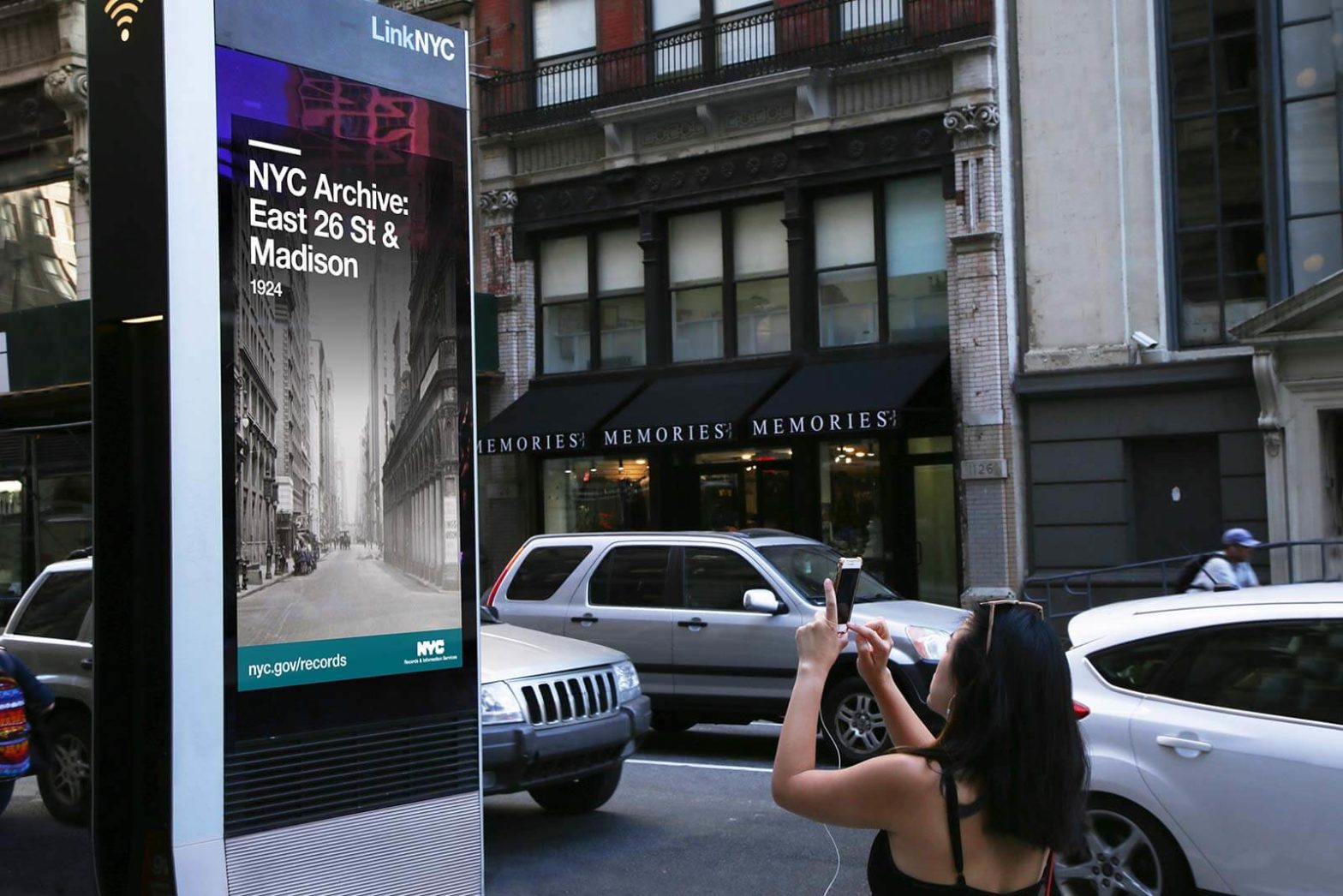
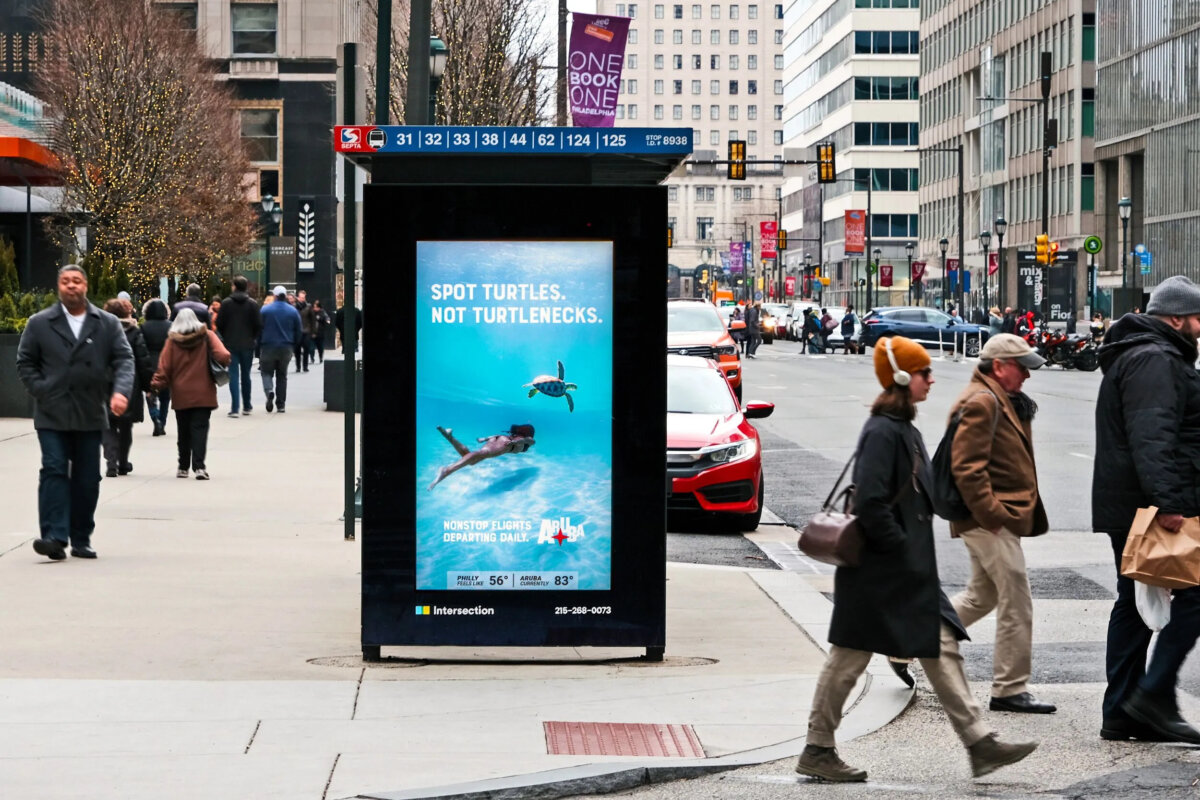
Intersection will use Broadsign’s content management system, Broadsign Control, to deliver advertising and dynamic HTML5 content to its national network of digital displays. From a unified platform, Intersection will be able to manage branded content on more than 3,500 Link kiosks, urban panels, interactive station platform displays and bus shelters it operates nationwide.
“Our digital network extends across the top media markets in the U.S., providing brands the opportunity to connect with millions of customers on their daily journeys through our largest cities,” said Adrian D’Souza, SVP of sales strategy and operations at Intersection. “With Broadsign, we have the enhanced flexibility, creative capabilities, and planning tools to make those connections more efficiently and cohesively across our network.”
Intersection’s network reaches over 48 million consumers across the top DMAs in the U.S., including New York City, Chicago, San Francisco, Philadelphia and Dallas, and several other top metro regions. This network includes signage throughout major transit systems such as the Chicago Transit Authority (CTA) and the Southeastern Pennsylvania Transportation Authority (SEPTA), as well as New York City’s LinkNYC Wi-Fi kiosks.
The Intersection digital display network, which generates 2.5 billion impressions per month, is the ideal platform for advertisers to share their brand stories. To more efficiently manage and sell ad space, Intersection will also use Broadsign’s sales platform, Broadsign Direct. Broadsign’s leadership in DOOH advertising will help Intersection and its partners to connect with consumers in even more creative, dynamic and meaningful ways.
“With screens and kiosks connecting people in the busiest urban areas, smart cities are changing the way we live our lives,” said Maarten Dollevoet, SVP of global sales at Broadsign. “We are proud to be working with a leader in the smart cities revolution and we are committed to helping digitize many more cities around the world.”
Increasingly, cities around the world are installing connected technologies and devices to improve the urban experience. According to the Outdoor Advertising Association of America, OOH innovations like Intersection’s digital assets can help cities deliver WiFi, transit information, emergency communications and other critical services to residents and visitors.
Intersection’s growing network of digital assets enables cities to provide these critical services free of charge. With engaging and informative content, including real-time transit updates, weather, local events, and contextual, dynamic advertisements, the Intersection network is one of the most noticed and relied upon in the U.S.
About Broadsign
Broadsign is the leading digital out-of-home (DOOH) marketing platform that enables brands, agencies and DOOH media publishers to buy, sell, and deliver DOOH campaigns efficiently, reliably and securely. Lighting up airports, shopping malls, health clinics, street corners and more, the Broadsign platform powers screens at the heart of people’s lives and delivers more than 11 billion ads and 30 billion impressions per month.
The Broadsign marketing platform includes Broadsign Control for content distribution, playback and proof of performance, Broadsign Direct for sales inventory availability and proposal generation, and Broadsign Reach, a customized SSP for programmatic DOOH transactions.
About Intersection
Intersection is at the forefront of the smart cities revolution, improving the experience of public places through technology that provides connectivity, information, and engaging content and experiences. With award-winning products like LinkNYC, the largest and fastest free public Wi-Fi network in the world, Intersection connects the digital and physical worlds, enhancing people’s journeys through their cities and offering brands the opportunity to drive more relevant and engaging advertising, rooted in real-world context. Intersection partners with cities, transit systems, airports, and real estate developments around the globe, as well as advertisers seeking to reach audiences on a global, national, or local scale.
Product News | October 11, 2021
Why in-store retail media is essential to an omnichannel RMN strategy
Retail is no longer defined by individual channels, as consumers move seamlessly between digital and physical environments, they expect a connected, consistent experience at every touchpoint.
Omnichannel retail connects ecommerce, mobile, marketplaces, and physical stores into a single, seamless experience across the customer journey. Shoppers can browse on their phones, check local inventory, receive personalized offers, and complete purchases in-store with consistent pricing and messaging. For retailers, this means unifying customer experience, data, and operations to improve engagement, build loyalty, and drive efficiency.
With 80% of shopping still happening in-store, physical retail continues to play a central role across North America. Rather than just another channel, it acts as a high-impact environment that amplifies the entire retail media mix.
The evolving role of in-store in an omnichannel RMN
As retailers advance their omnichannel strategies, digital channels have taken the lead, driven by stronger targeting, measurement, and automation. At the same time, the physical store is evolving from a point of transaction into a critical moment where digital intent turns into real-world action.
In-store environments sit closest to purchase, where messaging can directly influence decisions from discovery to conversion. Yet they often remain disconnected from broader retail media efforts, limiting true omnichannel alignment.
When fully integrated, in-store media strengthens the entire strategy. It reinforces digital messaging, creates a more consistent experience, and engages shoppers at the moments that matter most. By linking in-store environments with signals like online behaviour, purchase history, and audience data, retailers can move from isolated tactics to coordinated, full-funnel execution across onsite, offsite, and in-store.
Technology and data are transforming in-store media
Technology and data are transforming in-store media into a more measurable, responsive, and connected part of the retail media ecosystem. Real-time analytics enable retailers to adjust messaging, promotions, and placements based on live shopper behaviour, while dynamic content adapts to context like time of day, location, and audience signals.
Tools like dwell time analysis help identify high- and low-engagement zones, optimizing store layouts and improving both the customer experience and campaign performance. At the same time, more immersive formats, including touchscreens and augmented reality, are increasing engagement, turning stores into active media environments.
The real impact comes from how these capabilities are connected. By combining in-store signals with online behaviour, purchase history, and customer data, retailers can build a more complete view of the customer. This enables more precise targeting, stronger value for brand partners, and coordinated campaign execution across channels, while improving measurement and tying digital engagement to in-store outcomes.
In-store drives more RMN revenue
In-store media expands both what retailers can sell and how they sell it. It introduces new, high-intent inventory within owned environments, from digital screens in high-traffic areas to placements tied to specific aisles, categories, and products. Unlike traditional digital formats, this inventory sits at the point of decision, where budgets are often larger and tied more directly to sales outcomes.
It also enables more commercial, retailer-driven monetization models. Beyond standard ad placements, retailers can package sponsored product campaigns, category exclusivity, and seasonal takeovers that align with merchandising priorities. In-store media can also be used to drive private-label visibility, turning media into a lever for margin, not just ad revenue.
Where this becomes more powerful is in how it’s packaged. On its own, in-store is valuable. But when bundled with onsite and offsite media, it allows retailers to move from selling placements to selling outcomes. Campaigns can be positioned around influencing the full path to purchase, which supports larger, more strategic investments from brand partners.
It also changes the economics of measurement. With in-store in the mix, retailers can connect media exposure to actual transactions, strengthening closed-loop attribution and making performance easier to prove. This is increasingly critical as brands scrutinize retail media spend and shift budgets toward channels that demonstrate real impact.
Without in-store, RMNs risk becoming overly reliant on digital formats that are easier to compare and commoditize. With it, they can differentiate through exclusive access to shoppers, richer data, and the ability to influence and measure outcomes at the shelf.
Practical steps to activate in-store in an omnichannel strategy
Operationalizing in-store media within an omnichannel RMN requires the right foundation across data, infrastructure, and activation.
Invest in integrated data platforms: Consolidate in-store and digital data to create a unified customer view. Connecting in-store interactions, online behaviour, and purchase history supports better targeting, measurement, and planning, while aligning online, merchant, and retail media teams around shared performance.
Upgrade in-store media infrastructure: Ensure your store environment can support dynamic, scalable media. This includes deploying digital signage and screen networks that can deliver flexible, real-time content across locations and formats.
Implement advanced analytics tools: Use analytics to understand how shoppers move, engage, and convert in-store. Insights like dwell time, traffic patterns, and product interaction can inform both media strategy and store optimization.
Enable programmatic buying and activation: Integrate in-store inventory into programmatic workflows so buyers can plan, purchase, and activate campaigns alongside other channels. Retailers can activate specific parts of the store (like POS systems, vestibule screens, or gas pumps) to support programmatic demand without introducing competing or misaligned brands. This reduces friction while maintaining control over the in-store experience and aligning with how media is bought today.
Continuously monitor and optimize performance: Treat in-store media like any other performance channel. Track results in real time, measure against business outcomes, and refine campaigns based on what is driving engagement and sales.
In-store is the foundation of omnichannel
Omnichannel success depends on connecting every touchpoint into a single, cohesive system, including the store. The path forward is clear: treat in-store as media, not infrastructure. Integrate it into your retail media strategy, connect it to your data and buying workflows, and package it alongside digital channels. Retailers that do this will unlock new revenue, stronger performance, and a more differentiated offering.
Ready to make your in-store signage a seamless part of your RMN? Learn more about how Broadsign can help you unlock the full value of your in-store presence.
Product News | October 11, 2021
What is out-of-home? A marketer’s guide to OOH media and outdoor advertising
Out-of-home (OOH) advertising, also known as out-of-home media or outdoor advertising, refers to ads displayed outside the home in public spaces. It includes billboards, transit advertising, and digital or static displays in retail locations and other high-traffic spaces.
While OOH was once associated primarily with traditional roadside formats, it now spans a wide range of physical environments and everyday moments — reaching audiences along commuting routes, at shopping destinations, and in travel hubs. The rise of digital screens, improved measurement, and more efficient, automation-enabled planning and buying processes has transformed how campaigns are executed and integrated into omnichannel marketing strategies. As a result, advertiser investment in the channel continues to rise, with global out-of-home ad spend expected to surpass $71.5 billion by 2030.
Keep reading for a closer look at what out-of-home advertising is, where it appears, and how brands use it today.
Types of out-of-home (OOH) advertising & outdoor media
When people think of outdoor advertising, they often picture massive billboards along busy highways. While those displays are certainly a key part of the channel, one of the defining characteristics of out-of-home advertising today is the sheer variety of placements and display types. From small static posters to large digital screens, today’s OOH media offers brands an incredible range of ways to connect with audiences in real-world environments.
Broadly speaking, today’s out-of-home advertising falls into two categories: traditional (i.e., static) OOH or digital OOH.
Traditional OOH refers to printed placements like billboards, posters, and transit wraps that display the same creative for a fixed period. These formats remain widely used thanks to their scale, prominent placements, and ability to deliver continuous brand visibility. Digital out-of-home (DOOH) is a subset of OOH that delivers advertising through digital screens rather than printed displays. Instead of showing a single static creative for the duration of a campaign, these screens rotate multiple ads and can support motion graphics, video, and dynamic content that responds to contextual signals like time of day or weather.
Traditional (static) OOH
Printed billboards, posters, and wall murals
One creative displayed for the duration of a campaign (100% share of voice)
Messaging remains fixed while the campaign is live
Long-term placements designed for sustained visibility and broad reach
Static OOH billboard promoting Canva’s graphic design tool
Digital OOH (DOOH)
Digital billboards, screens, kiosks, and menu boards
Multiple creatives rotate on the same screen
Content can be scheduled or updated via digital software
Flexible execution well-suited to time-sensitive or context-aware campaigns
Can be more expensive than static OOH, but programmatic buying (pDOOH) enables more targeted activation and dynamic budget allocation
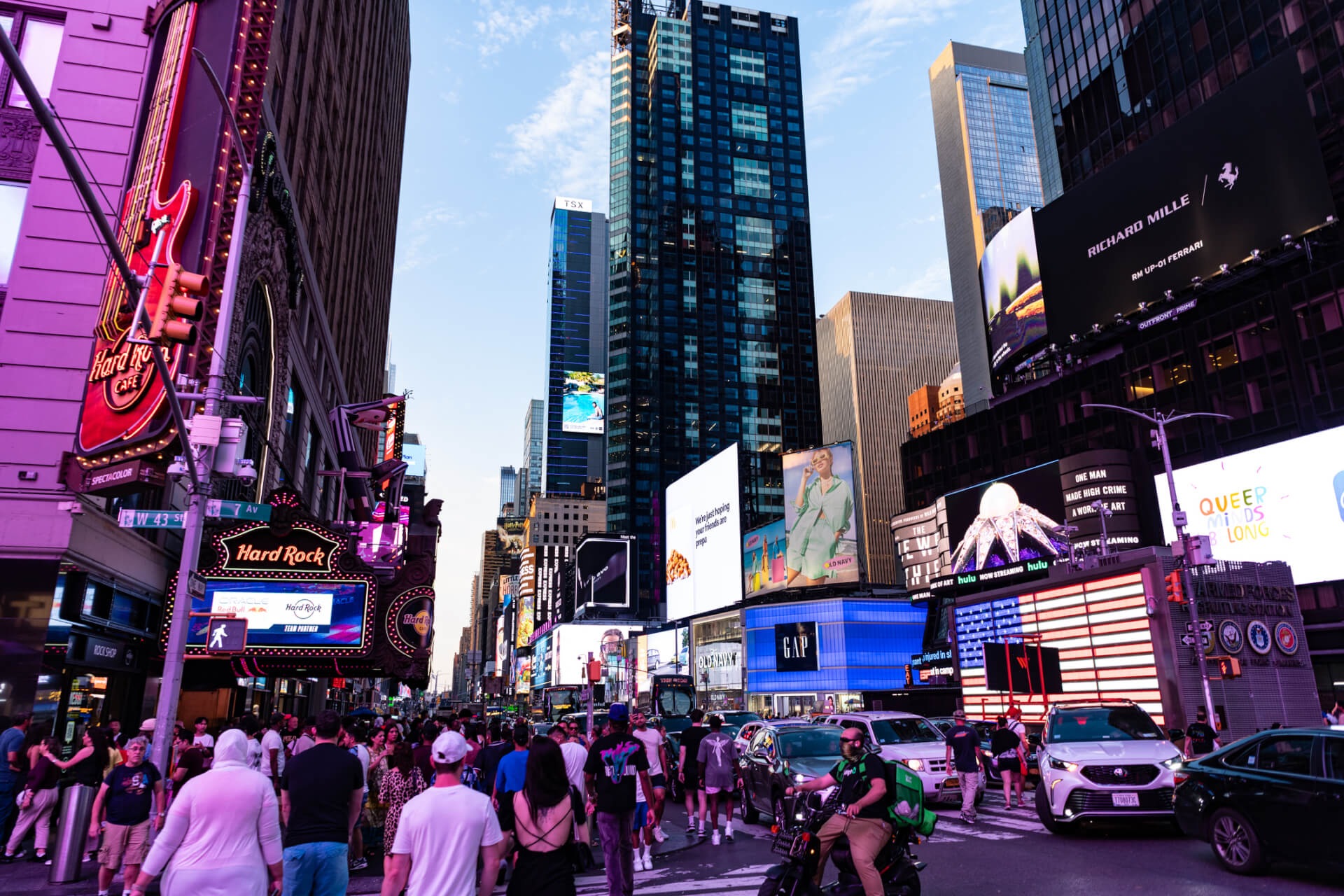
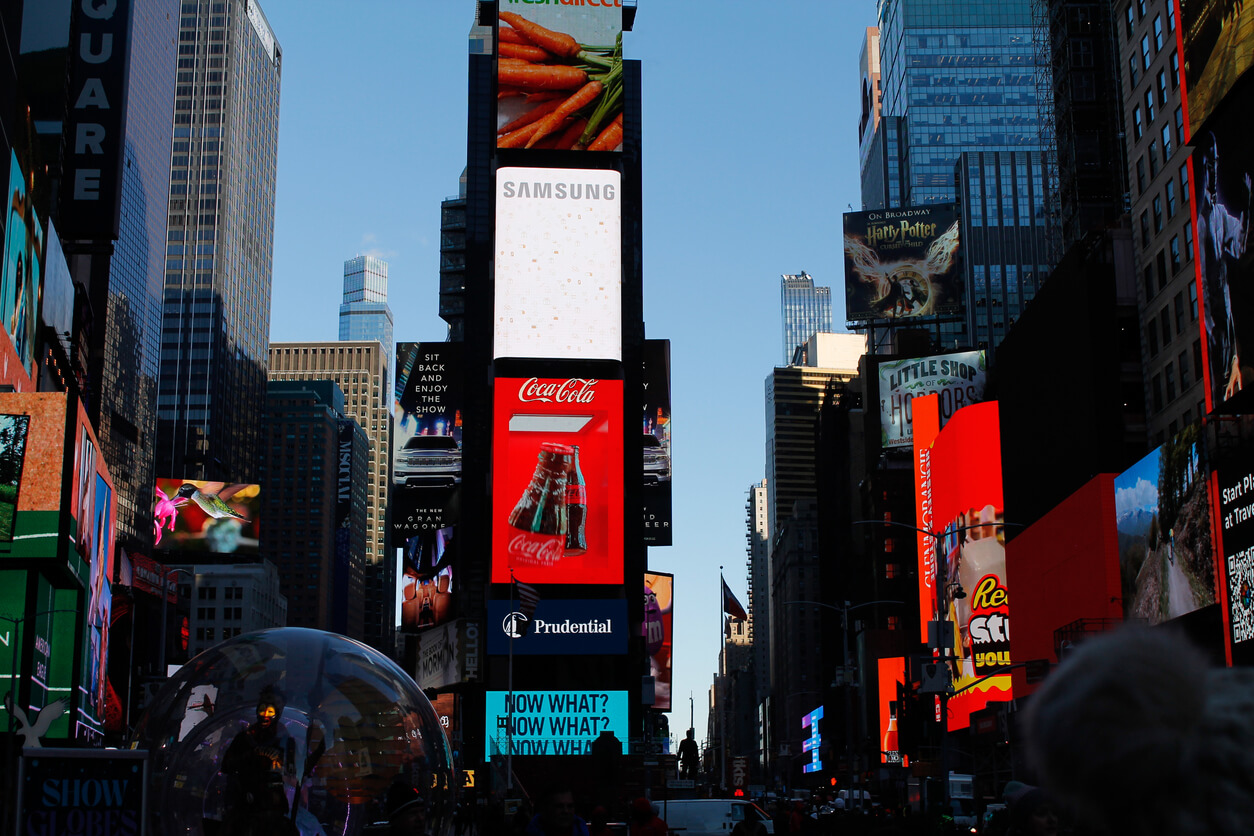
Digital billboards in Times Square, New York City
Both traditional and digital OOH have demonstrated their effectiveness, and many marketing teams combine them to leverage their respective strengths depending on their campaign’s overarching strategy and goals.
Out-of-home advertising appears across a wide range of environments where people move through their daily lives. Historically, OOH media has been grouped broadly by format, with the Out of Home Advertising Association of America (OAAA) defining four primary categories of standard OOH media formats:
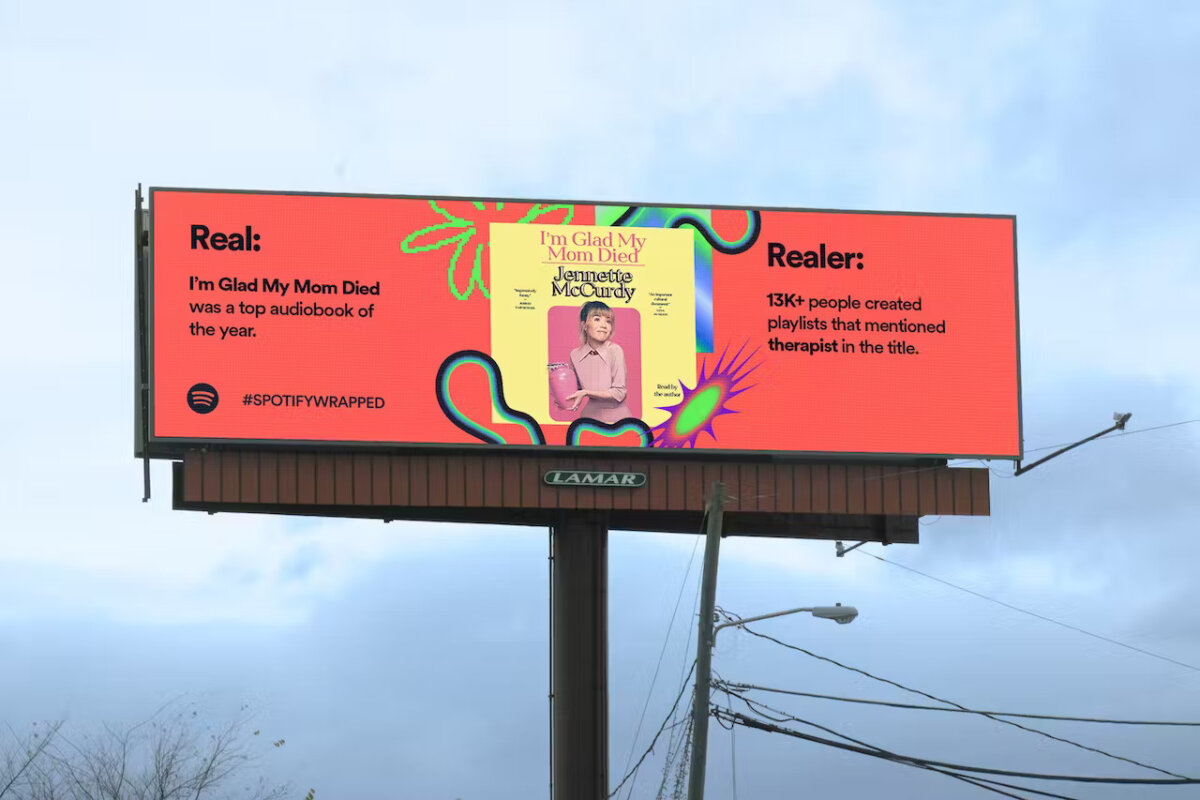
Billboards (bulletins, posters, wall murals, and spectaculars): Large-format advertising displays positioned along highways and major roadways, designed for long-distance visibility and broad reach.
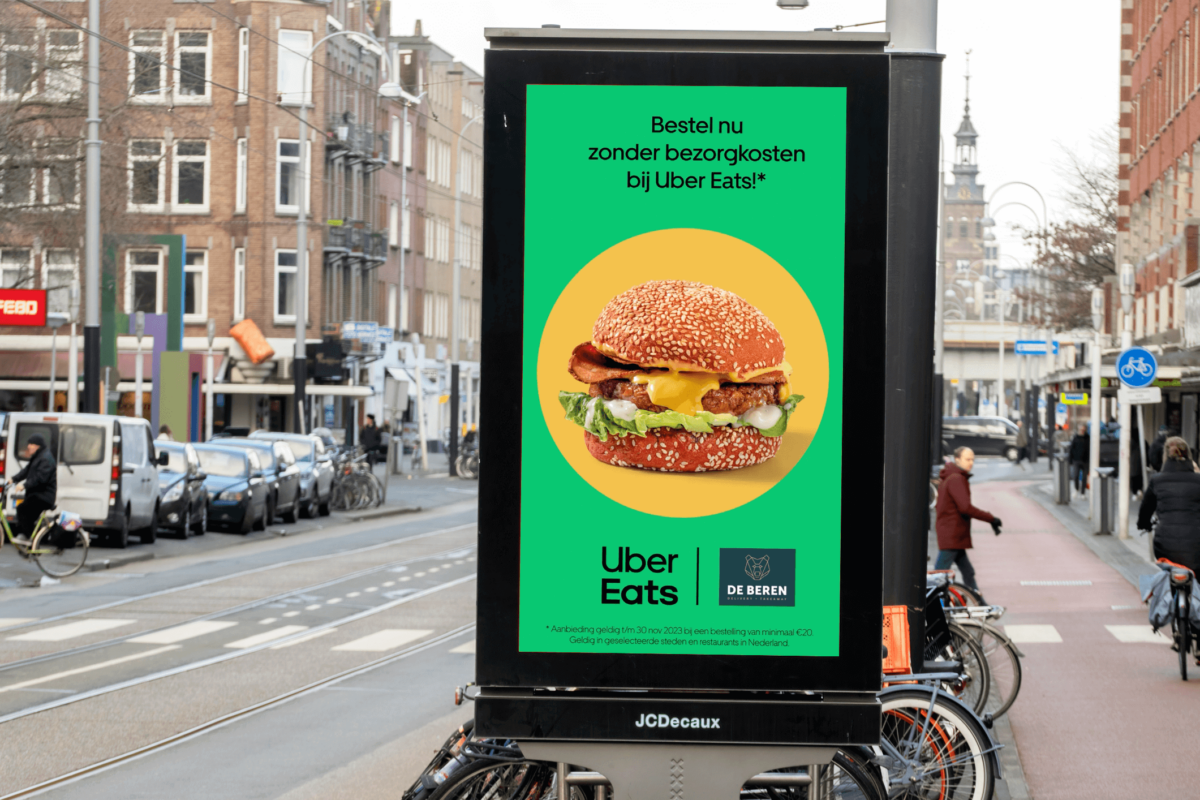
Street furniture (bus shelter panels, kiosk displays, urban panels, and bench ads): Advertising displays integrated into public infrastructure — often providing a civic amenity — and typically positioned for eye-level viewing in dense urban areas and pedestrian-heavy corridors.
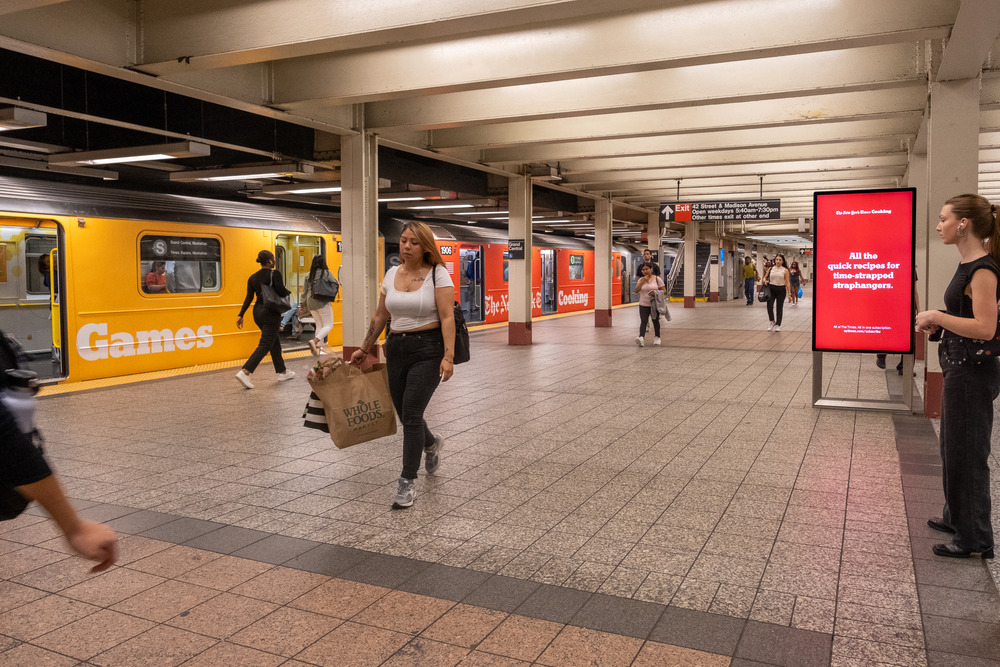
Transit advertising (vehicle wraps, station posters, and platform displays): Ads affixed to moving vehicles such as buses, trains, and taxis, or placed in the common areas of transit environments like stations, terminals, and airports, allowing advertisers to reach commuters and travellers throughout their daily journeys.
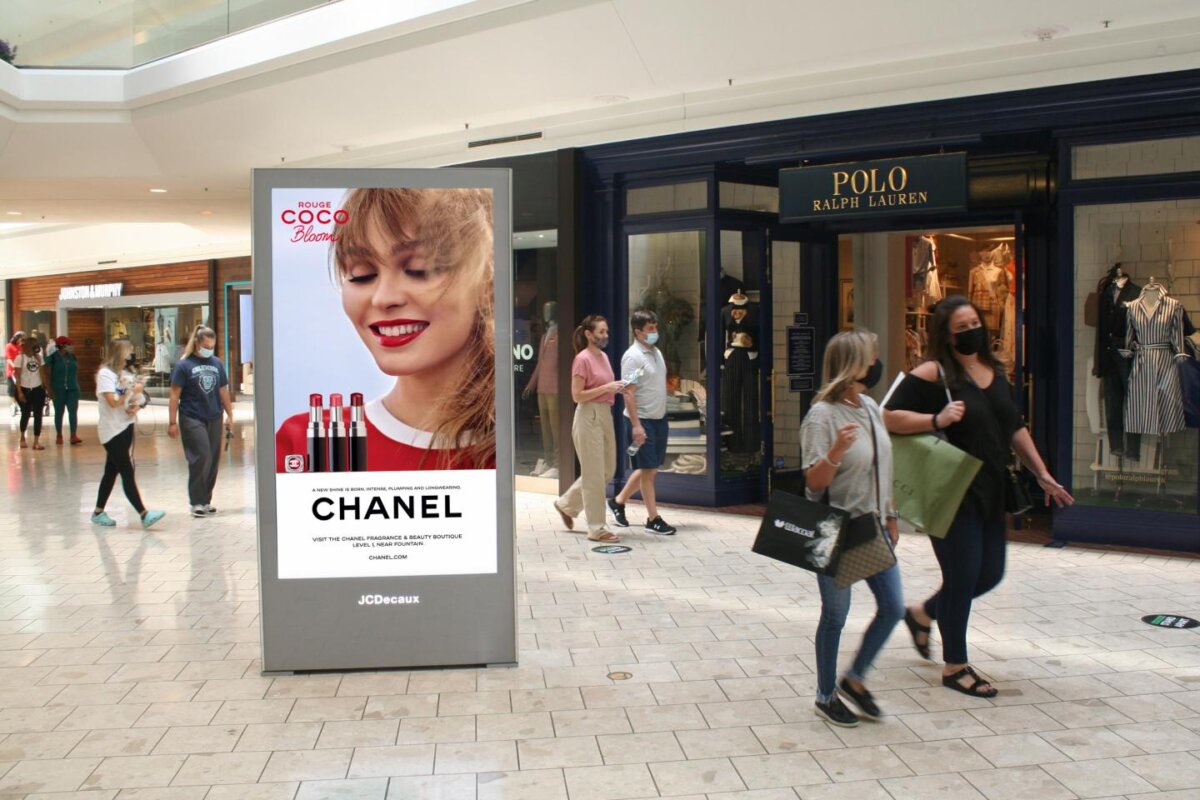
Place-based OOH (displays inside retail stores, malls, restaurants, gyms, and office buildings): Advertising displays located in environments where audiences gather for work, shopping, dining, and other activities, allowing brands to connect with people in contextually relevant settings and reach consumers along the path to purchase.
While these format categories help organize the OOH landscape, modern campaigns rarely rely on just one placement type. Most advertisers combine multiple formats and environments to build reach, reinforce messaging across locations, and connect with audiences throughout different moments of their daily routines.
OOH ad on an urban panelLarge-format OOH billboardPlace-based OOH ad in a shopping mallTransit OOH ads in a subway station
Benefits of OOH advertising: Why advertisers still use OOH today
Out-of-home advertising has remained a core part of the media landscape for decades because it delivers something few channels can replicate: high-visibility brand exposure in real-world environments where audiences can’t skip, scroll past, or block the message.
Today, advertisers continue to invest in OOH for several key reasons:
OOH ads can offer unmatched size: Large-format billboards and big digital screens offer a lot of room to execute visually stunning ideas (see our favourite OOH and billboard ads) in a way you can’t match on personal devices. Research from Ocean Outdoor shows that premium large-format DOOH attracts five times more attention than online digital formats, with significantly longer viewing time. Even smaller placements — like totems and bus shelter displays — offer a larger creative canvas than most personal devices.
Outdoor advertising is unskippable and ad-block-proof: If people are around an OOH display, they’re going to see it. There are no ad blockers, no below-the-fold positions, and no issue with users switching to a different app or tab. And it’s effective: recent research from Solomon Partners found that OOH drives the highest consumer ad recall and strongest audience ROI across major media, delivering better CPM value than TV, print, and most digital channels.
OOH is privacy-safe and builds consumer trust: At a time when consumer privacy concerns are top of mind, advertisers are under increasing pressure to reach audiences without relying on personal identifiers. Because OOH reaches target audiences based on location and context rather than individual user data, it offers high-impact visibility while remaining inherently privacy-safe. And consumers have taken note: 31% say they trust OOH advertising, with nearly half (49%) saying it’s more trustworthy than social media.
Out-of-home media supercharges your other channels: Yes, digital out-of-home and traditional OOH advertising are impactful on their own, but they really shine when paired with other channels like social media and mobile advertising. Research from MRI-Simmons and the Outdoor Advertising Association of America (OAAA) found that adding OOH media to a campaign’s mix can boost audience reach by as much as 100% or more, depending on the medium.
(D)OOH drives real-world action: OOH doesn’t just build awareness — it’s also highly effective at driving consumer action. In a Harris Poll survey conducted in partnership with the OAAA, 76% of DOOH ad viewers reported taking some form of follow-on action — from watching a video (38%) or visiting a nearby restaurant (36%) to entering a store (29%), making a purchase (30%), or talking about the brand with others (30%).
How out-of-home advertising works today
Advances in first-party data integrations, automation-enabled transacting tools, and improved targeting and attribution capabilities have made the channel more flexible and data-informed, helping advertisers execute campaigns more efficiently and better understand how OOH contributes to broader omnichannel campaign performance.
Planning and buying OOH campaigns
In the past, buying out-of-home media meant negotiating placements directly with media owners — a time-consuming manual process involving back-and-forth RFPs, PDFs, and endless email chains. These slow, fragmented workflows often led to longer planning cycles and made it harder to integrate OOH into omnichannel digital campaigns.
Today, the buying landscape has expanded. Like online digital advertising, digital out-of-home can now be purchased programmatically. Known as programmatic digital out-of-home, or pDOOH, this approach allows advertisers to target specific audience demographics or trigger campaigns in real-time based on contextual signals such as weather conditions, live sports scores, or time of day — allowing messaging to align more closely with the context in which audiences encounter it.
Measurement and attribution in modern out-of-home campaigns
As OOH planning and activation have become more flexible and data-driven, advertisers have also gained new ways to evaluate campaign performance.
Once perceived as trailing behind digital channels in terms of measurement, advances in campaign analytics and attribution now provide deeper insight into how audiences respond to OOH exposure — and make it easier for advertisers to understand how out-of-home contributes to broader digital campaign performance and omnichannel outcomes.
Today, advertisers have a range of tools and methodologies to evaluate OOH performance and understand how campaigns influence audiences and outcomes, including:
Delivery metrics: Estimates of impressions, reach, and frequency help advertisers understand how many people were likely exposed to a campaign. In digital OOH, impressions are calculated using an impression multiplier — a screen-specific index that converts ad plays into estimated audience impressions based on real-world data provided by media owners.
Engagement metrics: Interactions such as QR code scans, along with passive measurement methods like targeted mobile surveys, help advertisers evaluate audience response, brand perception, and interest generated by an OOH campaign.
Attribution analysis:Attribution studies use anonymized location and behavioural signals to determine whether audiences exposed to an OOH campaign later visited a store, downloaded an app, or took another measurable action.
Centralized reporting: Programmatic platforms that support multiple forms of digital media can consolidate campaign data and reporting across channels, helping advertisers understand how OOH contributes to omnichannel campaign performance.
Examples of out-of-home advertising in practice: OOH case studies and real-world campaigns
To see how these capabilities come together in practice, here are two real-world campaigns that demonstrate how brands have used out-of-home to reach audiences and drive measurable results.
Uber Eats: Driving purchase intention across the Netherlands
Uber Eats launched a programmatic digital out-of-home (pDOOH) campaign in the Netherlands to increase brand awareness and purchase consideration while promoting its “No Delivery Fees” offer. The campaign was developed with agency partner EssenceMediacom and OOH technology partner Broadsign using the OutMoove demand-side platform (DSP). Ads were activated on digital screens in high-traffic locations across major cities like Rotterdam, Eindhoven, and Haarlem and ran alongside other channels like paid social and online video.
A brand lift study conducted with Happydemics showed strong results: ad interest nearly doubled among audiences who recalled the ads, and purchase consideration increased twofold, placing the campaign in the top 15% for purchase consideration within the food delivery category across all media platforms. Read the full Uber Eats case study to see how programmatic DOOH helped drive measurable brand and purchase intent outcomes.
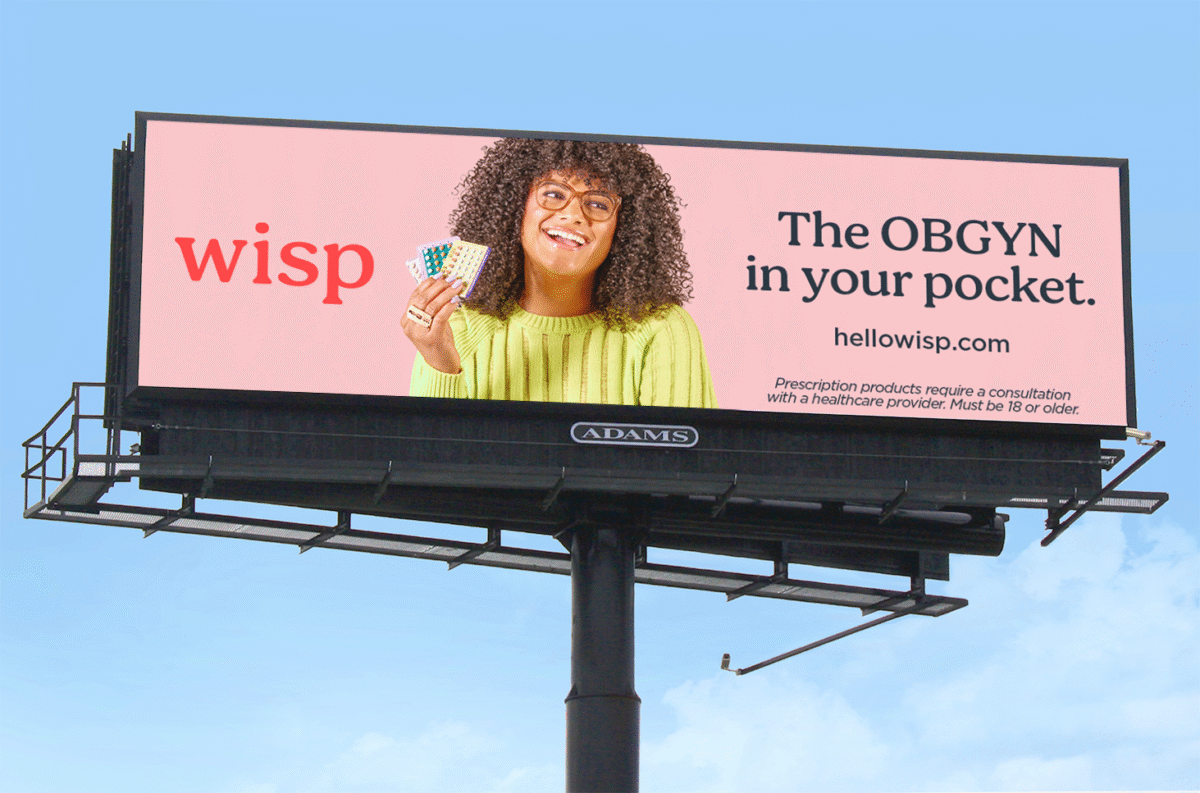
Wisp: Building brand awareness and consideration in New York
As Wisp prepared for its next phase of growth, the women’s telehealth platform set out to increase awareness and familiarity among its target audience in the New York DMA. To reach consumers across the market at scale, it partnered with Broadsign on a high-impact programmatic digital out-of-home campaign using the OutMoove DSP, accessing premium inventory across 2,839 screens in the region.
The campaign combined large-format billboards for broad visibility with urban panels near high-traffic areas and pharmacies, along with in-pharmacy screens to deliver messaging in contextually relevant environments. The effort produced strong results, including a 4× lift in brand preference compared with top competitors. Read the full Wisp case study to see how targeted pDOOH also delivered a 3.8× increase in brand familiarity and a 107% lift in purchase consideration.
FAQs about OOH advertising
How do advertisers buy out-of-home media?
OOH advertising can be purchased in several ways depending on a campaign’s goals.
Traditionally, advertisers work directly with media owners or through specialized media agencies to secure placements at specific locations for a set period of time.
Today, many campaigns are also planned and transacted using technology-enabled buying tools that streamline how inventory is discovered, booked, and managed across multiple screens. This can include programmatic digital out-of-home (pDOOH) platforms as well as other forms of automated or platform-based transactions that simplify the planning and buying process. Both approaches remain widely used, and many campaigns combine them depending on the desired reach, flexibility, and level of control.
How is OOH advertising measured?
OOH measurement typically combines audience modelling, location data, and campaign analytics to estimate how many people are likely to see an ad and how those exposures influence consumer behaviour.
Historically, measurement relied on traffic counts and circulation studies to estimate potential impressions. Today, additional data sources such as mobile location data and movement patterns can help advertisers understand outcomes like store visits, website traffic, and brand lift associated with OOH exposure.
How much does OOH advertising cost?
The cost of OOH advertising varies widely depending on factors such as location, format, audience reach, and campaign duration.
Large-format placements in high-traffic locations typically command higher prices, while smaller or more localized placements can be more cost-efficient. On average, OOH advertising often delivers competitive CPMs compared with other media channels, making it an attractive option for brands looking to build awareness at scale. Billboard advertising costs, for example, can vary significantly depending on the market, placement, and format.
Ready to start planning your first OOH campaign? Browse Broadsign’s inventory catalog to explore high-impact out-of-home placements across the globe.