Product News | October 11, 2021

Rethinking the Cinema Experience with a Digital Signage Network
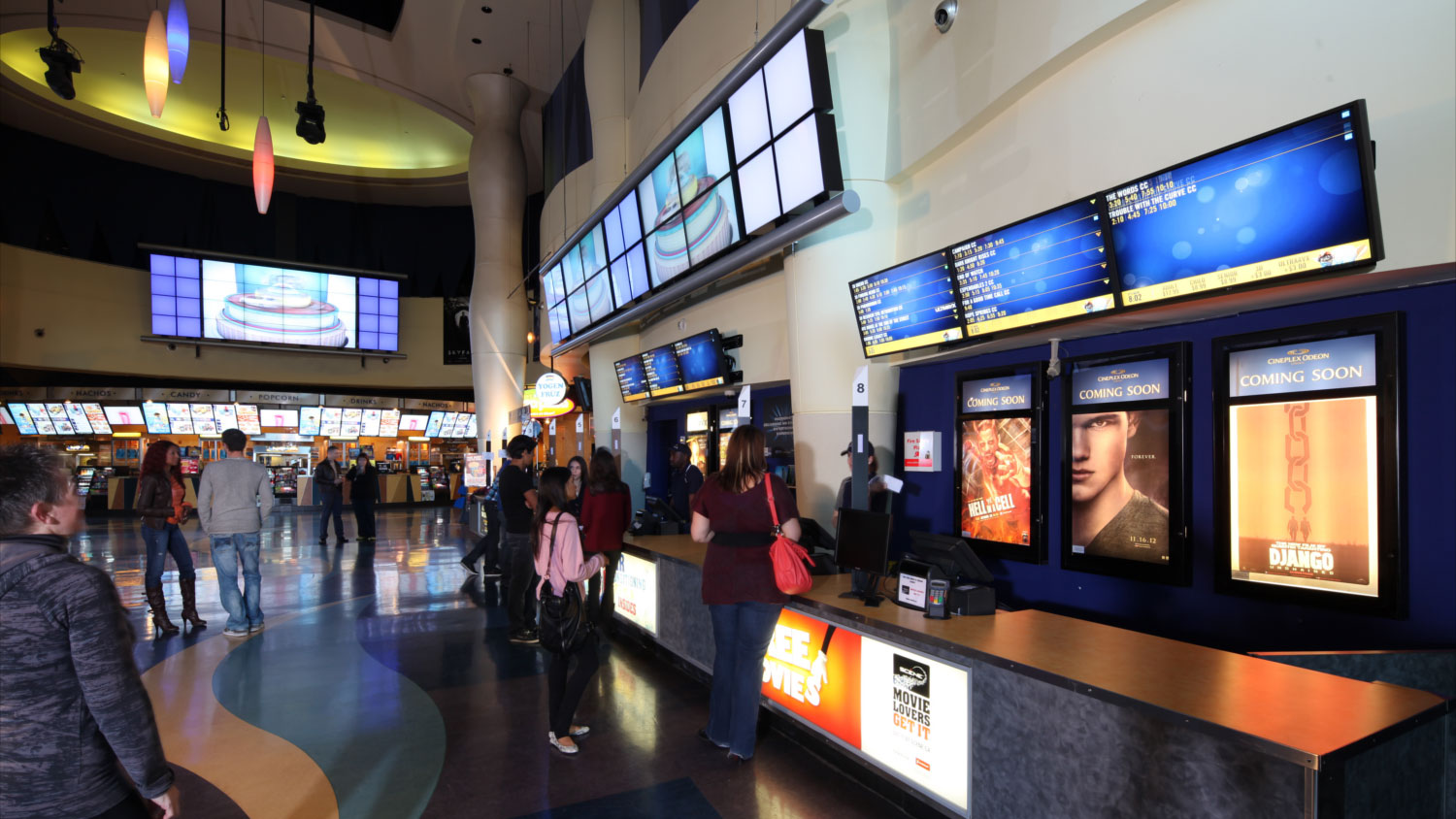
In today’s Netflix age, movies are easily accessed from the comfort of our own couches or even our beds. Yet even with this convenience, there is still an active audience that prefers heading to the theatre.
But why? What keeps them coming back time and time again?

It’s all in the experience. People go to movie theatres to enjoy the feature film but it’s much more than that. Cinemas offer an ambiance and atmosphere that simply cannot be recreated at home.
Even so, cinema attendance today isn’t as high as it was during the cinema heydays. To truly attract an audience, cinemas must ensure that the magic of the movies is felt from the moment they enter the box office until the rolling credits.

As a matter of fact, people spend around 15 minutes in the cinema lobby before the film. This is the ideal moment to entertain the audience and increase anticipation for the movie-world they are about to enter.  Not to mention, it’s an opportunity for cinemas to generate more revenue by promoting concession sales and partner advertisements.

So, how exactly can your cinema achieve the goals and results above?

Augment the Movie-Goer Experience

To turn the cinema outing into a true adventure, it’s important to deliver a great experience at every touchpoint with the customer.
Using a digital signage network makes it easy to create an engaging environment through interactive features. Fun social media campaigns, creative mobile integration, and enticing touch screen activities are just a few examples of how cinemas can augment the movie-goer experience.


With the help of digital signage, you can create memorable movie experiences and the option of streaming a movie on the couch pales in comparison.

Inform Customers
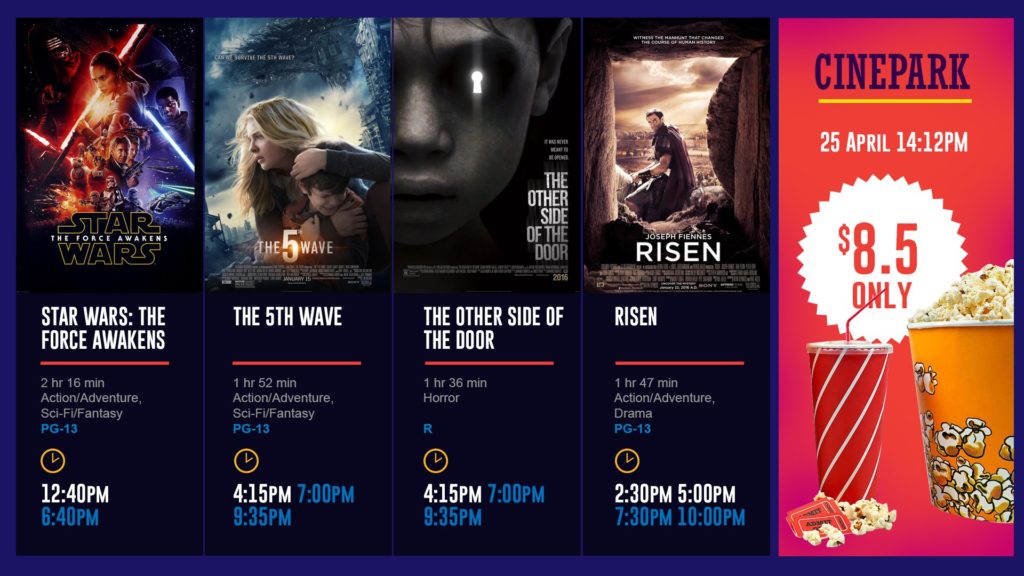
The box office is the first thing customers see when they enter your cinema. It’s important to make sure the experience is as smooth as possible, especially on busy opening nights.

By opting for digital signage, important information including showtimes, movie details and age ratings can be clearly displayed. Screens in the lobby can also be used to show theatre numbers and help with general wayfinding.

Going digital also gives you more flexibility with signage. Is one movie performing better than another? Easily change the order in which posters appear. Have a special event coming up? Create a one-minute takeover of every movie theater lobby display to encourage attendance.

Digital signage helps you delight your attendees and keep them in the loop about upcoming movies to encourage a future visit.

Increase Concession Sales

Concession stands are where cinemas turn a profit. The good news is that around 78% of cinema lobby activities are concession purchases. This means that customers are definitely in a purchasing state of mind.

Digital menu boards bring concession goods to your consumers’ attention and can produce a 10-50% increase in sales. They are easy to manage and menu items can display differently based on time of day, the day of the week and more.

Gain Alternative Sources of Revenue
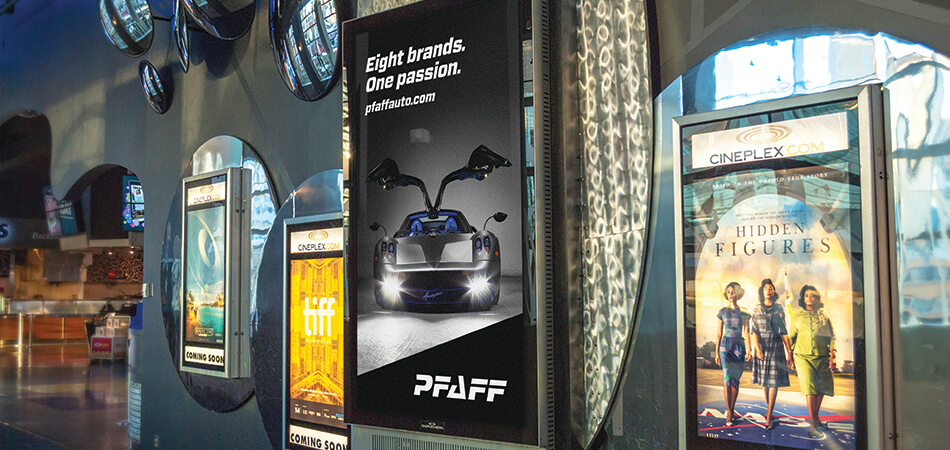
A digital signage network creates the opportunity for extra revenue. Unlike a static poster, space can easily be shared between various external advertisement and your cinema’s own content when using a digital signage network.

Pre-movie in-theatre content is also an interesting opportunity for advertisers. The audience is easily segmented by demographic, as different movies can attract different types of people. As they wait for the movie to begin, the audience has little else to do, which means they will be very captive when the ad is playing.

Now, let the digital signage credits roll!

Automation, digital interaction, and slick displays don’t only belong in sci-fi flicks but are real-life experiences for film-goers. With digital signage, your cinema can go above and beyond the status quo.
Product News | October 11, 2021

Meet Manuel Ameneiros, Broadsign’s Head of Media Sales and Service, LATAM

Out-of-home advertising across Latin America is gaining strong momentum, driven by expanding digital infrastructure, ongoing innovation, and growing demand from brands seeking high-impact audience reach. As the market evolves, there is a clear opportunity to bring greater efficiency, scale, and flexibility to how OOH is planned and transacted across the region.

To support this next phase of growth, Broadsign has appointed Manuel Ameneiros as Head of Media Sales & Service for LATAM. Based in Mexico City, he will focus on driving sustainable growth across the region while building a strong, scalable commercial foundation. This includes managing strategic relationships with agencies, advertisers, and media owners, and advancing market education as programmatic DOOH adoption continues to evolve.

Manuel brings over a decade of experience across the advertising ecosystem, spanning brand, agency, and adtech roles throughout LATAM. Most recently, he served as Chief Commercial Officer at OLA Media, where he focused on scaling revenue and driving market expansion. Earlier, he held roles across brands, agencies, and adtech companies, including Retargetly and Boletia, building expertise in data-driven marketing, programmatic adoption, and go-to-market strategy.

We caught up with Manuel to learn more about his background, what drew him to Broadsign, and his perspective on the opportunities ahead in LATAM.

Welcome to Broadsign. What drew you to the team, and what excites you most about your new role leading Media Sales & Service for LATAM?

I’ve always been drawn to the intersection of media, technology and data, and that’s exactly what makes this opportunity so compelling for me. Broadsign has built a strong reputation as one of the companies helping modernize OOH by giving media owners and advertisers the tools to plan, transact and scale more intelligently. What excited me most about joining the team is the chance to help accelerate that momentum across Latin America, a region where markets are evolving quickly and where there is real appreciation for innovation.

How would you describe the current state of the OOH market in Latin America, and where do you see the biggest growth opportunities?

The OOH market in Latin America is in a dynamic phase. It continues to benefit from strong reach and visibility, particularly in urban areas, but it’s also evolving quickly as digital infrastructure expands and advertisers demand more accountability and flexibility around their campaigns.

Having worked both in adtech and more recently in the OOH space, I’ve seen firsthand how the conversation is shifting from static inventory and broad reach to more data-driven planning, audience segmentation, and integration with digital channels.

The biggest opportunity lies in accelerating that transition. There is still a gap between DOOH’s potential and how it’s currently bought and sold in many markets. Bridging that gap through better data use, automation, and programmatic transactions is where much of the next wave of growth will come from.

Programmatic DOOH is gaining momentum globally. How is this evolving in Latin America, and what’s needed to accelerate adoption across the region?

Programmatic DOOH in Latin America is moving from early adoption into a growth stage. Buyers are looking for more flexibility, more precise activation, and easier connections between OOH and broader omnichannel campaigns. Media owners, in turn, are recognizing that programmatic can help open inventory to new demand sources, improve fill rate, and make digital assets easier to transact.

To accelerate adoption further, the region needs continued progress in a few areas: more digital inventory, stronger education across buyers and sellers, and better tools for targeting and measurement. 

What role do you see Broadsign playing in the future of OOH across LATAM, and what are you most excited to build or accomplish in the region over the next few years?

I see Broadsign as a key enabler of the next phase of growth for OOH in Latin America. The company is uniquely positioned because it operates across the entire ecosystem: a CMS, SSP and DSP, which allows it to support both media owners and buyers in a very holistic way.

For media owners, Broadsign can help modernize operations, increase efficiency, and open up new revenue streams. For advertisers and agencies, it simplifies access to OOH and makes it easier to integrate into omnichannel strategies.

What excites me most is the opportunity to help build a more connected, scalable, and performance-driven OOH ecosystem across LATAM. In practical terms, that means expanding programmatic adoption, strengthening relationships with key agencies and advertisers, and helping media owners unlock more value from their inventory. It’s also about making DOOH a more consistent part of media strategies rather than a complementary channel.

From a market perspective, Brazil and Mexico are critical due to their scale and level of sophistication, but I also see strong potential in Colombia, Chile and Argentina, as well as in emerging segments like mobility and retail media, which I’ve been closely involved with in recent years.

Product News | October 11, 2021

Broadsign partners with JB Hi-Fi to accelerate Retail Media Network

Retailer launches scalable in-store digital signage network to enhance customer experience and increase brand amplification opportunities

SYDNEY, April 22, 2026 –Broadsign announced that leading Australian consumer electronics retailer JB Hi-Fi is deploying the Broadsign Platform to build and scale its in-store retail media network (RMN), which spans over 200 stores across Australia. The technology will streamline operations, enabling JB Hi-Fi to seamlessly plan, execute, optimise, and measure in-store media and ad campaigns across locations from one central hub.  

With the Broadsign Platform providing real-time availability, intuitive ad serving, and robust campaign reporting out-of-the-box, JB Hi-Fi will be able to unlock impactful in-store opportunities and deliver measurable results across its network. An open API also allows JB Hi-Fi to integrate with its preferred retail systems, platforms, and processes, while still maintaining complete ownership and control over its network. 

“We’re seeing strong interest in retail media from advertisers and brands who want to reach local audiences where purchase intent is high. We already had the screens to deliver in-store, and now with Broadsign, we have access to the same advertising toolset that major media owners use, and the ability to scale,” explained Gary Siewert, Director of Marketing and e-commerce, JB Hi-Fi. “Broadsign’s open API has also proved more valuable, allowing us to select the partners we want to work with as we build our omnichannel RMN, such as Retail Media Works and Criteo.”  

“As Australia’s leading consumer electronics retailer, JB Hi-Fi is home to some of the world’s biggest brands. By partnering with best-in-class solutions such as Broadsign, JB Hi-Fi are not only maximising the potential of their retail media network, they’re setting the strongest possible foundation for themselves in an increasingly competitive space,” said Ben Allman, Regional VP of Platform Sales at Broadsign. 

For more information about Broadsign’s in-store media network offering, visit: https://broadsign.com/retail-digital-signage/

About Broadsign

Broadsign is the leading out-of-home (OOH) advertising technology platform, transforming how retailers, OOH media owners, and ad buyers reach and connect with audiences. More than 2.8 million static and digital signs along roadways and in shopping malls, grocery and convenience stores, airports, transit systems, and other OOH venues run on Broadsign. The Broadsign platform helps customers seamlessly plan, deliver, and optimize dynamic, data-driven in-store and OOH campaigns. 

Through Broadsign’s programmatic SSP, Place Exchange, and integrations with 50+ omnichannel and OOH DSPs, the company offers advertisers and media buying agencies the largest footprint of global OOH inventory, enabling them to intuitively execute guaranteed and non-guaranteed OOH campaigns across a variety of OOH formats. Interoperability with retail POS systems, loyalty programs, and omnichannel media platforms allows retailers to create engaging, measurable in-store experiences that tie into on- and off-site campaign strategies. https://broadsign.com/retail-digital-signage/