Nemooh Servicos de Mídia LTDA Deploys Digital Signage Bus Network with Broadsign International, LLC Software
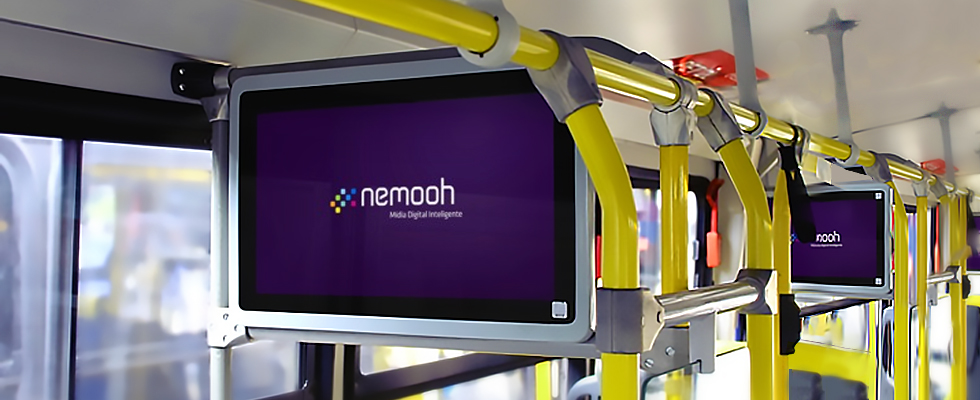
1,000 screens in 500 buses across Sao Paulo inform and entertain millions of mass transit users.
Sao Paulo, Brazil. July 22, 2014. Prominent Brazilian digital signage transit network, Nemooh Servicos de Mídia LTDA, has deployed its first 1,000 screens in 500 buses with Broadsign International LLC’s digital signage software platform. Expansion plans involve attaining 4,000 screens in 2,000 buses by the end of 2015.
The vandal-proof, 22” LED displays in Nemooh Mídia buses are viewed by 11.3 million people in Sao Paulo per month, playing real-time news, entertainment, sports and health tips spaced between the likes of bank, telecom and government ads. A typical content loop is 60 minutes of 15 second slots- a format suited to commuters who watch the screens on lengthy daily commutes.
“Having worked in digital media for over 15 years, I can say that Nemooh Mídia brings the most advanced technology to Sao Paulo’s buses,” said Luciano Ramo, Executive Director at Nemooh Mídia. He continued, “operating on ad-based revenue, Broadsign allows us to present advertisers with proof of play reports instead of memory card solutions, and provides our network with proven strength, reliability and stability. Nemooh Mídia aspires to be the biggest digital signage network in Brazilian buses and views Broadsign as a safe bet given its many other enterprise-level customers.”
“This deployment is the result of a partnership that began in 2007 upon realizing that Broadsign and Nemooh Mídia shared a vision of digital out-of-home’s potential in Brazil,” said Skip Beloff, Vice President of Sales at Broadsign. “Years later, our shared success is recognized by Nemooh Mídia’s 23% and growing market share, along with a strong presence of Broadsign customers across the country.”
A testament to its support of and integration in Brazil’s digital signage industry, Broadsign is the Conference Sponsor of the first Brasil Signage Expo, held on September 18 and 19. Attendees are invited to book a meeting with a Broadsign representative to discuss how Broadsign’s digital signage software can meet the needs of their networks.
About Broadsign
Broadsign International, LLC is the first global provider of cloud-based software for digital signage networks. Its platform was designed exclusively as a management system for media companies operating digital out-of-home and digital place-based media networks, giving them an unlimited capacity for growth without adding personnel. After over a decade in the industry, Broadsign’s latest incarnation, Broadsign X, has become a mature and reliable fit for all digital signage software needs and its Android-based smart player, Broadsign Xpress, has decreased the cost of deploying digital signage compared to PC-based hardware alternatives. Broadsign’s constant growth, extensive network and dedication to predicting and responding to industry trends make its digital signage solutions a safe bet for the future of networks with even the most complex of requirements. For more information about Broadsign, visit https://broadsign.com.
About Nemooh Mídia
Nemooh Mídia is one of the leading digital signage networks in Brasil with a fast growing network of 500 buses in Sao Paulo, Brasil. We are passionate about high level contents and technology. Our network is the first and only online in Sao Paulo, delivering many relevant contents to watchers in real time.
Product News | October 11, 2021
Best practices for high-impact out-of-home creative
The out-of-home (OOH) ads that stop people in their tracks, spark awareness, and drive action all share a common thread: they’re built on proven creative principles shaped by real-world testing and what works in today’s evolving OOH landscape.
Effective OOH creative relies on bold design, minimal text, and clear branding. But what works on a static highway billboard may not have the same impact on a digital out-of-home (DOOH) screen or a crowded subway platform at rush hour.
That’s what makes OOH unique. It reaches audiences as they move through real-world environments like airports, malls, roadways, and city centres across both static formats and dynamic, data-driven digital displays, offering far more creative flexibility than the medium often gets credit for.
This guide explores the OOH and DOOH creative strategies that consistently deliver results before you plan your next campaign.
OOH creative fundamentals
When developing the creative for an OOH ad, there are core principles to keep in mind.
Define your goals: What does the ad wish to accomplish? Is the aim to drive in-store traffic? Stand out from competitors? Remind existing customers of an ongoing promotion? A firm strategy narrows the focus and clarifies the message.
Be bold: Most out-of-home ads have only seconds to reach audiences. When producing OOH or DOOH creative, employ boldness to stand out.
Keep it simple: A less-is-more approach is typically most effective. Messaging should be clear, direct, and to the point.
Let brand personality shine: Use humour, surprise, intrigue, even edginess to amplify your message.
Context is key: think about how your creative fits into its surroundings. Incorporating messaging that speaks to current events or relates to live data can boost performance and turn your ad from informative to innovative.
Think Design
Great OOH design is built for how people experience it. In fast-moving environments, you have seconds to make an impression, so clarity and visibility matter more than complexity.
At its core, effective design comes down to a few essentials:
High-contrast colours that cut through busy surroundings
Simple, focused layouts that are easy to process at a glance
Bold, recognizable imagery paired with clean, legible type
KFC’s bold, recognizable imagery makes this billboard instantly identifiable
Context matters just as much as design. What works on a roadside billboard viewed at speed won’t translate the same way to a street-level or place-based screen where dwell time is longer. Simpler creative performs better at a distance, while closer environments allow for more detail, as long as clarity isn’t compromised.
And while best practices exist for a reason, they are not rules. Intentionally breaking them can be just as effective when done with purpose.
Get the Specs Right
Even the strongest creative can fall flat if it is not built for the screen. OOH and DOOH formats vary widely across billboards, transit shelters, retail environments, and place-based networks, each with different dimensions, orientations, and file requirements.
A few fundamentals to keep in mind:
Design for both vertical and horizontal formats so layouts translate cleanly across environments
Stick to supported file types like JPG or PNG for static, and MP4 or HTML for digital placements
Keep file sizes within recommended limits to ensure smooth delivery and playback
Always build with the final screen size and placement in mind to avoid cropping or distortion
Below are some of the most common specs for digital and video displays in the US.
That’s why incorporating motion into your digital content is such a powerful way to capture attention. In most environments, videos should run no longer than 10-15 seconds; however, longer videos can be impactful for audiences in specific venue types with longer dwell times, like gyms, doctors’ offices, or bars.
Note: Place Exchange by Broadsign can seamlessly adapt social media and in-app vertical video creatives for portrait-mode screens, so you can get maximum value from a single video.
Creating personalized and dynamic content
When vying for a consumer’s attention, optimizing a digital out-of-home campaign with Dynamic Creative Optimization (DCO) can be the x-factor in reaching target audiences.
DCO means adjusting and optimizing DOOH ads for real-world contexts and environments, pulling data to deliver ads in response to current events or trends, such as the weather, sports scores, financial markets, audience profiles, or other nearby events or relevant information.
With DCO, ads can deliver more personalized experiences and stronger audience relevance. In fact, according to the OAAA and The Harris Poll, 81% of respondents exposed to weather-triggered ads featuring relevant product offers found them valuable. Thinking about where your ad will live along the consumer’s journey, and in what context, is an opportunity to create a high-impact ad that resonates with your target audience.
To create a high-impact ad, thread in creative that responds to live signals like time of day, weather, audience demographics or current events for a more targeted activation that reaches audiences at key moments.
Some ideas include:
Modify messaging based on relevant data inputs (e.g., weather, sports scores, etc.): Entice customers on rainy days to pop by for a warm cup of coffee, or advertise air conditioning units on extremely hot days, display sports scores during high-ticket events.
Schedule time-sensitive or product-specific promotions
Incorporate daily countdowns for popular movies or big events with universal appeal
McDonald’s weather-triggered OOH campaign in Qatar
Tracking and measurement
Knowing how your current campaign performs is crucial for planning the next. Use ID markers like QR codes, SMS messages, short-link URLs, hashtags, emails, or phone numbers to track and measure your ad’s performance. Adding a Call to Action (CTA) to your creatives can enable you to directly track “click-through” response to your OOH creative.
The winning formula for an out-of-home ad that gets noticed and delivers on ROI is to combine brand-safe creativity, outside-the-box thinking, and contextual relevance. With these OOH creative best practices in your toolkit, you can successfully create an ad that stands out.
Ready to launch a high-impact, creative out-of-home campaign that delivers results? Browse our inventory catalog to see the complete network of high-impact digital screens available.