Discover Broadsign’s Header Bidder, the smarter way to work with multiple programmatic partners
There’s been an industry-wide shift and pDOOH adoption is on the rise. This is in large part due to how the format facilitates and automates the buying and selling of programmatic ads. We’re seeing more media owners embracing pDOOH transacting and incorporating programmatic platforms like Broadsign’s programmatic SSP (and other SSPs) into their revenue mix, a move that usually equals greater profits.
The catch? Usually, to work with multiple supply-side platforms (SSPs), media owners must split their ad slots between different SSPs. But this can be an inefficient way to go about things, and sometimes different SSPs don’t always work well together. Besides, media owners shouldn’t have to run their programmatic business across three different SSPs or block inventory from guaranteed buys. To minimize complications, Broadsign is introducing a smarter way for media owners to work with multiple programmatic partners.
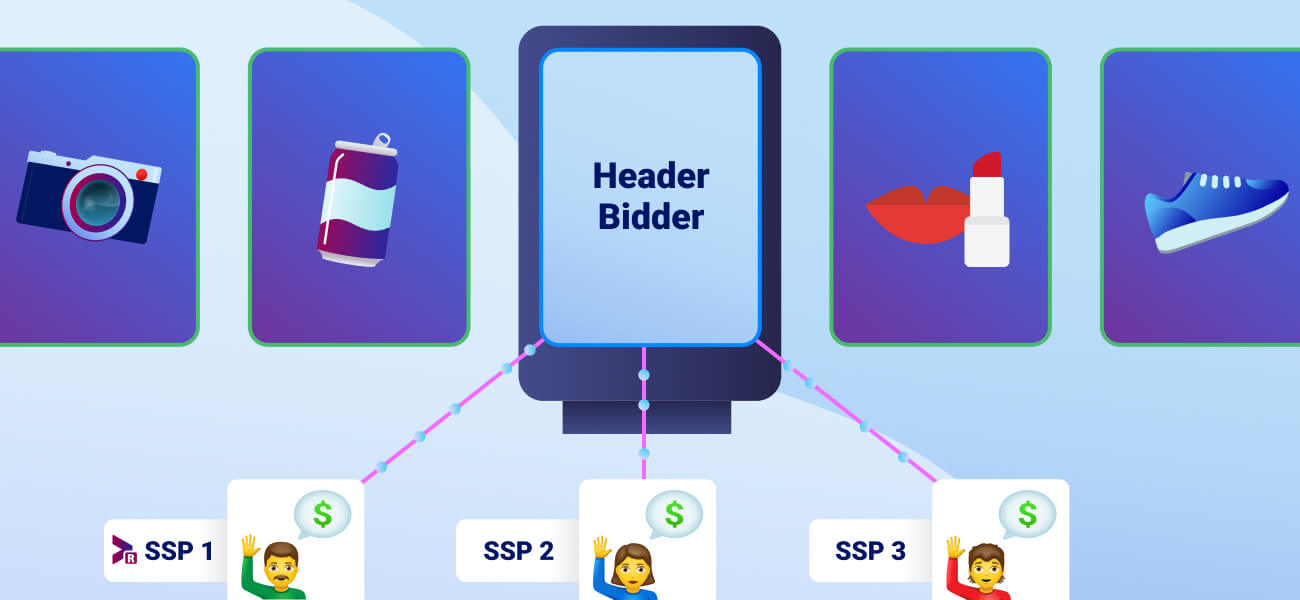
The Broadsign Header Bidder acts as an ad exchange between multiple SSPs and a single host SSP. So rather than sticking to the current (and clunky) process, which sees media owners reserving a dedicated slot for each SSP partner, Broadsign Header Bidder offers a one-to-many programmatic solution. It’s all backed by our fair play auction, so the highest bid wins.
Check out the video below to see how it works:
Why this solution?
With programmatic growth on the rise, increased efficiency and optimization yield management is only going to help fuel the pDOOH wave taking over the industry. As the saying goes, it takes a village and in order to stimulate programmatic growth — our ultimate goal — industry-wide collaboration needs to happen.
That’s where Broadsign’s Header Bidder comes in. This solution is especially beneficial because we’re seeing more media owners work with multiple SSPs —but to do so, they are required to reserve a separate HTML wrapper or container in an ad loop for reach, thus reducing the overall yield on their inventory. The Header Bidder combines pDOOH demand from multiple SSPs into one slot and chooses the winning bid to play based on Broadsign’s fair play auction logic. Furthermore, it’s natively integrated with Broadsign’s CMS creating a smoother ad viewing experience for audiences. Broadsign media owners can enjoy features like gapless playback, screen synchronization, preemptible campaigns, and pre-caching for faster ad loading and optimization.
Who benefits?
Media owners running Broadsign’s programmatic SSP who are looking to consolidate their programmatic demand will undoubtedly benefit from this solution. Not only does it help streamline the process, but it also removes the need to work with multiple HTML5 wrappers. It frees up more ad space to create more guaranteed ad opportunities. It’s yet another way we’ve got media owners’ best interests in mind.
All sounds pretty great, right? Contact us today to schedule a demo and see how Broadsign can help open your inventory available to new buyers across the globe.
Product News | October 11, 2021
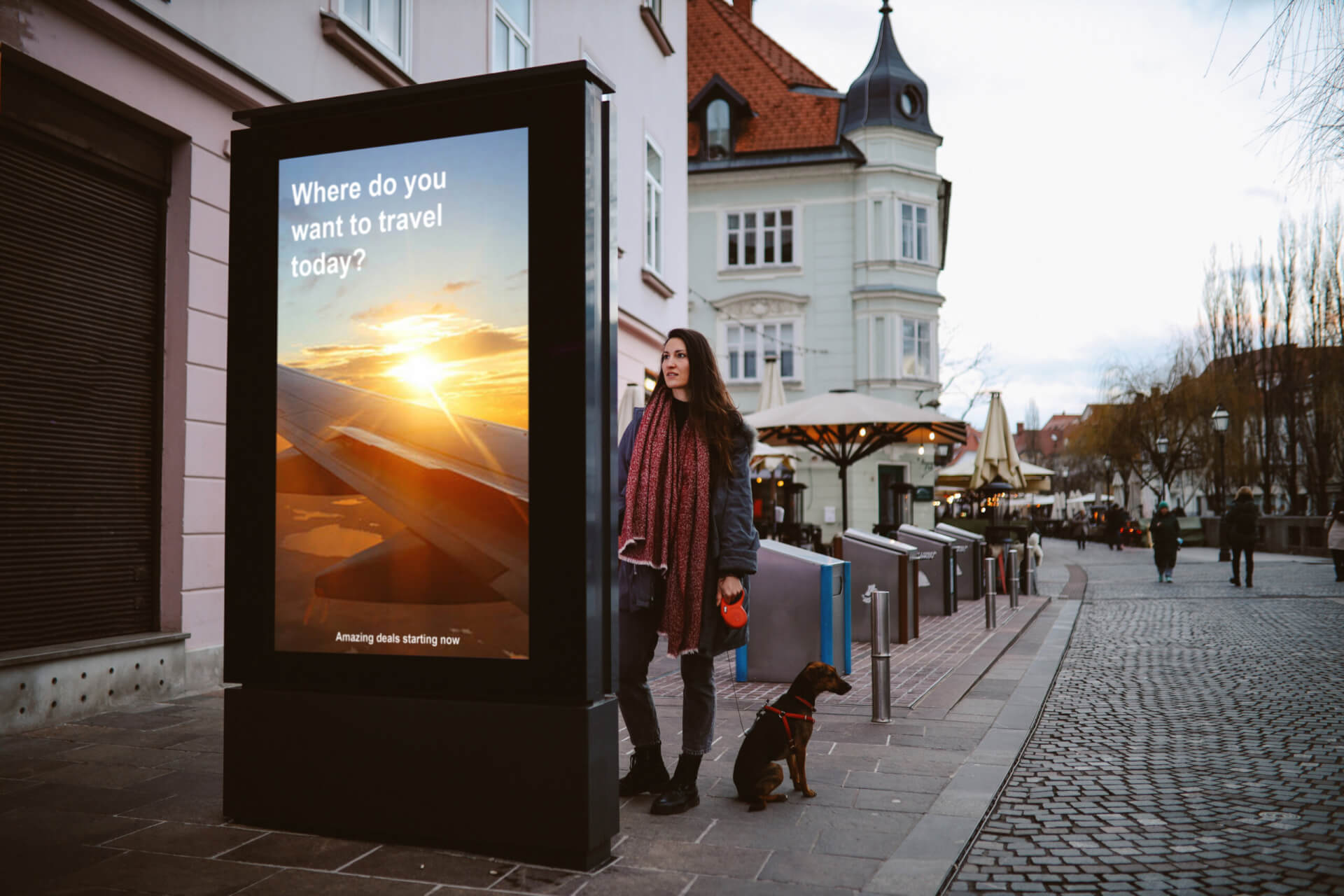
Why out-of-home belongs in your next travel and tourism campaign
Despite economic challenges, demand for travel isn’t slowing down. Recent research shows that 93% of Americans plan to travel in 2026, with nearly half prioritizing it in their financial planning. Travellers are committed to getting away, but how they plan and book those trips has changed.
Marketing in the travel and tourism industry now means navigating a more fragmented journey. With more than 80% of travellers saying booking online is essential, and nearly half using AI to plan their trips, the path to booking is rarely direct. Today’s journey spans social, search, CTV, mobile apps, and real-world touchpoints, which means brands must deliver experiences that feel connected at every stage.
That’s where out-of-home (OOH) advertising plays an important role, extending digital strategies into the real world to reinforce messaging, prime audiences, and bridge the gap between inspiration and final booking.
Turn awareness into action
For travel and tourism marketers, awareness alone isn’t enough. It needs to drive action, and OOH plays a more direct role in that process than many realize. Research from the Out of Home Advertising Association of America (OAAA) shows that 74% of mobile users took action on their phones after seeing a digital OOH (DOOH) ad, with 44% searching for the brand, 38% visiting its website, and 30% checking social channels.
It also consistently outperforms other media in driving digital response. According to OAAA and Comscore, OOH generates online activation rates five to six times higher than expected, beating channels like TV, radio, banner ads, print, and even online video. For travel brands navigating a fragmented booking journey, that kind of cross-channel impact is exactly why an omnichannel approach matters.
Keep campaigns agile with programmatic DOOH
Programmatic digital out-of-home (pDOOH) has fundamentally shifted how travel and tourism brands can integrate OOH into omnichannel campaigns. Instead of managing placements market by market with long lead times, marketers can activate across multiple cities or countries from a single platform. For campaigns that often span key markets, that level of scale and coordination is critical. Teams can launch quickly, maintain consistent messaging across regions, and still tailor creative to local audiences.
Programmatic buying also introduces additional flexibility from traditional OOH. Budgets, creative, and targeting can be adjusted mid-flight based on performance data or shifts in traveller behaviour. If demand rises in one market, spend can follow. If bookings soften, messaging can pivot. In a category shaped by seasonality, economic shifts, and cultural moments, that agility matters. It also ensures OOH stays aligned with digital channels, moving in sync with the broader media mix rather than operating in isolation.
Dynamic Creative Optimization (DCO) adds another layer of relevance. Creative can adapt in real time based on signals like location, weather, language, or time of day, allowing campaigns to feel timely and context-aware. A winter cold snap in Chicago, for example, can trigger creative promoting a warm beach getaway. Instead of running static messaging everywhere, travel brands can deliver the right inspiration at the right moment.
Connect offline impact to online conversion
One of the biggest advantages of programmatic DOOH is its ability to turn physical exposure into digital action. By leveraging first and third-party data, travel marketers can extend their online audience strategies into OOH, reaching the same consumers across environments with consistent messaging.
In practice, that might mean a bold airport or transit ad prompting travellers to explore a destination online or check availability. Through geofencing and mobile retargeting, those same audiences can later be served tailored ads that reinforce the message and encourage them to book. Using privacy-compliant, anonymized mobile IDs and device ID passback, brands can reconnect with exposed audiences across mobile, CTV, display, social, or audio, creating a coordinated path to conversion.
Just as important, this activity is measurable. For years, OOH was seen as difficult to quantify beyond awareness, a challenge in a results-driven category like travel. Today, advances in location intelligence and attribution modelling allow marketers to connect exposure to real-world behaviour. Travel brands can track visitation uplift, overnight stays, and the broader path to purchase by matching anonymized mobile advertising IDs to campaign exposure. This makes it possible to quantify incremental arrivals and foot traffic tied directly to OOH.
Measurement also extends into digital performance. Web and app lift studies can reveal increases in searches, site visits, and bookings, while sales and brand lift studies provide insight into revenue impact and shifts in awareness or intent.
For tourism boards and travel brands, proving impact isn’t optional. Budgets are often tied to partners, stakeholders, or public funding, which means showing clear ROI matters. When measurement is built in from the start, it becomes much easier to report on performance, optimize along the way, and make smarter decisions about where to invest next.
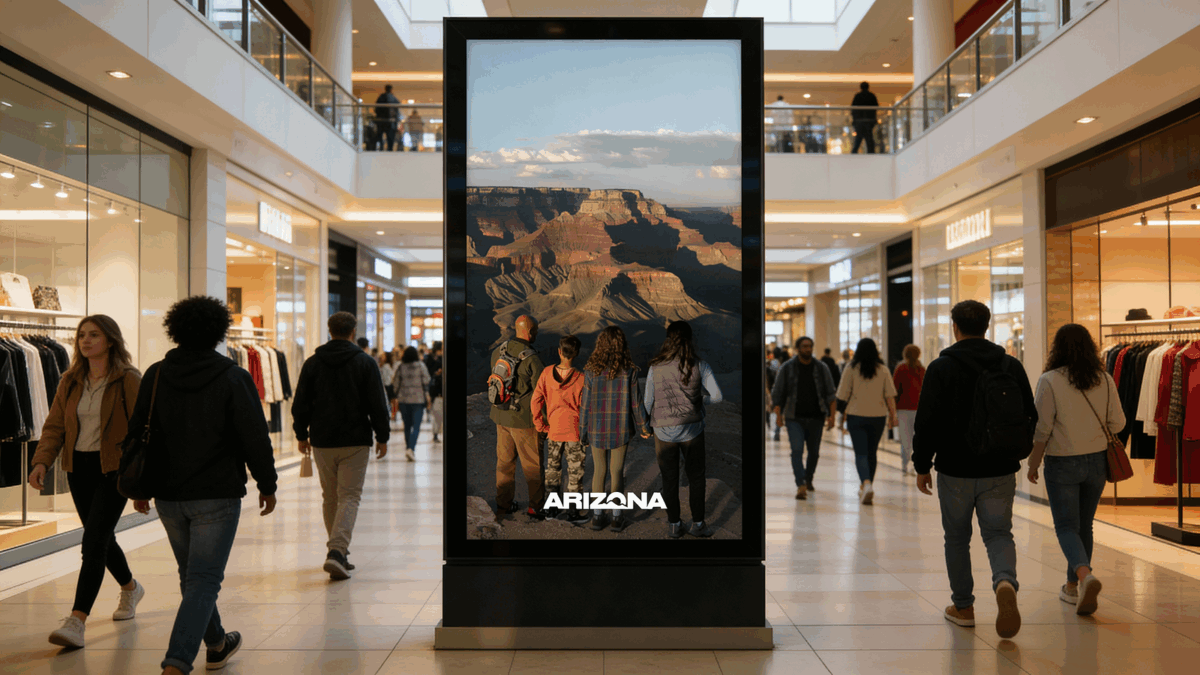
Real-world example: Visit Arizona drives a 30% increase in arrivals with pDOOH
Visit Arizona set out to build top-of-mind awareness while driving measurable increases in arrivals. From the start, the campaign was built as an integrated effort, combining DOOH, mobile retargeting, and arrival lift measurement to connect exposure across channels and tie it back to real-world visitation.
Planned by agency of record Off Madison Ave, the campaign tapped into the OutMoove DSP to run DOOH placements in high-traffic venues across key markets. Programmatic buying made it possible to focus on Visit Arizona’s High Value Personas, keeping the destination visible during travellers’ daily routines and at important moments in their planning journey.
What made the campaign truly omnichannel was how each touchpoint worked together. Consumers exposed to DOOH were later re-engaged through mobile retargeting, extending the conversation beyond the physical environment and reinforcing messaging in a more personal, digital context. The mobile ads achieved viewability rates of over 90%, highlighting strong cross-channel alignment and continuity.
Measurement was also integrated across the whole journey. An arrival lift study linked campaign exposure to actual visitation, showing a 30% lift in arrivals, well above the 23% national benchmark for similar campaigns.
Wisp drives 4X lift in brand preference with programmatic DOOH
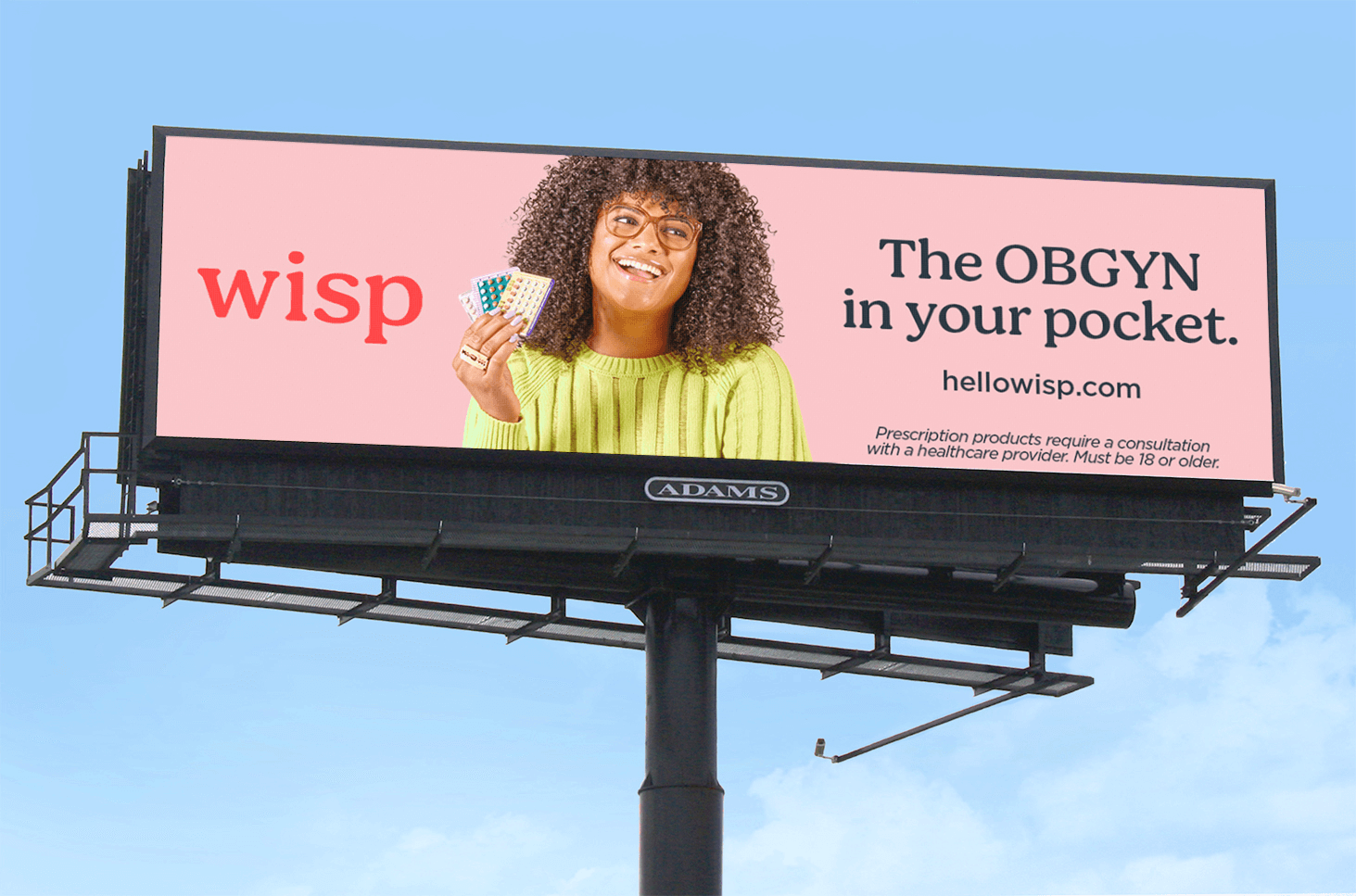
To support its next phase of growth, Wisp, the leading pure-play women’s telehealth platform, partnered with Broadsign to reach its target audience at scale. Together, they launched a high-impact programmatic digital out-of-home (pDOOH) campaign across New York to build brand visibility and preference among Wisp’s core audience.
Objective
The campaign aimed to increase brand awareness and familiarity for Wisp among its target audience in the New York DMA. A core objective was to drive consumer interest and consideration, encouraging audiences to search for Wisp and visit the site to learn more about its telehealth consultations and prescription services.
Strategy
Wisp partnered with Broadsign to launch a high-impact programmatic digital out-of-home campaign using the OutMoove DSP, accessing premium inventory across 2,839 screens in the New York DMA. The campaign activated a diverse mix of placements to deliver broad reach and sustained frequency at scale.
The media strategy combined large-format billboards for visibility, urban panels located near high-traffic areas and pharmacies for repeated exposure, and in-pharmacy screens to deliver contextually relevant messaging at moments of high intent. This approach ensured Wisp’s message reached audiences consistently throughout their daily routines.
Results
+3.8x Lift in Brand Familiarity: The campaign significantly increased awareness and understanding of the Wisp brand across the New York DMA.
+4x Lift in Brand Preference vs. Top Competitors: High-impact placements, particularly in contextually relevant environments such as pharmacies, strengthened Wisp’s positioning and favorability among consumers.
+107% Lift in Purchase Consideration: Campaign exposure drove a meaningful increase in intent to use Wisp’s platform, demonstrating programmatic DOOH’s ability to influence consideration and real-world decision-making.
Want the campaign highlights? Check out the infographic below.
Product News | October 11, 2021
What is programmatic DOOH (pDOOH) advertising?
Programmatic digital out-of-home, often shortened to programmatic DOOH or pDOOH, refers to the automated buying, selling, and delivery of out-of-home (OOH) ads via real-time bidding on digital screens. Instead of booking fixed placements, advertisers set the conditions under which media should run, and ads are served automatically when those conditions are met.
Once a niche buying method, pDOOH is now a core part of modern media plans, as automation-enabled OOH planning workflows and faster, data-driven decision-making reshape a medium that has traditionally relied on slower, manual processes. This momentum is reflected in forecasts for leading markets like the U.S., where pDOOH spend is expected to account for 65% of national DOOH spending by 2029, up from just 24% in 2024.
Read on for a closer look at what programmatic DOOH is, how it works, and why it’s gaining traction with today’s advertisers.
Programmatic DOOH applies programmatic buying technology to digital screens in public, shared environments such as city streets, transit hubs, and retail locations. While it uses many of the same tools and data sources as other programmatic channels, the key distinction lies in where ads appear and how impressions are defined.
As a form of out-of-home (OOH) advertising, pDOOH operates in one-to-many physical settings. Each ad exposure may be seen by multiple people viewing the same screen at the same time, rather than a single logged-in user or device. This changes how reach, exposure, and measurement are approached compared to online programmatic media.
In practical terms, this means advertisers plan around real-world moments, environments, and aggregated audience signals, shifting decision-making from fixed placements (as in traditional OOH) or individual-level identifiers (like in online advertising) to data-driven eligibility across shared physical spaces.
Programmatic DOOH (pDOOH) vs traditional DOOH: Understanding the difference
At a high level, programmatic DOOH doesn’t change the channel or environments where ads appear — it’s still digital out-of-home (DOOH) media. That means the strengths that make DOOH appealing to advertisers, including its high-impact creative formats, unskippable exposure, and proven ability to drive real-world action, also apply to pDOOH.
What it does change is how DOOH campaigns are planned, activated, and adjusted over time. Instead of locking in every decision upfront, programmatic DOOH introduces automation and rules-based buying that can influence which screens run ads, when they run, and under what conditions.
Here’s what actually changes when DOOH becomes programmatic:
Traditional DOOH
Direct buying through manual negotiations and insertion orders
Fixed schedules planned in advance
Manual planning focused on locations and durations
Periodic reporting after or between campaign flights
Programmatic DOOH (pDOOH)
Automated buying via real-time bidding on programmatic platforms, either through open exchange (oRTB) or private marketplace (PMP) deals
Real-time optimization based on availability, conditions, or performance
Data-driven activation using signals like time, location, and external data
Dynamic delivery potential with creative updates triggered by conditions
Automated reporting with faster access to delivery and performance insights
NOTE: While many buyers associate “automation in OOH” with programmatic ad buying — i.e., via real-time bidding — automation has expanded beyond bidding models to include newer transaction paths that complement pDOOH.
Now take everything that’s great about DOOH and layer in extra data, better targeting, and easy access. Those are the added benefits you’re looking at with programmatic DOOH.
Programmatic DOOH enables faster planning, activation, and in-flight flexibility
Programmatic flexibility is a key driver of pDOOH adoption, with 75% of agencies citing flexible buying as a major reason for use, according to a 2025 report from IAB Australia. By replacing manual negotiations and insertion orders with software-driven buying, teams can move from planning to launch more quickly and make in-flight adjustments based on campaign delivery and performance insights.
Programmatic DOOH supports more precise, context-driven targeting
Instead of relying on broad-reach, fixed buys, advertisers can use aggregated data signals to target audiences and moments with far greater precision. Contextual and real-time environmental data, like weather, time of day, or nearby events, can also inform creative delivery, helping brands dynamically align messaging with real-world moments for increased relevance without relying on personal identifiers.
Programmatic DOOH improves measurement and reporting
With streamlined access to centralized delivery data and automated reporting, pDOOH provides clearer visibility into campaign performance and enables more strategic decision-making. Using technology like in-screen sensors, device ID passback, and geo-fencing, advertisers can more accurately measure digital OOH ad exposure and strengthen attribution for downstream actions such as store visits or website activity, bringing DOOH closer to the precision of online advertising.
Programmatic DOOH integrates more easily into omnichannel strategies
As more and more DSPs get on board with programmatic DOOH, planning DOOH alongside channels like social media and mobile advertising as part of a multichannel strategy is becoming more straightforward. Advertisers can often adapt existing online or mobile creative for DOOH displays, while cross-channel insights and shared planning logic make it easier to extend reach and retarget audiences across connected digital channels.
If your agency or brand uses online advertising, you may already know the basics of programmatic ad buying or have even set up a campaign using a demand-side platform (DSP). But even if the technology is similar, a few features of programmatic DOOH are unique compared to other digital formats.
The same is true from a traditional OOH perspective. While the environments and formats will feel familiar, programmatic DOOH changes how campaigns are planned, activated, and adjusted.
How targeting works
In traditional OOH and directly bought DOOH, targeting is defined upfront through fixed placements, environments, and schedules. Programmatic DOOH separates targeting logic from specific screens, allowing eligibility to be determined by predefined criteria rather than locked-in placement lists.
Targeting in programmatic DOOH is driven by contextual and aggregated signals, including:
Time-based criteria (time of day, day of week)
Location and environment (screen type, venue category, proximity to POIs)
Weather and situational factors (local events, traffic or transit conditions)
On top of this, programmatic DOOH supports a shift toward audience-based targeting. Instead of selecting screens directly, advertisers use aggregated audience signals like movement patterns or first-party data to inform where and when ads are eligible to run based on who is likely present in a given place and moment. These signals guide delivery without identifying or targeting individuals.
The same targeting logic can also support dynamic activation and dynamic creative optimization (DCO), allowing different approved creative variations to run based on audience context and real-world conditions, rather than serving a single static message throughout a campaign.
Platforms and DSPs: How advertisers access programmatic DOOH
In programmatic DOOH, the DSP is the central interface where buyers define campaign rules, budgets, and eligibility criteria, rather than selecting individual screens. For digital teams, this extends familiar DSP workflows into out-of-home; for OOH teams, it replaces screen-level booking with a single control layer that governs delivery across multiple environments.
DOOH inventory can be accessed either through a purpose-built DSP for out-of-home or via integration with the DSP your team already uses for other digital channels. In both cases, the DSP manages how and when eligible inventory is activated, supporting a range of buying methods from open auctions to more structured, pre-arranged deals.
Real-world examples
Looking for inspiration? Here are two pDOOH advertising examples that show how different agencies and brands have leveraged the medium. Explore our full case study catalogue for more programmatic success stories.
Visit Arizona: Inspiring travel planning with nationwide programmatic DOOH
Visit Arizona, the state’s official tourism organization, set out to influence travel consideration and planning among high-intent audiences across the U.S. Using programmatic DOOH, the campaign activated high-traffic screens in key markets and paired on-screen exposure with mobile retargeting to stay connected beyond the initial impression.
By combining DOOH with arrival-based measurement, the campaign linked media exposure to real-world travel behaviour and delivered strong mobile engagement. The result was a 30% lift in arrivals, outperforming national benchmarks for comparable tourism campaigns. Read the full Visit Arizona case study to see how programmatic DOOH supported measurable travel outcomes at scale.
HP: Building brand impact and driving sales with programmatic DOOH in Dubai
HP used programmatic DOOH to support awareness and consideration for its Smart Tank printer range in Dubai, a highly competitive and high-value media market. The campaign focused on reaching family households through frequent exposure on premium digital screens in malls, transit hubs, and other high-traffic, family-oriented environments.
By aligning screen environments with its core audience and measuring impact beyond impressions, the campaign delivered strong brand and business results. Exposure drove a 12% year-over-year sales lift, a 42% increase in purchase consideration for the Smart Tank 585, and a twofold increase in positive brand perception among exposed audiences. Read the full HP case study to see how programmatic DOOH supported both brand and sales outcomes in a key regional market.
See how HP leveraged programmatic DOOH to drive incremental sales in Dubai
FAQs about pDOOH advertising
How does programmatic DOOH differ from traditional OOH or DOOH advertising?
The difference lies in how the media is bought and managed, not where ads appear. Traditional OOH and DOOH campaigns are typically planned and booked upfront using fixed locations and schedules, while programmatic DOOH uses software-based buying to apply targeting rules, budgets, and conditions that determine when and where ads are eligible to run. The screens and environments remain the same — programmatic simply introduces more flexible, data-informed decision-making.
Is programmatic DOOH privacy-safe?
Yes. Programmatic DOOH does not rely on cookies, mobile ad IDs, or individual user tracking. Instead, targeting and delivery are informed by aggregated, privacy-safe signals such as location context, time of day, environmental factors, and anonymized audience insights. Because ads are delivered in shared, one-to-many public environments, programmatic DOOH aligns well with evolving privacy expectations and regulations.
Meet Ari Buchalter, Broadsign’s new Chief Strategy Officer
As Broadsign enters its next phase of growth and transformation, we’re excited to welcome Ari Buchalter as Chief Strategy Officer. Ari joins the team at a pivotal moment, focused on aligning strategy, platform direction, and growth priorities as Broadsign and Place Exchange move forward as a more unified organization.
Ari brings a long track record of building and scaling technology at the intersection of media, data, and automation. As the founder of Place Exchange, he helped advance programmatic buying in out-of-home and has spent his career in leadership roles across out-of-home (OOH) and programmatic advertising, focused on making complex ecosystems more connected, accessible, and effective.
We sat down with Ari to talk about the year ahead, how the platform is evolving, and his perspective on bringing Broadsign and Place Exchange together under a shared vision.
As Broadsign and Place Exchange come together, how would you describe your role and main areas of focus across the combined organization?
As Chief Strategy Officer for the combined entity, I’m excited to explore the many areas where we can create and capture value from the combination of these two incredible organizations. Some of the opportunity areas I’m keen to focus on include leveraging our leading global supply footprint to unlock more demand for programmatic DOOH, accelerating growth in emerging markets, and delivering innovative offerings that complement existing buyer and seller tools with more data, analytics, and insights. Additional opportunities include:
Combining our industry-leading monetization and technology solutions to unlock more value for media owners
Expanding our PerView offering to new markets and customers
Simplifying how buyers and sellers can layer the benefits of programmatic onto direct buys
Technical innovations that open up new sources of demand for DOOH inventory
What excites you most about joining Broadsign at this moment, and how do you see our combined strengths accelerating innovation in DOOH?
This is a fascinating moment in the industry. What was once a market made up largely of independent players has shifted, with many of those companies now having been acquired by larger players. Those new partnerships have manifested different strategies and challenges: some players are now focused on building omnichannel advertising platforms, drawing their focus away from OOH. Others face the challenge of being owned and controlled by a large publisher, which can pose a potential conflict of interest in the eyes of other publishers.
The combination of Broadsign and Place Exchange creates the most comprehensive solution in the industry for managing and monetizing OOH inventory, instantly amassing the largest global aggregation of programmatic supply and demand, and bringing together the two most talented and respected teams in the industry. Those “raw ingredients” alone are extremely compelling. But unlike our competitors, we are the only company that is both focused solely on OOH and not owned or controlled by a large publisher. I think that focus, independence, and objectivity put us in a unique position to succeed if we can deliver what our clients and partners need.
What are the biggest opportunities ahead as we work toward a unified SSP for media owners and buyers?
The media landscape is not just fragmenting in terms of the number of channels; it is becoming more advanced (and complex) in terms of the technical capabilities and consumer experiences that each channel can deliver. Think of CTV, with innovations like shoppable overlays, pause ads, and product placements; or gaming with in-world ads, branded skins, and rewarded video – those are just a few examples of how individual channels are transforming. With location data, real-time dynamic creative triggers, anamorphic ads, augmented reality, and more, OOH is no different.
To me, that means the role of SSPs will need to evolve beyond a connection pathway between supply and demand, towards the development of channel-specific technology that helps media owners and buyers ideate, develop, scale, monetize, and optimize consumer experiences that deliver growth for publishers and results for advertisers. In other words, a strategic technology partner to navigate the complex new landscape that is emerging. That is the real opportunity of the “new SSP,” and our combined business puts us in a strong position to deliver against it.
As we look to unify our SSP technology, what guidance can you give customers on what to expect?
If you are already integrated with Place Exchange – on the supply side or the demand side – expect the same, but more. The same high-performing technology, but with more ideas and innovations to grow your business. The same excellent service, but with even more tools and resources to support you. The same level of premium demand and supply, but more of it.
If you are a partner of the Broadsign SSP that will be migrating to Place Exchange, expect the best of both worlds – to keep the features and benefits you have today, while opening up new opportunities for innovation and growth. We will provide a glide path for our partners to deliver a smooth and seamless transition, along with the chance to explore how we can open up your integration to even more scale.
Programmatic DOOH has undergone significant shifts over the past few years. What trends do you think will define 2026 and beyond?
There are three interesting trends that I think will shape 2026 and beyond, all of which saw seeds planted in 2025.
First, I think OOH media owners will increasingly embrace programmatic across their business. Historically (in all channels), the push for programmatic was usually led by the buy-side, given the massive buyer benefits it brings in terms of targeting, measurement, and efficiency. As traction grows, the benefits to the sell-side become more apparent: programmatic is not just a sales channel but a technology that can deliver benefits across all sales channels, including direct. In other channels, programmatic started off focused on non-guaranteed buying, but over time, the hybrid benefits of programmatic guaranteed (PG) buying became evident. In 2025, we saw forward-leaning publishers embrace buyer demand for PG with tremendous success, and I think PG / in-advance buying will cross the chasm in 2026. While it may take a few years to overtake non-guaranteed buying, I think that will happen in the not-too-distant future.
Second, I think we will see a lot more intentional demand for DOOH inventory coming from other media channels. By that, I mean CTV buyers looking to buy CTV inventory in public places (for example, during live events), retail media buyers looking to buy retail media in stores at the point of decision-making purchase, and audio buyers looking to buy broadcast audio inventory heard by many people instead of a single person on a personal device. The challenge, however, is that a “regular” programmatic DOOH integration won’t cut it; to meet the needs of these CTV or retail or audio buyers, we have to instrument the connections to DOOH inventory differently and with full transparency across the value chain. We spearheaded innovations in all of these areas in 2025, proving the revenue potential is there, and I think 2026 will begin to see these new demand sources scale.
Lastly, I think a lot of focus in 2026 will go towards understanding exactly how AI interacts with programmatic. The initial hype cycle has (naturally) focused on the many opportunities, which are likely to be fundamentally transformative for the industry. But what’s received less attention thus far are the many challenges and risks that AI-driven media buying could bring. I think 2026 will be the year where important work gets done, rolling up sleeves to build, test and learn where, when and how AI can go beyond press releases and snazzy demos and begin to come up alongside billions of dollars of ad spend to add real value to the business of advertising.
What data advancements or opportunities are you most optimistic about as we start 2026?
We’ve proven that the impact of OOH – at any stage of the funnel – can be measured like any other channel. That’s a big deal and leaps ahead of where the industry was not too long ago. The challenge is that measurement still requires separate, siloed data, systems, and processes (e.g., one-off measurement studies).
Programmatic has already unified targeting, creative, and execution of OOH with other channels – measurement is next. Imagine if you could report on the impact of an OOH campaign without having to set up and run a separate measurement study; instead, what if OOH performance just automagically showed up in the systems and methods buyers use to measure the performance of every other channel they buy? The ability to unify the data and measurement for OOH with other channels is probably the last major hurdle to OOH capturing a larger share of ad spend. I don’t think we’ll get to that endgame in 2026, but I believe we’ll make some big moves in that direction.
Stay tuned for more news and insights from Broadsign and Place Exchange on the Broadsign blog.